

- Article
- Read in 10 minutes
Anthony Phillips – Gemini: Pieces For Piano – review
In April 2026, Anthony Phillips is releasing another piano album: "Gemini – Pieces For Piano". Gereon Schoplick has reviewed it.
He had already been playing the piano as a teenager – alongside his main instrument, the guitar. And even in the early years of Genesis, Anthony Phillips wrote songs not only on the guitar but also on the piano. After leaving the band in 1970, he studied music and composition at the Guildhall School of Music in London, and took professional piano lessons.
Consequently, on Anthony's first solo albums, the piano and other keyboard instruments play an important role alongside various guitars. Piano music features time and again on subsequent mixed releases. In 1986, Ant surprised his fans with Ivory Moon, his first album consisting exclusively of compositions for piano, followed in 1999 by Soiree. Now, the prolific musician presents Gemini, his third piano album, a double album featuring 44 compositions. The release date is 10 April 2026.
Cover and Artwork
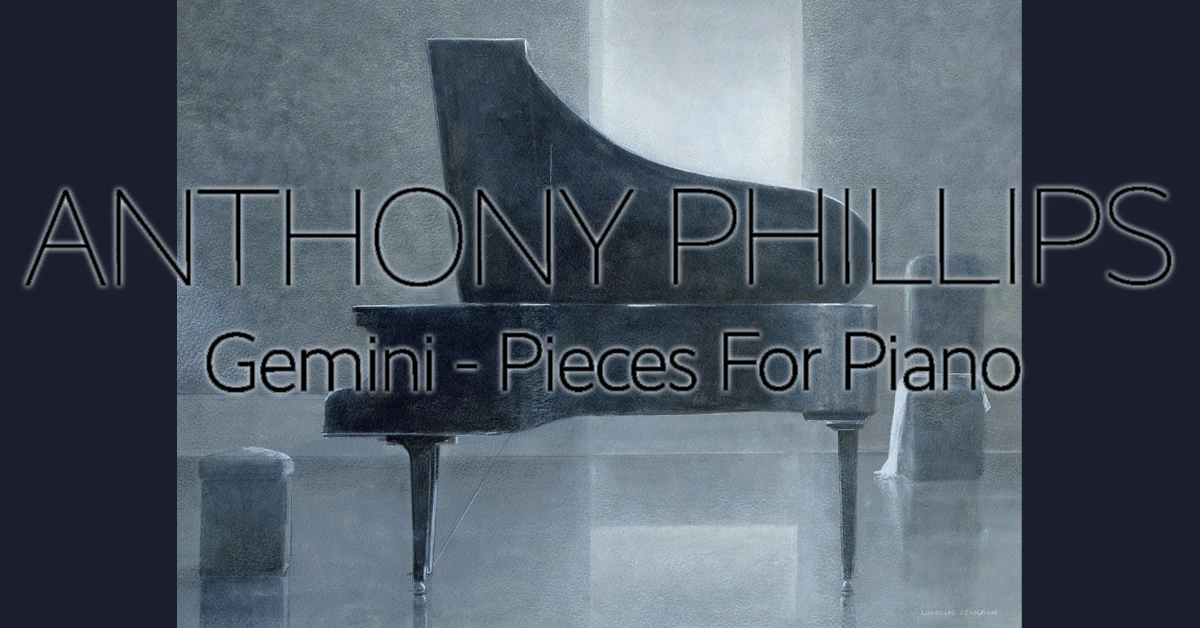
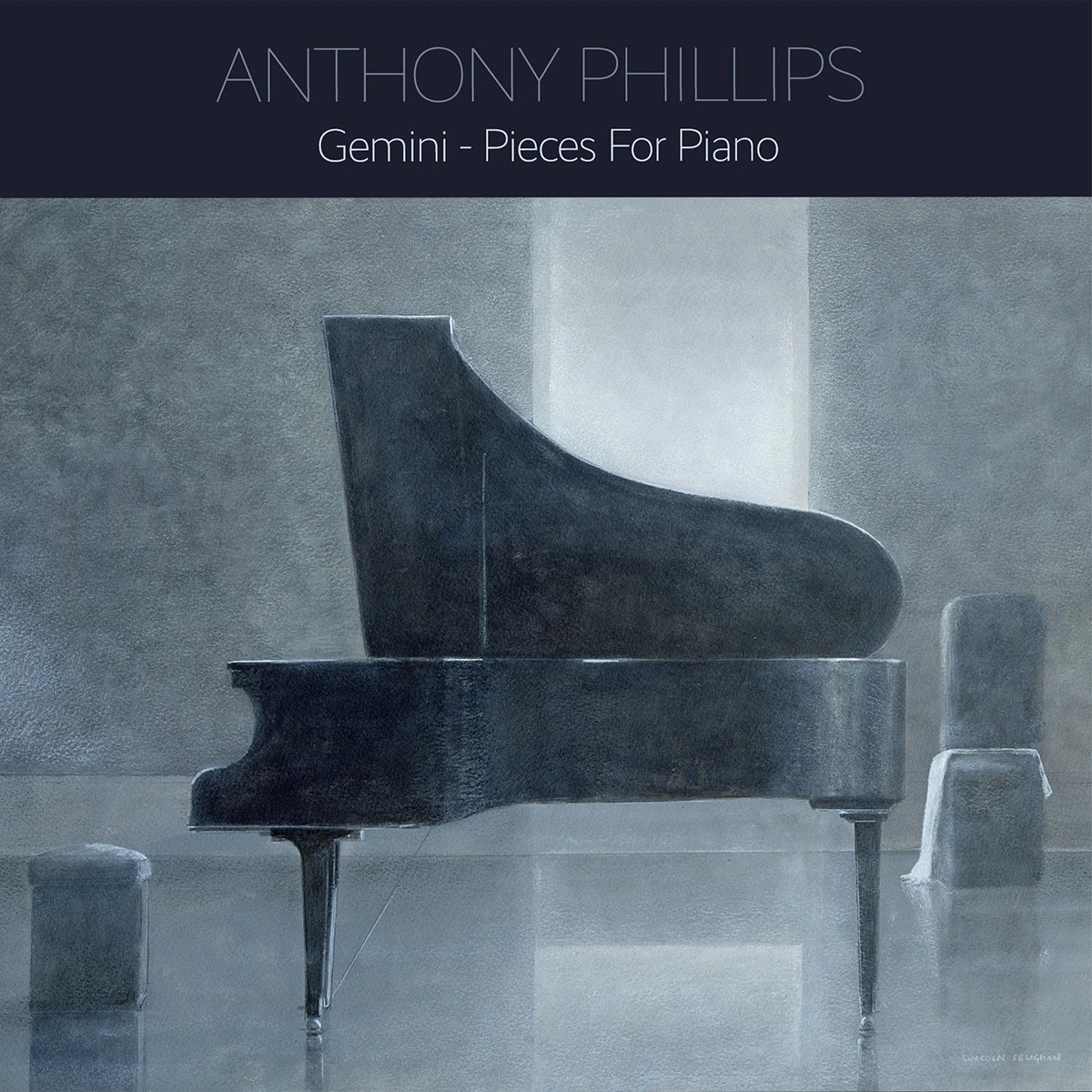
The CDs are housed in a fold-out digipak. The cover art is a painting by Lincoln Seligman. Depicted in shades of blue and grey, it shows a spartanly furnished room bathed in diffused light through a window, with a large concert grand piano taking up most of the space.
An eight-page booklet accompanies the album, also designed in dark blue with white lettering. Alongside the track listing and the names of those involved in the recording, the liner notes written by Anthony Phillips provide a few details on the making of the album.
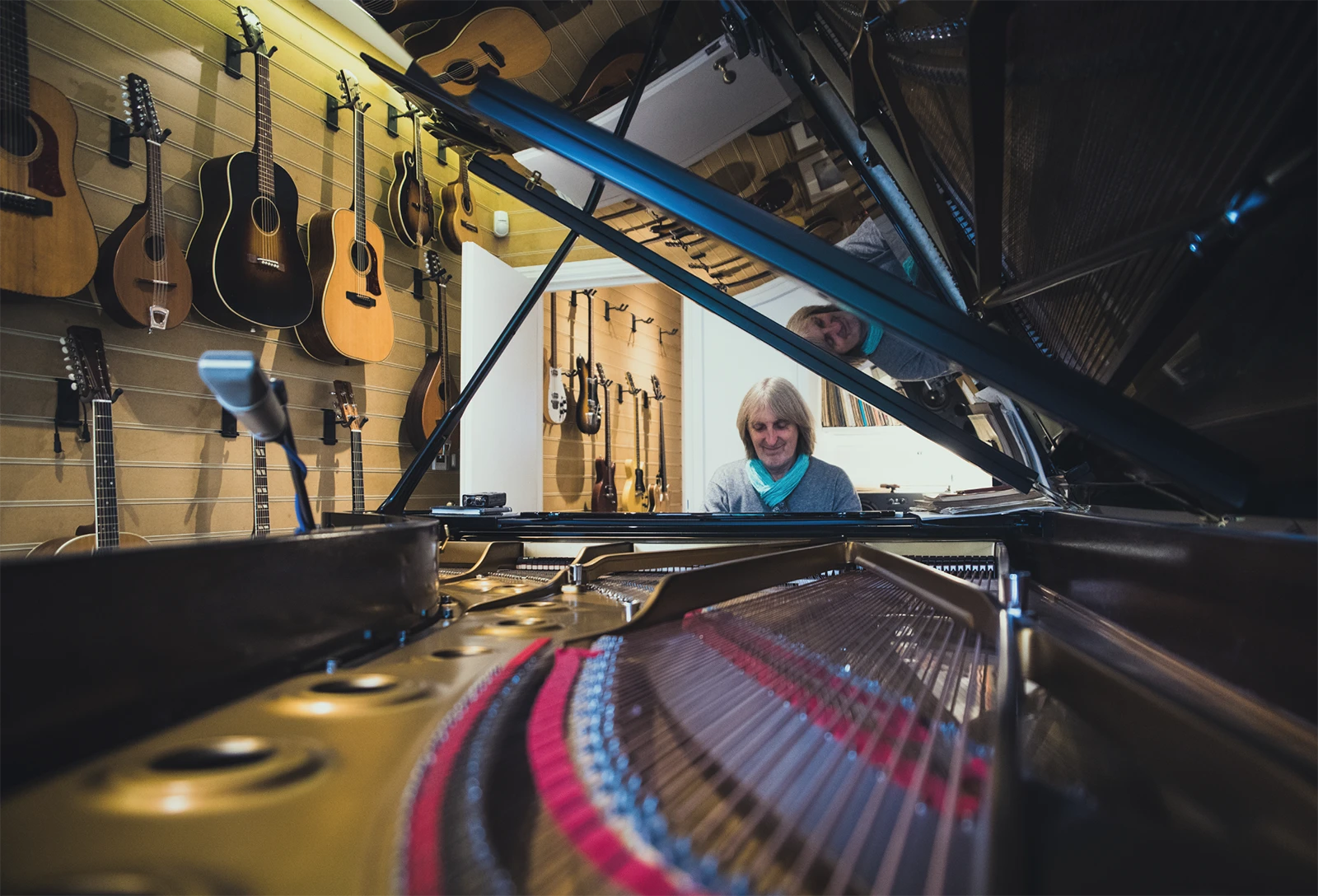
In the centre of the booklet is a double-page photograph which, from an interesting perspective, shows Anthony Phillips sitting at the instrument in his studio, smiling pensively, as if through the open grand piano, with numerous guitars on the wall beside him.
Incidentally, the album's title refers to a particular milestone in the composer's life: the title track, Gemini, was written at the request of Anthony's friend, the Italian pianist Gabriele Baldocci, originally as a version for two pianos. In a duet with the world-famous classical pianist Martha Argerich, to whom the piece is dedicated, he performed the composition for the first time in concert in Valencia in 2018 [see video at the end of the article]. A unique honour for a composer's work!
The music
The two CDs contain 44 compositions of varying lengths: these range from a few fragments lasting just under a minute to five longer pieces lasting between five and six and a half minutes. The majority of the compositions are of medium length, ranging from two to four minutes.
All pieces are performed as solo piano pieces; only on Spring Fair does Anthony play a four-handed duet with himself, and on Lost Love a three-handed piece. The short interlude Crossing Lines is performed on the harpsichord.
The pieces were recorded on Anthony's Steinway grand piano in his own studio between October 2022 and October 2025. Upon first listening to the more than two hours of music, one gets a good sense of the romantic mood that pervades the entire double album: many of the pieces radiate a great sense of calm and harmony; Anthony's music has, after all, always been associated with melodiousness. In Repose, in tranquillity – fittingly, this is also the title of one of the tracks.
DISC ONE:
River Of Serenity
Sanctum
Oblique
Testament
Twister
Solitude
Kaleidoscope
Spring Fair
Gravitas
Piece For C.S.
Odyssey Of A Somnambulant
Confessional
Penitence
Lost Love
Cradle Of Night
Golden Days
Empyrean
Dying Star
Forest Green
Memoir
The opening track River of Serenity also follows this theme. Indeed, it is striking that many of the compositions bear titles that suggest a sense of spiritual contemplation and transcendence: Sanctum, Testament, Confessional, Penitence, Hymnal, Sanctity, to name but a few. If one creates a playlist from the pieces titled in this way (which the author of these lines has done), one actually ends up with a collection of music that invites contemplation without losing any of its depth or substance.
But Gemini does not stop at this aspect, and the album is certainly not what is sold on the market as 'relaxation music'. Thus, the pieces on the piano album take the listener through a wide variety of moods, a few examples of which are given below.
There are, for example, several arpeggio studies in which the piano builds cascades of shifting broken chords full of tension. 'Studies' here does not refer to purely technical exercises, but rather to pieces in the spirit of Chopin's études, which, whilst focusing on specific techniques, are above all substantial pieces of music. Twister is one of these studies that I particularly like. The piece presents the listener with some surprising key changes, only to fade away very quietly on the root chord at the end.
Piece for CS also falls into this category; it is slower and more melancholic, and in the middle section—which accelerates—the arpeggios are interwoven with counter-melodic lines in the upper voice. The piece is dedicated to the memory of Colin Stunge, a friend of Anthony's.
One of my favourite tracks on the first CD is also the longest on the album, clocking in at over six and a half minutes: Spring Fair was recorded as a four-handed piece, with a radiant, joyful tone defining the intertwined voices. Images spring to mind: the awakening of nature, babbling brooks and singing birds, and the joy of people gathering in a meadow for the spring fair after a harsh winter.
Odyssee Of A Somnambulant, at 5 minutes and 32 seconds, is also one of the longer tracks; it builds drama and tension in individual scenes, and one can imagine, through one's imagination and vivid imagery, the places the sleepwalker might find himself in on his journey. I wonder if Anthony Phillips had in mind a soundtrack for the silent film The Cabinet of Dr. Caligari when composing this piece?
Another highlight for me is the rousing Empyrean. – Like a blaring fanfare, jubilant chords resound over a powerful pedal point played in the bass: the triumphant entrance of a king, and here the empire is not a dark one, as in John Williams' Imperial March, but a liberated land with a benevolent and just ruler, as at the end of the Lord of the Rings saga.
The first disc draws to a close with the wistful, melancholic melody of Memoir, which then builds dramatically; after a few seconds of silence following the final note, a few playful sounds can still be heard, like a musical echo from times gone by.
DISC TWO
Gemini
Hymnal
Frost Flower
Pablo Farceur
Labyrinth
Sanctity
Fathomless Caverns
Perdita
Faded Glory
Marking Time
Lady Moon
Sundowner
Canticle
Crossed Lines
Chansons Sans Mots (i)
Chansons Sans Mots (ii)
Chansons Sans Mots (iii)
Chansons Sans Mots (iv)
Chansons Sans Mots (v)
Chansons Sans Mots (vi)
In Repose
Sliding Doors
Pool Of Memory
Into The Firmament
The second CD begins with the title track mentioned earlier. Gemini (the Twins) is the zodiac sign of the famous Argentine concert pianist Martha Argerich, to whom the piece is dedicated and who gave its world premiere. – An impressionistic-sounding work of elegiac beauty; unlike the original duo version by Anthony, this arrangement is performed here by Anthony alone at the piano.
The beautiful Labyrinth is somewhat reminiscent of the harmonies found in some pieces by Ant's old colleague Tony Banks.
Anthony Phillips' love of changing and irregular time signatures also comes to the fore a few times on this second CD: in the short fragment Marking Time it is in 5/4 time, and in the B section of the playful, colourful composition Sundowner it is even in 13/8 time.
A significant portion of the second CD is taken up by a cycle comprising six pieces: Chansons sans Mots is undoubtedly intended as a tribute to Felix Mendelssohn and his sister Fanny, who invented this term and genre: according to Reinhard Amon's *Lexikon der musikalischen Form*, 'Songs Without Words' are characterised by 'narrative tone, speech-like quality, easily accessible and lyrical melodies, and clear form' *. – All this also applies to Anthony's cycle; he employs song forms such as ABABA, creating crescendos in the repetitions. In doing so, he avoids simply imitating Mendelssohn's style, but rather transports the form into the present day. Thus, for example, Chansons sans Mots (iv) even sounds a little like pop piano.
The longest track on CD2 is Fathomless Cavern, one of the strongest pieces, dark and mysterious. Thundering bass notes in the lower registers of the piano introduce the piece, over which impressionistic chords and melodies weave, played with many pauses in which the resonances of the grand piano's strings are allowed to unfold freely and interplay through the use of the pedal. The atmosphere is somewhat reminiscent of Debussy's Cathédrale Engloutie with its bells ringing beneath the sea. If the filmmaker Werner Herzog did not already have a regular musical partner in Ernst Reijseger, one could well imagine this impressive composition as the soundtrack to Herzog's film about the ancient cave paintings in France.
Sliding Doors is a short piece that appears just before the end of the album. Many of Anthony Phillips' earlier releases demonstrate his penchant for the sounds that slowly build up and then abruptly cut off when music is played backwards. At a point when you'd least expect it on first listen, a short backward-playing piece appears here too, serving as an atmospheric interlude leading into the next track, Pool of Memory.
Right at the very end, the sonic journey finally leads, with plenty of sparkle and glitter, into heavenly realms: In Into the Firmament , the piano is not heard in its pure form, but is seasoned with plenty of reverb and adorned with other effects; the music and the soul rise up into the infinite vastness of space, perhaps to a distant, better world in the constellation of Gemini…
All in all
Anyone who has read this far will surely have noticed the enthusiasm the author felt whilst listening to, analysing and describing his subject.
Even with his first two piano albums, I always felt that this was the kind of piano music I would have wanted to hear from Tony Banks as a soloist. For Anthony Phillips, the piano is the third instrument he has mastered, alongside the classical guitar and, above all, the 12-string guitar, on which he occupies a unique position in the world of music. Of course, as a pianist, he is not technically on a par with a concert pianist who, as a specialiszt**, devotes his entire professional life to interpreting the music of composers.
Yet, thanks to his great musicality and his feel for nuances, he should not be underestimated as a pianist either. And you can hear that on this album too. There are very few musicians who play the guitar as their primary instrument and who have developed such a high standard of playing on the piano as Anthony has. Ralph Towner or Egberto Gismonti spring to mind; after that, the list becomes rather sparse.
As a composer, Anthony Phillips is a true virtuoso; he is a master of form and a wizard of harmony. He has mastered the craft of composition, and you can hear that in every note. The way he develops an idea, then varies and refines it, is nothing short of a cinematic soundscape. His influences from classical music are unmistakable, particularly from the Romantic and Impressionist periods. Perhaps he himself has sometimes lamented that he lives in the wrong century. But one should not forget that, despite the references to past composers such as Schubert, Respighi or Ravel, he has nevertheless found a style all his own, and that he is, after all, a musician of the present. I would particularly like to mention here the great visual quality of his music, which would be inconceivable without the medium of film. A true cinematic experience, in other words.
It should also be noted that the order of the pieces is very well chosen; each of the two CDs works on its own, but also, when listened to consecutively, forms a whole, a journey through sound in its own right.
The excellent production also contributes to the album's overall success. The sound is transparent and dynamic, making full use of the instrument's wonderful, balanced tone and all its overtones and resonances. Yet the production is by no means purist. Subtle effects such as isolated resonances and reverb tails are unobtrusively placed in certain spots, creating atmosphere and a touch of acoustic magic.
A clear recommendation to purchase the album naturally goes out to all Anthony Phillips fans who appreciate his acoustic, chamber-music gems. However, lovers of classical, Romantic and Impressionist piano music are sure to find pleasure in this lovingly crafted work too, as there are clear affinities and influences here. I, for one, will certainly be sitting down to listen to it frequently, discovering new nuances in this varied and lovingly crafted work time and again.
Author: Gereon Schoplick
Gemini – Pieces For Piano will be out on 10 April 2026 and is available via CherryRed and Burningshed.
Remarks:
* Reinhard Amon: *Lexikon der musikalischen Form*, Vienna 2011, entry 'Lied ohne Worte'.
** The word 'Specialiszt' does not, of course, exist; it is a typo that I made. However, when I went to correct it, I realised how aptly humorous this mistake was in this context, so I left it as it was.
More sources
Booklet Gemini, 2026, Cherry Red, Esoteric Recordings
www.anthonyphillips.co.uk