

- Article
- Read in 7 minutes
Anthony Phillips – Radio Clyde 1978 – review
In 2025, Esoteric Records released Radio Clyde 1978, an expanded reissue of Anthony Phillips' radio concert.
Ever since recording technology made it possible to record concerts, live albums have held an unbroken fascination for music lovers. There is great appeal in experiencing the immediacy and special energy and atmosphere of a concert, or in hearing different versions of pieces you already know by the artist.
What about a musician like Anthony Phillips, who stopped performing in front of an audience at a very early stage of his career and chose to work in the studio as his preferred form of musical expression? It goes without saying that the small but enthusiastic fan base of Ant Phillips probably wants nothing more than to experience their hero in concert.
To meet this need for a live experience, Anthony and his sound archivist Jonathan Dann have made three different CDs available over the years, featuring concerts that Anthony recorded live for radio: The Living Room Concert in 1995, followed in 2003 by the first edition of Radio Clyde on Blueprint, although the recordings are much older. In between, there was the release of the Live Radio Sessions with Argentine musician Guillermo Cazenave, which musically goes in a more 'electric' direction and was recorded for a Spanish radio station at the time.
The origins of the project
In 1978, Anthony Phillips launched a series of PR activities. The main focus was on promoting his second solo album, Wise After the Event, and Private Parts & Pieces, which was about to be released and featured chamber music gems from Phillips' home recordings.
The promotional activities included trips to Italy and the Netherlands, and finally a series of interviews at various radio stations in the United Kingdom. This also included the broadcast of a one-hour 'concert' on the Scottish station Radio Clyde. Recorded in July 1978, the recordings are all uncut and recorded 'live' without overdubs, but because they were not broadcast live but about a month later, Anthony had the opportunity to re-record a piece if he made a mistake.
The original tapes are lost, but in 2003 a cassette recording from the station turned up in Anthony's archive, which had suffered some damage over the years. At the time, some effort was made to restore the material, but the tracks towards the end of the cassette, which were apparently more badly affected, are of slightly lower sound quality.
Radio Clyde was out of print for several years and has now been reissued by Cherry Red on the Esoteric Recordings label. This is the last in a series of reissues of Anthony Phillips' albums that has been running for several years.
Remastering was carried out, but no further restoration of the source material. Overall, the volume has been increased subjectively and objectively (we checked), and the music seems a little more powerful than on the first release.
Cover and packaging
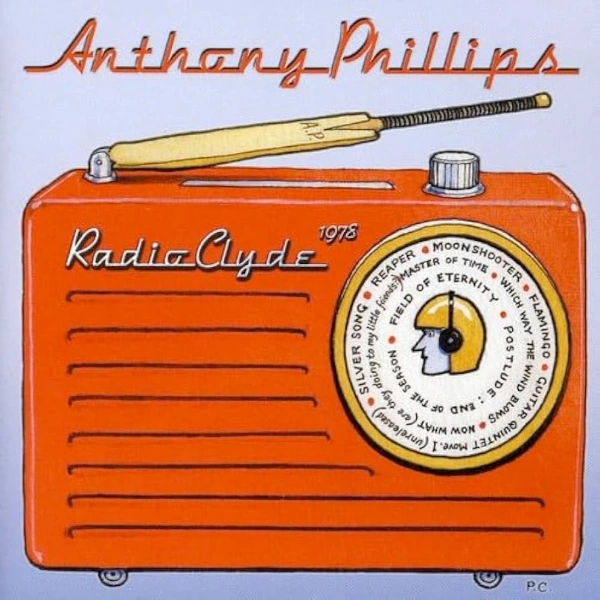
After a long break, Peter Cross was once again responsible for the cover design for Radio Clyde. It is not quite as detailed and intricate as many of his previous covers, but it is original and spiced with a few nice and humorous details.
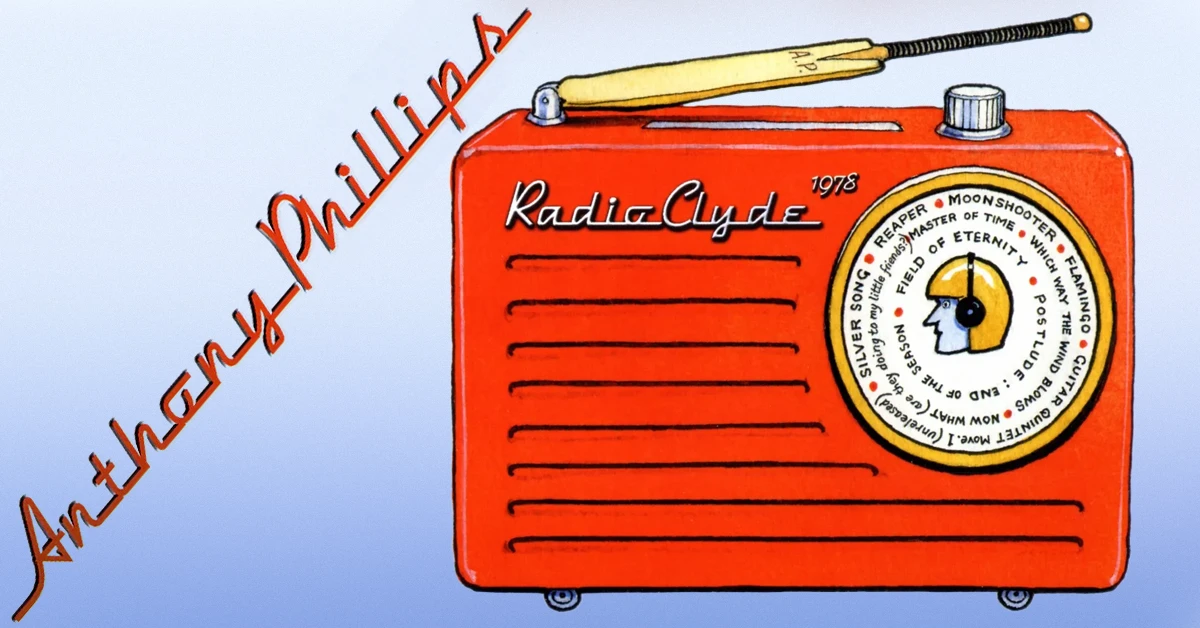
The front cover features a small red transistor radio with the words Radio Clyde 1978. The folded antenna is a cricket bat with the initials A.P. on it, and the titles of the tracks are listed in concentric circles on the right side of the speaker. In the middle of the speaker is a caricature of Ant in profile wearing headphones.
While the original CD release from Blueprint was packaged in a jewel case, the reissue comes in a high-quality, fold-out digipak sleeve. The booklet (originally 4 pages) now comprises 16 pages and contains an extensive new essay by Jonathan Dann on the history of the album, as well as some amusing anecdotes.
The music
The original version of the album contains ten tracks, half of which are instrumental, with Anthony singing to the guitar on the other five tracks. It is noteworthy that almost exclusively 12-string guitars were used here. Only Field Of Eternity was recorded on a concert guitar, and Now What… seems to feature a six-string steel-string guitar on the accompaniment.
Compared to the Living Room Concert, there is some overlap in the repertoire: the song Which Way the Wind Blows is included, and all the instrumental tracks except for the short Postlude are featured on both albums. But there are also differences, the most important perhaps being that the Living Room Concert featured piano in addition to guitars and vocals.
About the songs
First of all, I would like to say that I really like Anthony's voice on all these tracks. Anthony had just finished the elaborate production of the album Wise After the Event. The CD booklet states that Anthony worked very intensively on his voice in collaboration with producer Rupert Hine. This is obviously also to the benefit of Radio Clyde, especially as the songs are not embedded in opulent band arrangements, but appear in their purest form, stripped down to voice and guitar. From Wise…, Anthony plays the tracks Moon Shooter and Now What (Are They Doing To My Little Friends)?. Silver Song (written by Mike Rutherford and Anthony as a farewell song for the second Genesis drummer John Silver) has hit potential with its catchy chorus, and Anthony encourages the listeners to sing along in his tongue-in-cheek announcement.
Two tracks are taken from Anthony's legendary solo debut The Geese and the Ghost: Which Way the Wind Blows impresses with its feel and the homogeneous harmony of voice and 12-string guitar, which is all the more remarkable given how high the bar was set by the original. And Master of Time, which was unreleased at the time and whose demo would only appear twelve years later as a bonus track on the CD version of the Geese album, shines here in all its glory, sung with a powerful voice and accompanied by a nuanced accompaniment and colourful instrumental interludes.
Let's now turn to the instrumentals on Radio Clyde: Here, Anthony Phillips shows himself to be a master of his signature discipline, his unique playing on the 12-string guitar. Conversation Piece is a solo variation of a composition originally intended as an ensemble piece. At the time of the release of the two live albums, no studio version of the piece was available; this was only rectified with the latest re-release of Private Parts & Pieces.
For me, the two long pieces Reaper and Flamingo are the absolute highlights of the album. In my opinion, they are masterpieces that set new standards for composing and playing the 12-string guitar when PP&P was released. Reaper, played in an open D major tuning, develops from a distinctive rhythmic chord riff with great dynamics and harmonic finesse, via compositional resting points, to a brilliant finale. And Flamingo (at 10 minutes, the longest piece on Radio Clyde) is played in standard tuning and written in E major, thrilling listeners with its great virtuosity, power and harmonic ingenuity.
Finally, Field of Eternity is one of Anthony Phillips' most beautiful pieces for classical guitar: imaginative harmonisations, a syncopated melody on the bass strings, while a third voice unfolds in the treble, this is compositional art at its finest. Greatly played, but unfortunately the sound quality leaves something to be desired due to the condition of the cassette. The same applies to the following short number, which was originally the closing track and was still titled The Last One to Leave in 1978, but was later renamed Postlude: End of the Season. With a short announcement, Anthony thanks the team at Radio Clyde for the 'smashing session'.
On the new version of Radio Clyde, the two bonus tracks follow at this point.
Radio Pennine – the bonus tracks
It is one of the commendable achievements of Ant's sound archivist Jonathan Dann that he has discovered undiscovered treasures in (almost) all of the reissues in the master's extensive sound archive, thus creating added value for buyers compared to previous editions of the albums.
In this case, these are two other live recordings of Reaper and Which Way the Wind Blows, made during the same promotional tour for another radio station, Radio Pennine, based in Bradford, Northern England. In addition to the quite different nuances in the interpretation, what is particularly interesting here is that the slight impairments caused by speed fluctuations are absent. Incidentally, in the case of these two tracks, the recording was broadcast live on the radio during the interview, under difficult conditions. There were no bar stools or chairs without armrests in the station's recording studio, so Ant played the two tracks sitting on a huge pile of empty tape boxes!
Conclusion
Even if other albums might be the first recommendation for people who are not yet familiar with Anthony Phillips' music, I would still warmly recommend listening to Radio Clyde to anyone who likes Anthony's music, despite some sonic limitations.
Here we experience an artist at an important point in his career. The recordings were made after the release of his first two large-scale ensemble albums, on the threshold of the intimate chamber music Private Parts & Pieces, which later became an ongoing series that continues to this day.
Above all, however, the album conveys an immediacy that is characteristic of live recordings, only without an audience. Phillips' witty announcements make you smile and are so concise and short that you don't want to skip them even after listening to them several times.
I have already mentioned the quality of Anthony's singing, and his great instrumental skill is impressive. All this was created without high-tech studio equipment to hide behind. Just one man, his voice and, of course, his guitars, live and direct!
Author: Gereon Schoplick, August 2025
Sources used:
www.anthonyphillips.co.uk
Booklets from Radio Clyde in the 2025 (Esoteric Recordings) and 2003 (Blueprint) editions
Booklet from Wise After the Event, deluxe version Esoteric Recordings, 2016
Tracklist:
Reaper
Moonshooter
Flamingo
Conversation Piece
Silver Song
Master of Time
Which Way The Wind Blows
Now What (Are They Doing To My Little Friends)?
Field of Eternity
Postlude: End of the Season
Bonus tracks (session for Pennine Radio 1978)
Reaper
Which Way The Wind Blows
Where to buy
Radio Clyde 1978 is available from: CherryRed (UK)