

- Article
- Read in 8 minutes
Anthony Phillips – Sail The World – review
In April 2025, a new edition of the Anthony Phillips album Sail The World was released, which also contains a number of previously unheard tracks.
Anthony Phillips' soundtrack album Sail The World was first released in 1994 on the Resurgence Records label. Due to high demand, there were three re-releases on Voiceprint between 1997 and 2010, two of them in Japan. These were supplemented by three bonus tracks compared to the original edition.
The latest version of Sail The World has now been released as part of the reissues of numerous albums from Anthony Phillips' oeuvre, now equipped with a whole CD of additional material. This is the penultimate in the extensive series of re-releases from the Esoteric Recordings label.
Cover, packaging and sleeve notes
As already mentioned, the new edition is a double CD. The cover of the sleeve shows an exotic bay with sailing boats, an image that already adorned the cover of the last Voiceprint reissue from 2010.
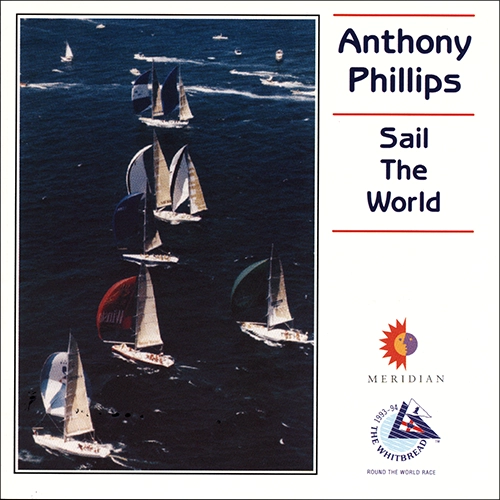
Included is a 24-page booklet with a new, extensive essay by Jonathan Dann on the background and creation of the project as well as detailed information on the music, in particular on all the tracks on the bonus CD. The booklet is livened up by photos from previous releases in the UK and Japan as well as beautiful seascapes that evoke wanderlust.
History of the album's creation
Since the end of the seventies, Anthony Phillips has been increasingly involved with commissions for library music and the creation of music for TV productions. This became his main source of income from the 1980s onwards. The album Finger Painting from the new Missing Links series, released in 1989, was the first to present exclusively material from this area of the composer's extensive oeuvre. Sail The World makes a complete soundtrack by Ant available to the public for the first time.
In 1991, Anthony Phillips and his Genesis colleague Mike Rutherford collaborated musically for the first time in 15 years. It was the theme music for the multi-part series Horse Trials. This was a first for Anthony, as he had no previous experience of scoring sporting events. Incidentally, the resulting music was made available to the general public for the first time on CD under the title The Victors on the re-release of Ants and Joji Hirota's collaboration Wildlife on Esoteric Recordings.
Music about a regatta for ocean-going yachts
As a 'follow-up commission', so to speak, the broadcaster ITV asked Ant to write music for a TV series about a major global regatta for ocean-going yachts, the Whitbread Around The World Race. Anthony had just completed a piece of music (the Opening Theme, which then became the theme music), which the producers liked so much that – to the composer's surprise and delight – Ant was commissioned to create the soundtrack for the entire series. This initially included a 50-minute programme for the 20th anniversary of the race.

Subsequently, the progress of the race was to be reported on continuously over a period of several months. As the film scenes to be set to music for the documentary were not yet available for the series, Anthony created themes and sound sketches in advance that could match the expected images: dynamic sailing sequences, storms and high waves, but also contrasting moments such as romantic sunsets, calm seas or encounters with sea creatures such as whales and seabirds.
During the course of the series, the availability of the CD was publicised alongside the broadcasts and was finally released in May 1994.
The music
There are a total of 41 tracks on the album, 26 on the first CD and 15 on the bonus CD, 5 of which are alternative versions of tracks from the original album and 10 of which are completely unreleased material.
The disc contain only instrumentals. The length of the compositions is mostly between 1:30 and 3:00 minutes, so the majority are short pieces. The sound is dominated by various synthesizers and keyboards, synth bass and drum computers, and electric guitars are also used as accompanying and lead instruments. Acoustic instruments such as piano, percussion and acoustic guitar are used less frequently. Sail The World is therefore one of Anthony Phillips' keyboard-orientated albums.
While several of the tracks are underpinned by continuous rhythms, the other half consists more of atmospheric soundscapes and soundscapes with sometimes meditative qualities.
All of the instruments were played by Anthony Phillips, except for a few songs in which two co-operation partners are involved. These two will be discussed later.
Tracklist CD1:
Opening Theme
Fast Work
Dark Seas
Cool Sailing
Wildlife Choir
I Wish This Would Never End
Salsa I *
Roaring Forties
Lonely Whales
Icebergs
Majestic Whales
In the Southern Ocean
The Fremantle Doctor
Long Way from Home
Wildlife Flotilla
Big Combers
Cool Sailing II
Cape Horn
Amongst Mythical Birds
Salsa II *
Into the Tropics
In the Doldrums
Heading for Home & Victory
Paradise
Eastern Magic
Closing Theme
* with Joji Hirota
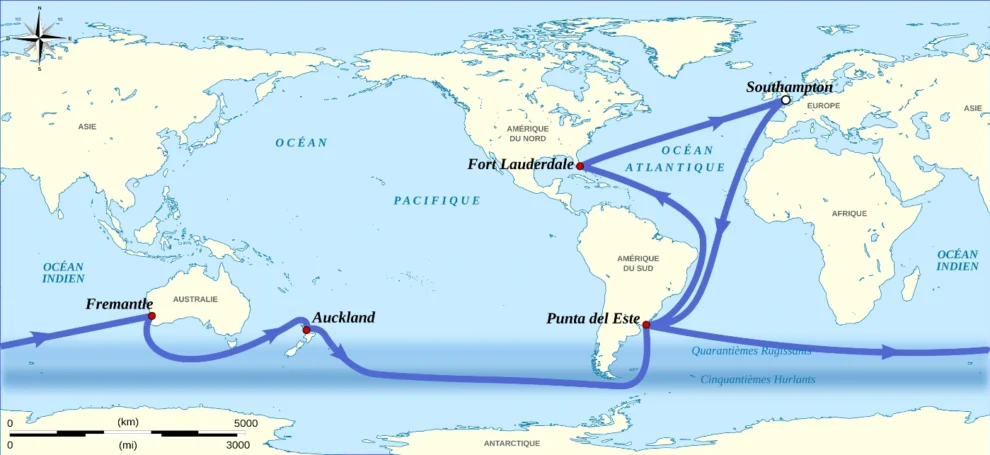
As already mentioned, the first CD contains the original 23 tracks from the first edition, plus the three bonus tracks. The order of the tracks follows the route taken by the yacht race: from Southampton across the Atlantic to Punta del Este in Uruguay, then eastwards across the South Atlantic and Indian Ocean to Fremantle in Western Australia, then via Auckland (NZ) through the South Atlantic, past Cape Horn back to Punta del Este, and finally via Fort Lauderdale (Florida) back to Southampton.
The opening theme is the most rocking number, with a driving rhythm, electric guitar riffs and synthesiser fanfares. Three more numbers follow in the same style, chord changes over ostinato eighth-note bass lines, before Wildlife Choir becomes very calm and circular for the first time. A number of the following tracks go in this atmospheric, floating direction, such as the two Whales numbers, Icebergs, Mythical Birds and In the Doldrums.
What else does the album have to offer? I Wish This Would Never End spins a catchy melody on the electric guitar over a growling bass groove and fine string carpets. – Long Way From Home convinces with a melody full of longing that fits well with the title. – Cape Horn is characterised by an almost mystical mood. – On Salsa (I and II), collaborator and percussionist Joji Hirota inspires with Latin American rhythms (more samba than salsa). Incidentally, these two pieces accompany the two stopovers of the regatta in Uruguay. – The finish of the yachts in Southampton with Heading for Home & Victory is finally crowned with a jubilant electric guitar solo by Ant.
Tracklist CD2
Opening Theme (original version)
The Dream Race
Starboard Drift
Epic Whales
World Piece*
Temple*
Ocean Life*
Cool Sailing (alternate mix)
Playmaker**
Another Day
Fast Work (alternate mix)
Journey's End
Tokyo Nights*
Paradise (alternate mix)
Heading for Home & Victory (alternate mix)
* with Joji Hirota
** with Martin Robertson
So now to the bonus CD, which was of course of particular interest to me because I already knew the other tracks. It contains 15 tracks, five of which are alternative versions of the original. A shorter version of the title track, Opening Theme, is of interest to anyone interested in the original version with which Anthony probably received this (hopefully lucrative for him) TV contract.
Finally, ten completely new numbers, and there are some real highlights: Another Day, for example, which creates a small sound painting over repetitive patterns with marimba sounds, piano and guitar, or Journey's End with a catchy, almost folky melody that is also easy to imagine in an acoustic guise.
My personal favourites are the five tracks that feature the two guest musicians. The first to be mentioned is Joji Hirota, who is well known to all Anthony Phillips fans as co-composer, percussionist and also flautist from the two albums Time and Tide and Wildlife. Temple spreads a very dense atmosphere with gongs, cymbals, rustling and various bells. – Tokyo Nights works with Asian associations. And in Ocean Life, a polyrhythmic mesh unfolds on various percussion instruments in dialogue with Ant's floating keyboard sounds, with Joji playing a melody on the ocarina flute.
One of my personal favourites on the bonus CD is World Piece. Here Joji Hirota sets off a veritable firework display on his rich percussion arsenal, perfectly coordinated with Ant's keyboard sequences reminiscent of gamelan sounds. A great, crazy track that even reminds me a little of Frank Zappa's Jazz from Hell album!
Another favourite track of mine is the collaboration with the second guest musician and partner, saxophonist Martin Robertson (with whom Ant has worked before, so did Tony Banks, by the way). Ant accompanies with radiant, open chords on the 12-string guitar, with Robertson on sax and Anthony on the distorted electric guitar melodically throwing the balls at each other. It's a shame that this marvellous track comes to an end after just under two minutes.
All in all
So how can Sail The World be categorised in Anthony Phillips' oeuvre? And how does the music stand on its own? After all, one must not forget that the music was created for a purpose, to accompany moving images. In a film like this, where the music is not in the foreground but serves the whole, where in addition to the images there is also original sound, natural sounds such as wind and water as well as interviews and commentary, the music must not be too differentiated.
A delicate piece like The Geese and the Ghost suite, for example, would be completely out of place here. An example of what I mean by this: a piece with a driving, continuous rhythm and overlying guitar riffs and keyboard chords, on the other hand, works well when a yacht is ploughing through metre-high waves at 25 knots in the film. But how does the music work when it stands on its own without the film?
Well, as always, it is of course a matter of taste who likes and prefers which music. Anyone who hasn't been able to get to grips with Anthony Phillips' keyboard and synthesiser music so far and who perhaps also has an aversion to drum machines will probably not like Sail The World so much. The album is certainly not the first choice for people who are not yet familiar with Ant's music and are looking for a recommendation to get them started.
If, on the other hand, you like music with synthesizers in different styles, from circular to groovy, you'll get your money's worth here. Anyone who likes meditative music that goes beyond flat new-age noise in terms of harmony and sound and still flatters the ear will be able to put together their own playlists from the tracks. In any case, we recommend buying this album to all die-hard Anthony Phillips fans who are always longing for unheard treasures from the master's workshop.
Ultimately, the bonus CD alone offers considerable added value compared to the previous versions, especially thanks to the great contributions of the two guest musicians. Thanks to sound archivist Jonathan Dann for always unearthing undiscovered gems and making them available to us fans. A great deal of care has been taken with the mixing and the (new) mastering, and the lovingly designed booklet leaves nothing to be desired.
Finally, a few personal words from me: When I first bought the 2010 edition, Sail The World wasn't one of my favourites after the first listen, I couldn't really get into most of the tracks. Through intensive listening for the review of this new edition, much of the album has grown on me, because I have discovered many subtleties – even in the pieces that I didn't like at first – that only become apparent after repeated listening.
Have fun rediscovering Sail The World!
Author: Gereon Schoplick, April 2025
Regatta-Map: Sémhur, Flappiefh, CC BY-SA 3.0, via Wikimedia Commons
Sail The World (2CD expanded Edition) is available at CherryRed.