

- Article
- Read in 12 minutes
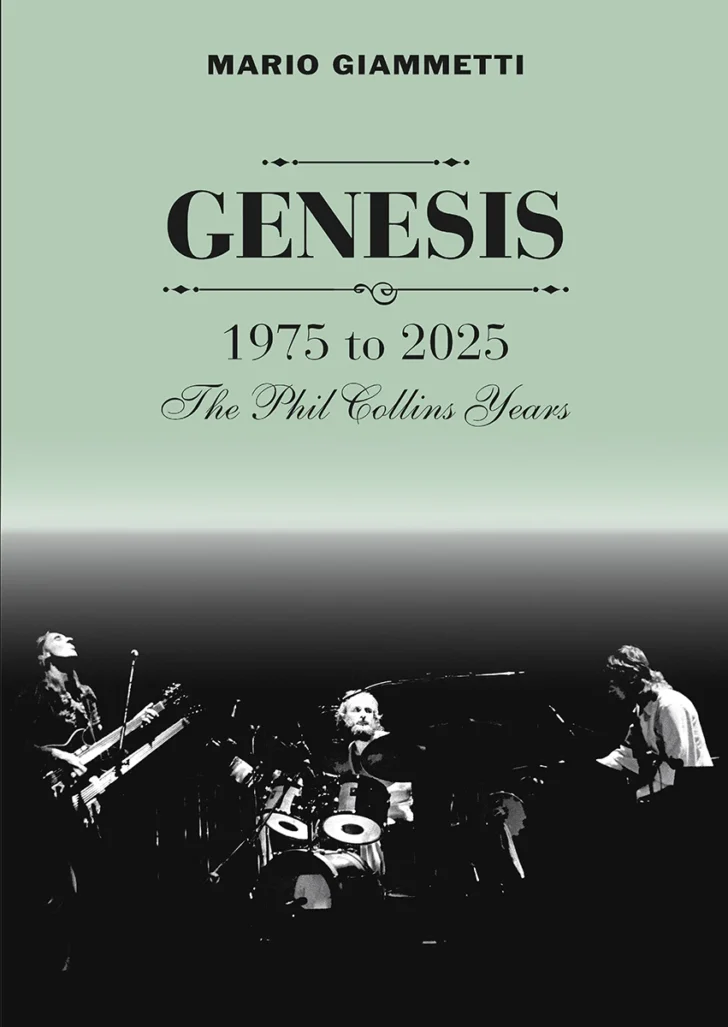
Genesis – 1975-2025: The Phil Collins Years (Mario Giammetti) – book review
Mario Giammetti's book GENESIS: The Phil Collins Years was first published in 2021 and eventually revised and re-published in 2025. Jan Hecker-Stampehl takes a closer look.
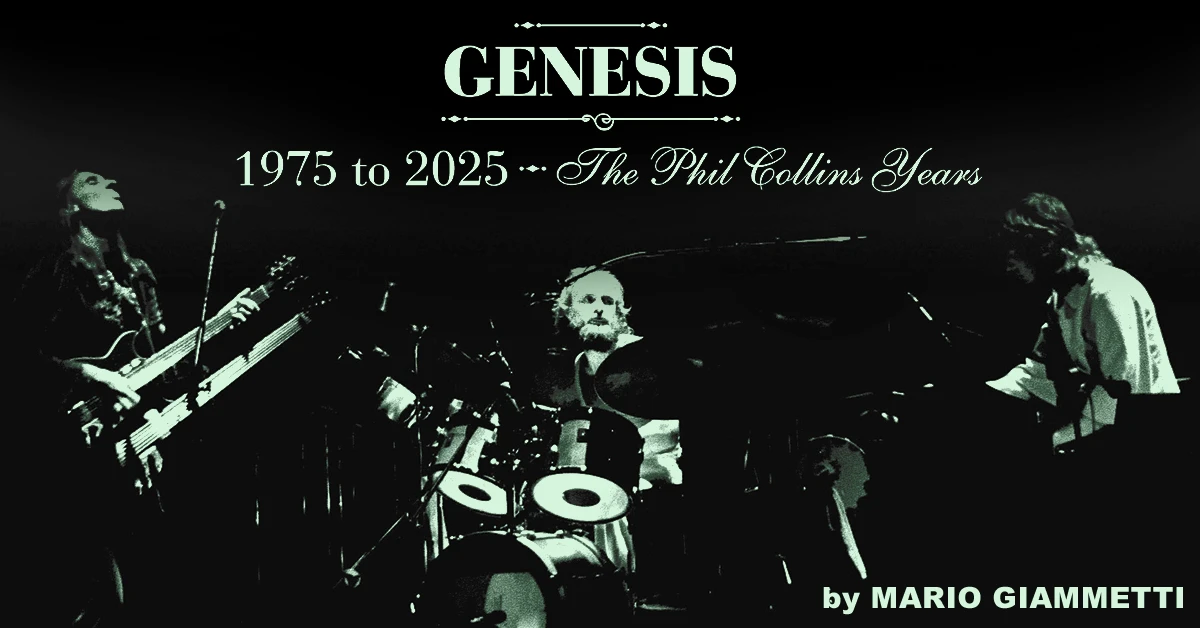
The book was updated with additional content in 2025. An extra section about this update can be found at the end of this article.
After the first part of Mario Giammetti's great Genesis biography was published in English in 2020, covering the phase from the band's foundation to Peter Gabriel's departure, the second part has now been published. Strictly speaking, the title is not quite correct, because this volume also covers the – admittedly rather short – time with Ray Wilson as singer. Since the presentation also covers the Turn It On Again tour in 2007 and ends with a preview of The Last Domino? tour in 2021/22, where Phil Collins was again at the microphone, and since he certainly left a much stronger impact on Genesis than Ray Wilson, the title The Phil Collins Years is certainly okay.
However, it should be admitted right away that Giammetti's portrayal by no means paints a picture of total domination of the proceedings by Collins, but tries to do justice to the roles of all the band members and additional stage musicians (Bruford, Thompson, Stuermer).
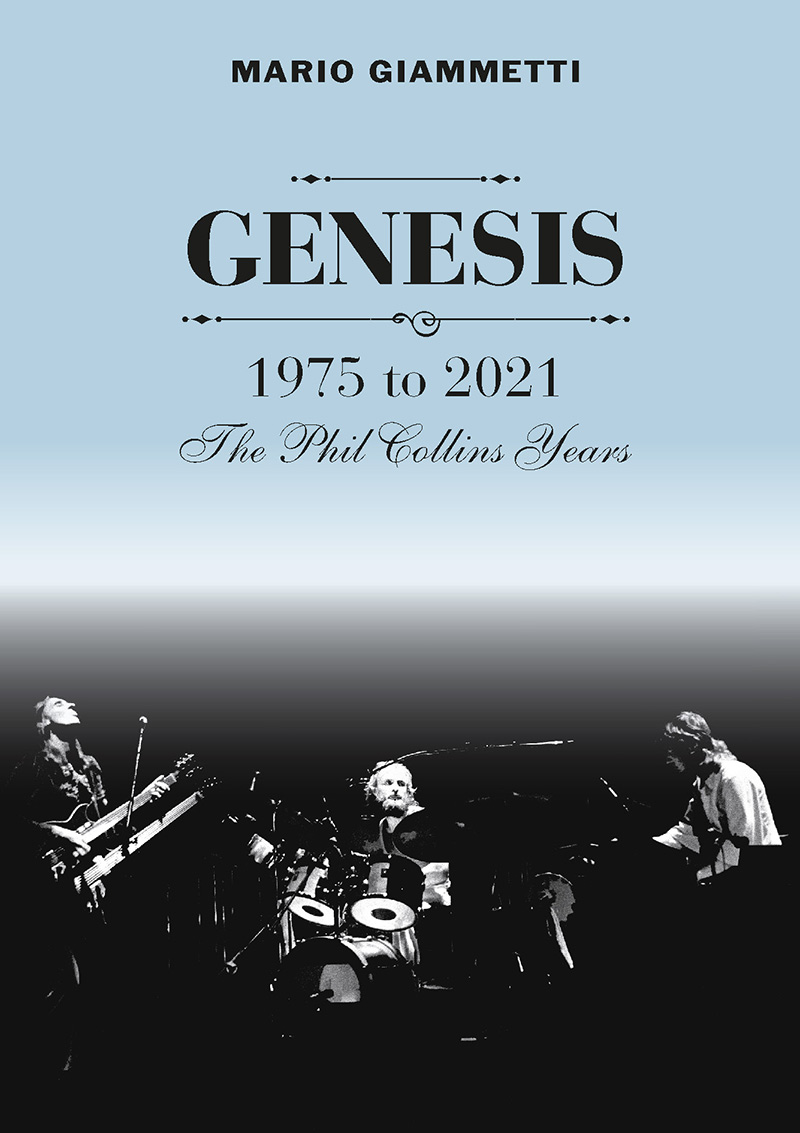
This second volume is introduced by a short foreword by Mike Rutherford, who pays tribute to Mario Giammetti's years of work for and about the band, before the author gets down to business after a brief introduction. The sources drawn upon here are exclusively new ones – numerous interviews and phone calls with key players – conducted either by Giammetti himself or by English journalist Michael Kaufman in connection with the Genesis back catalogue reissues published in 2008.. Only certain excerpts of these interviews made it onto the bonus content DVDs that accompanied the Genesis box sets for the respective years in video form. Giammetti was able to access the original interviews in their entirety. In addition, numerous interviews and articles were conducted or written, especially for the Italian fan magazine Dusk, which was founded and supervised by Giammetti.
All in all, he was able to access a considerable amount of material that was previously unavailable to the public, or at least not in English. Not even one single quote here has ever been printed before in any other book. This is clearly noticeable in the presentation: Even if the narrative of these Genesis years is very familiar to the informed fan in its basic features, an immensely multi-faceted picture emerges through numerous statements by the band members and the technicians, producers etc. involved in the creation and production of albums and tours. A great many new aspects are being revealed and many known facts are being enriched with new information. One main difference to the first volume is that he only heard one album together with a band member and let these impressions flow into the account (it was Wind & Wuthering, heard together with Steve Hackett)
In terms of structure, this second volume follows the model of the first: for each studio album (and also for Three Sides Live), there is one chapter, which in turn is divided into two main sub-chapters: Part A is dedicated to the album and its creation, Part B in turn documents the accompanying tour in detail. This creates a structure strictly following the official publications, which on the one hand seems obvious, but on the other hand also seems a little rigid. In addition, there is the meticulousness and great conscientiousness with which Giammetti treats his subject: Not only are the backgrounds of the albums' creation traced very precisely, but the context of rock music developments of the respective time is also sketched, so that it is easier, especially from today's point of view, to better situate the Genesis releases in their respective production period
Giammetti uses the introductions to the chapters to describe in detail the development that led to each album. He then goes into the specifics of each album's production, describing the working relationship between band members and with the various producers. For each album, he analyses each individual song and also all the pieces that were created during the respective sessions and that appeared as B-sides, later or not at all. These individual analyses deal with instrumentation, structure, atmosphere, lyrics and special features; the album covers are also discussed in detail, and the artists and designers behind them are being introduced.
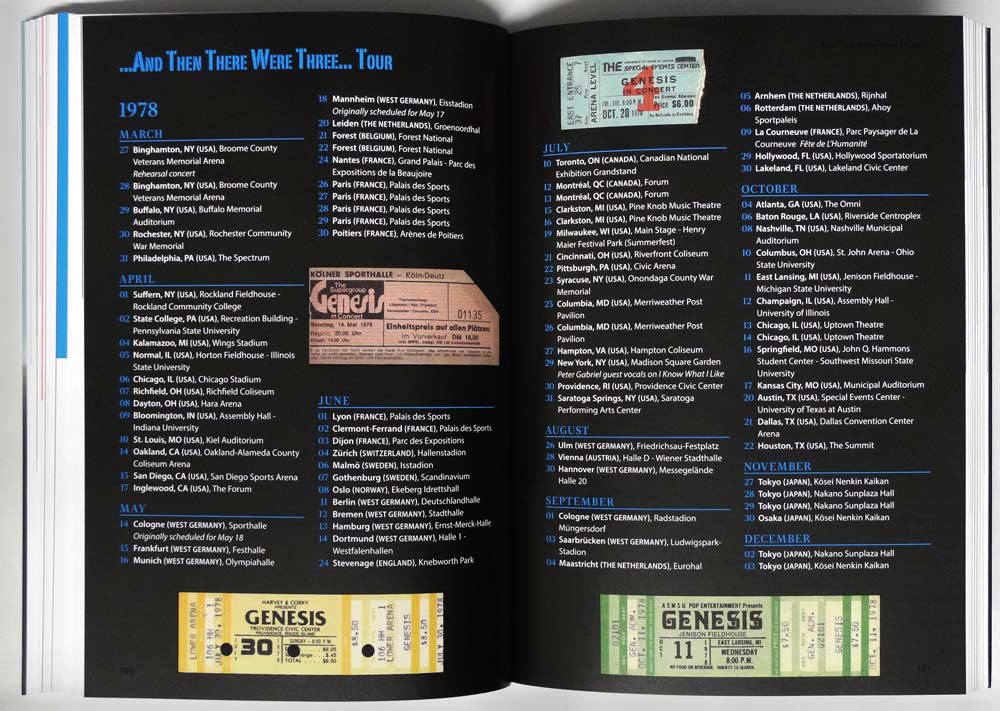
Giammetti is a big fan and does not even try to hide it. Thus his book combines two different natures, that of the meticulous documentarian who strives for completeness and accuracy, and that of the fan who has accompanied Genesis over many years with a loving eye, his personal musical taste and great sympathy for the band's fortunes. The documentary aspect is evident, for example, in the tour dates, which seem to me to have been exhaustively researched, right down to individual cancelled, postponed or made-up gigs.
Here the work becomes almost encyclopaedic, which on the one hand is very praiseworthy (one has a lot of well-checked information at hand), which on the other hand sometimes becomes a bit tiring (changes in the tour schedule don't tend to read so excitingly in the continuous text, documenting every change in the setlist is essential for some, for others perhaps not so much). Because Giammetti wants to pack all the information he has certainly gathered with great zeal and effort into the narration, it is sometimes not written very elegantly and it becomes somewhat arduous to read in places. There is also a double page with all the tour data for each tour as a continuous list – that is actually enough
Of course, the fan shows himself in this meticulousness, because what normal non-fiction author would care about such details? The fan also shows himself in the assessments of the music and the changing character of the studio releases over time. His preference seems to be clearly on the progressive years of the band, so that the four-man phase with Steve Hackett on board is still rated very well, but also the first albums after his departure still come off quite well, especially Duke. Albums like And Then There Were Three or Abacab are interpreted as important turning points and a chance to gain new experiences, and not simply dismissed.
His verdict on Genesis' commercially most successful album, Invisible Touch, is downright devastating. Nevertheless, Giammetti is able to differentiate and understand the context, and he is by no means purely bashing Phil Collins or the like. He tries to understand the band's decisions better, or at least to comprehend them, to place them in the course of things. In the end, he measures Genesis by what they wanted to be from the beginning of their career: good songwriters. So, for example, he also talks about what he considers to be technological fads such as certain production techniques or synthesiser sounds that he doesn't like; but, to return to this example, Invisible Touch scores so badly with him mainly because, in his opinion, the songwriting didn't reach the necessary qualities.
Giammetti does not despise pop or catchy melodies in and of themselves, but a good pop song should still not come across as too simple or flat. He is critical of the fact that many new technologies were used too uncritically, which, according to his interpretation, led to studio technology getting the upper hand over songwriting at times.
One aspect that additionally makes the book stand out and will probably make it unchallenged for a long time is the thorough and appropriate account of the events surrounding the album Calling All Stations and the accompanying tour in 1998 with Ray Wilson as singer. Considering that Mike Rutherford's autobiography (2014) only devoted half a page to this part of the band's history, one appreciates all the more that Giammetti does not shorten his account here because of the weaker commercial success. In fact, these 31 pages are probably the most detailed written documentation of this remarkable phase in the history of Genesis in many respects – whether it was remarkable in a positive or negative sense, everyone will have to decide for themselves.
Often enough, however, one has the impression that Tony Banks and Mike Rutherford would prefer to keep quiet about this period; here all the protagonists of that time have their say and a critical analysis of the events of that time is made, which takes into account both light and shadow. In any case, Ray Wilson is given enough space to express his disappointment and anger about the unfortunate ending of this ultimately short episode. Remarkably, even the recently so tragically deceased David Longdon has his say in detail, who was on the shortlist for the selection of the new Genesis singer but ultimately lost out [Mario's interview with him from 2010 can be found on the Dusk website here].
The views of drummers Nir Z and Nick D'Virgilio and touring guitarist/bassist Anthony Drennan are also taken up and one learns such a curious detail as the request to the then rather up-and-coming musician Steven Wilson (meanwhile risen to the prog god of our days) to take over the task as touring guitarist in 1997/98.
Giammetti's work not only profits from his own research, his own knowledge and experience of the band as a fan, but also draws from the large amount of sources already mentioned above. He succeeds in drawing an immensely differentiated picture of the history of this so multi-layered band. By reading this book, it once again becomes very clear, as if focused through a burning glass, how many imponderables the band encountered in their development, how many moults Genesis went through, but also what different influences and styles they processed.
Perhaps our present time, when this book is being published, allows us to take another, fresh and partly more relaxed look back. Now that it seems that Genesis will say their final goodbye with The Last Domino? tour, some things might look different, more final, sometimes the perspective of such a publication changes with the point of view. In my opinion, even long-time fans will read this second volume with great pleasure and enjoy it.
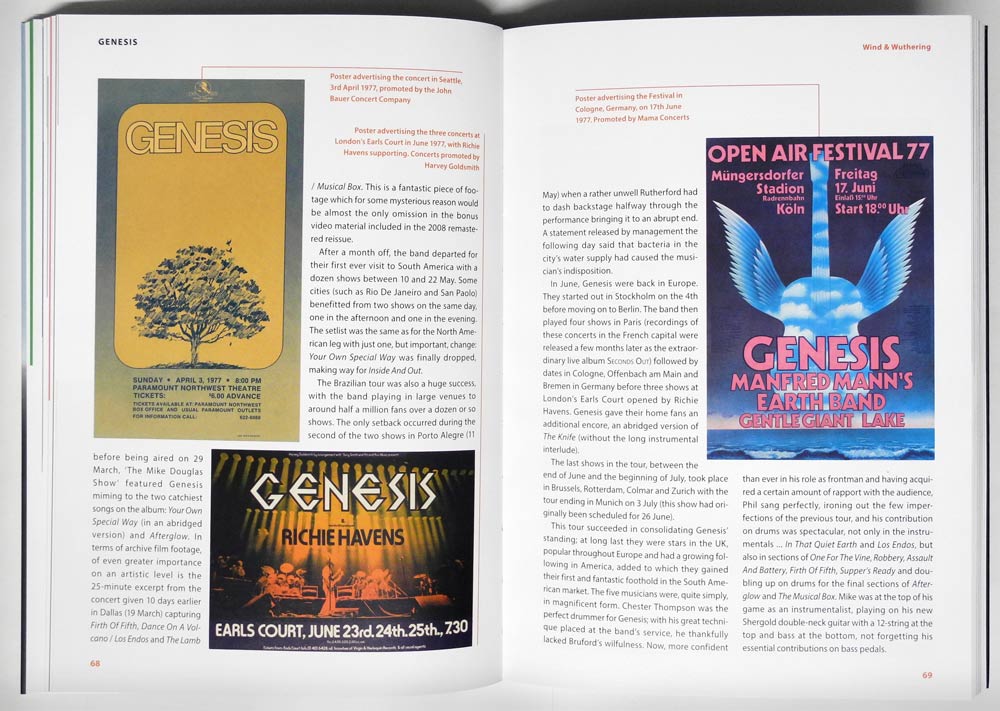
The book is produced throughout on thick, high-quality photo printing paper, with a very sturdy cardboard cover, the book is amazingly heavy in the hand for its paper dimensions and makes a very high-quality, noble impression overall. It is illustrated throughout, hardly a page without photos of concerts, press photos, covers of rock magazines, pictures of tour posters, tickets or advertisements; the illustrations stand out from other publications in that most of them have not already been seen dozens of times elsewhere.
It's a book that, like its predecessor, is a pleasure to pick up again and again and that you don't necessarily have to read through in one go, but that you can browse through again and again to read something about your favourite album or a lesser-known section. A read that almost feels like a visit to a museum – profitable, stimulating, with the opportunity to delve into details or to take a look at the major lines of the band's history and last but not least: always beautiful to look at.
The 2025 book upgrade
After the second volume of Mario Giammetti's Genesis biography being out of print, and with The Last Domino tour signaling the band's departure from the stage and the end of their decades-long career, a new edition with some revisions and additions was definitely in order. The first edition in 2021 ended with a brief preview of the tour that had just been announced (but was soon to be postponed due to Covid-19) and concluded with the uncertainty of whether the circumstances of not only the pandemic but also Phil Collins' fragile condition would still allow the performances to happen.
Giammetti can now shed more light on what had to remain in limbo at the time. The final chapter, originally entitled 'Afterglow', has now become an 'Interlude', which sows the seeds for the longest addition, the chapter on the farewell tour. This is done very vividly, for example with quotes from Daryl Stuermer, who could almost be described as the musical memory of Genesis as a live band in the latter years.
Giammetti goes into the final tour in his usual well-researched manner and with enormous attention to detail, going through the setlist piece by piece and summarising his impressions. He is not sparing with criticism and says that all the audience could do in the case of Phil Collins was to remember what an outstanding singer he once was. The author does indeed address the limitations, but rightly wonders, for example, why the new backing singers were not used more extensively.
He sees Stuermer as impeccably prepared, Tony Banks as in better shape than in 2007, Mike Rutherford solid on bass, slightly unsure on some guitar solos and Nic Collins as 'the new guy' so technically adept that he masters the more complex prog parts, but Giammetti thinks that he lacked the lightness of his father on the example of Duchess. The reviewer found the thundering drums in this live rendition of Duchess particularly impressive – just as Nic's playing and drum sound sounded a little more like the studio versions.
The readers will have to go through the review in detail for themselves. Perhaps it would have been worth pointing out that the unusual version of The Lamb Lies Down On Broadway in the "Unplugged" section (or rather the 'Stripped-Down' section) is the first and only time in their career that Genesis have subjected a song from their catalogue to a radical new arrangement for live performances.
Giammetti traces the rather curious development of the tour from the first to the second postponement to the originally unplanned extension to the European continent. From a German perspective, there is no mention of the fact that the realisation of the concerts here remained on a knife's edge right up until the very last moment – which certainly made the news that they could take place very emotional for the German fans.
In his conclusion, Giammetti is gracious despite all the criticism previously expressed and says that despite all the adversities, Genesis pulled the whole thing off as well as could be expected. A younger generation of fans thus was able to admire this seminal band in a live setting, and the tour offered Phil Collins one last opportunity to take a 'spin on the merry-go-round'. In a way, I personally think it's also very telling that he made his musical exit with the Genesis farewell tour and not as a solo artist.
The new last chapter is now called Fading Lights and takes detailed stock at the end, but also deals with the latest developments such as releases (e.g. BBC Broadcasts) and the various solo activities of the still active (ex-) Genesis members. Not the last sentence of the book, but it could have been, because it sums it up so well: „What we do know for sure is that the band's legend is far from fading."
With the newly conducted interviews and the meticulousness with which he brings to light many unknown details (Anthony Drennan as a possible Stuermer replacement on the final tour!), Giammetti once again proves that he is one of the great authorities on Genesis of recent decades. His update (which also corrects some printing errors and adds new quotations in some places in the original text) is absolutely coherent and it is most gratifying that the second volume of his comprehensive, well-researched and easy-to-read work on Genesis is now available in a more complete version and is available again at all. Kudos!
Author: Jan Hecker-Stampehl
Genesis: 1975 to 2025 – The Phil Collins Years
by Mario Giammetti
Kingmaker Publishing
Softcover, 314 pages
ISBN 978-1838491871
Released: 15th July 2021 (1st edition) and 17th April 2025 (revised edition)
The book is available at Burning Shed.
An interview with author Mario Giammetti was conducted in April 2025. You can read this interview here.