

- Article
- Read in 5 minutes
Genesis – Backstage Report – Light show during the Turn It On Again Tour 2007
In Munich, Christian Gerhardts met with Victor 'Livingstone' Anderssen from the tour's 'Genesis Lights Repair Centre' before the show…

Challenges for the lighting crew during the (rain) tour
Genesis on tour – that has always been a challenge for the crew, whether they're taking care of lighting, sound, video or other things, setting up and dismantling the stages or driving the lorries.
Genesis 2007 – this is the biggest stage they have ever had. Christian Gerhardts met Livingstone, a member of the technical crew, before the concert in Munich (on 10 July) and talked to him about life and work behind the scenes of such a production.
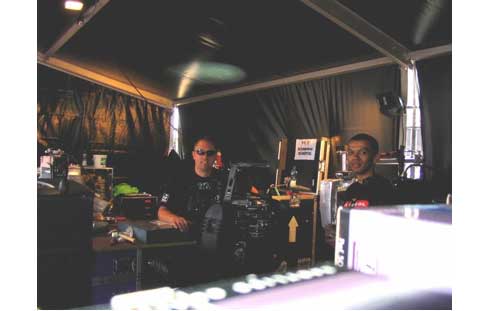
Livingstone speaks almost fluent German. He has been on tour since 1978 and has often travelled to Germany. His employer Roadtechservices Belgium was contracted by the London-based company Neg Earth Lights for this tour. Neg Earth Lights is the main supplier of the lights, stage effects and tools for the stage set-up on the 2007 Genesis tour.
In addition to Genesis, Livingstone has been involved in many productions around the world, including Uriah Heep, Jethro Tull, Pink Floyd, Rammstein, Riverdance, Oasis and Franz Ferdinand, to name but a few. He is part of the lighting team and is the emergency doctor for all things lighting, so he is responsible for the well-being of all installations and the Vari*Lites.
"Our team is divided into three teams: two advance teams and a universal (concert) team, which ensures that the concert works from a lighting perspective. The lighting department consists of sixteen people," explains Livingstone. The advance teams start the day before the show to lay all the cable infrastructure and install both the lights on the seven ribs and the Vari*Lites under the stage roof (for example, the ones directly under the roof that protect the band from the rain). The Universal team joins them on the morning of the concert day with the main equipment and effects.
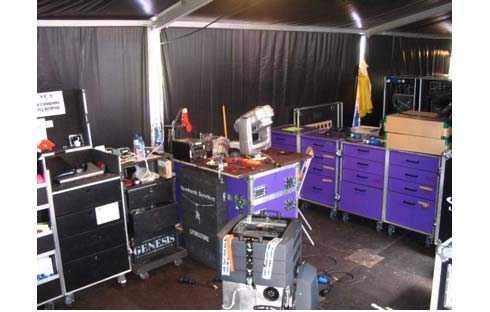
Livingstone explains how the use of headlights has been constantly revised over the years.
Until the 1980s, stage lighting for concerts and theatre productions filled a large space and required many installations (a rock concert usually required up to 3,000 lamps). Each light had to be focused by hand before coloured celluloid gel material was placed in front of each individual lamp to colour it. Colour changes were achieved by switching groups of spotlights on or off and dimming by controlling electronic dimmers from a computerised lighting console.
Throughout the 1970s, engineers worked on a colour change for a lamp. Finally, they found a solution: dichroic filters enabled almost instantaneous colour changes and produced rich colours that the gel filters could not offer.
Soon after, the development team flew to London to present a prototype of the automated lamp (then called 'VL Zero') to Genesis. The British band had long been at the forefront of utilising the latest technology – and were rehearsing for a new tour. The new luminaire made its debut on the side wall of a 500-year-old barn at a studio in the middle of the English countryside. 50 VL1™ luminaires and a computerised control console were installed at the first concert of the Abacab-Tour on 25 September 1981 in a bullring in Barcelona, Spain.
Since then, Livingstone has worked with Vari*Lites, repairing all sorts of automatic lights and other equipment backstage in his 'hospital'.
Open-air concerts are normally summer and fair-weather events, but this year seemed to be the year of the 'Turn the tap on' tour, as Jonathan "Sel" Sellers, head of the Neg Earth lighting team, noted.
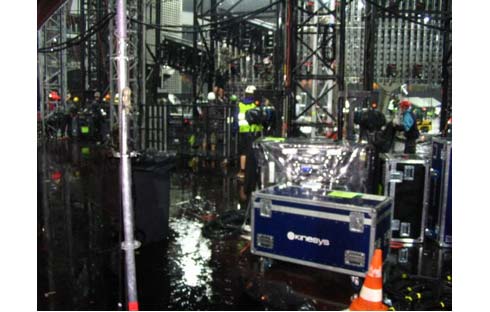
2007 was a complete tour through European rain; seven out of nine shows brought rain and some of them, like the ones in Bern, Hamburg and Chorzow, brought a lot of it. I've never experienced anything like it in all these years, we were literally washed off the stage by the unusually heavy rain.
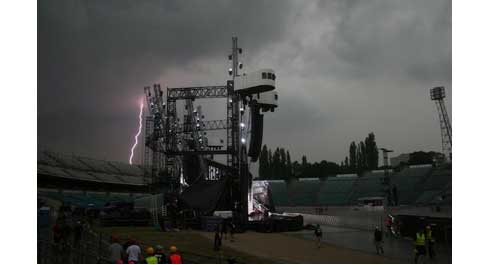
Chorzow was probably the worst show of the tour for the crew. In addition to the rain, a thunderstorm kept them on their toes. We weren't allowed on stage for about two hours in total – for safety reasons. There's nothing you can do about weather like that, so it will keep us on our toes to make sure all the equipment is in good shape for the next show.
The 'Turn it on again' tour will not only feature Vari*Lites, but also a whole host of new developments such as the new spotlights from ZAP, Robe and Coemar. According to Livingstone, the most interesting are the ZAP BigLites and Little BigLites; the new 3.5 and 4.5 xenon spotlights with colour changers are very powerful, fast and highly bred; they weigh up to 150kg and draw 130 amps each.
These important spotlights are the eyes in the sky and play an important role in the design. They are installed on Kinesys Automation Systems gondolas that move up and down the towers at high speed. The towers (ribs) are fitted with Coemar and Robe luminaires; the effects are installed on gondolas travelling up the towers for the first time at Home By The Sea.
'On this tour, the three teams use around 500 spotlights,' says Livingstone, 'which keeps us pretty busy' in this rainy year. It's hard to believe, but we don't have a roof like a normal stage. On every rainy concert night, we have two or three spotlights that don't work because they're too wet. A lot of people probably wonder what we do if a spotlight fails. We have to repair them on the day of the show. We can't replace them during the show itself for safety reasons.
Many fans also ask whether this Genesis show is bigger than the Pink Floyd production from 1994. 'You can't compare the two,' says Livingstone, "Floyd had a completely different stage with an arched roof at the back that covered almost three quarters of the equipment; they also used normal projections that require a black-covered stage, whereas this stage here is open with new video and lighting techniques.
All our equipment, scaffolding, sound systems, lights and video are exposed to the elements. Because it's light for a long time on summer evenings, the spotlights play a completely different role in conjunction with the video; the design is completely different."
Another company is in charge of the large screen wall, says Livingstone; XLVideo is supplying the 15089 Barco O-Lite panels via Blink TV for the 13 metre high and 55 metre wide rear wall, which is surrounded by seven light towers that rise up to 28.8 metres high and together resemble a snail shell. I think that's a world record in video land. XL also use two high-resolution Mitsubishi 16:8 screens on the left and right.
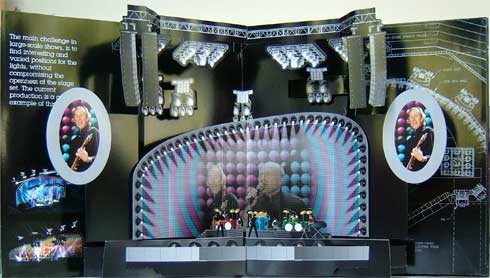
People also often ask what Genesis will be doing in North America, where they will be playing mainly in halls that cannot accommodate a stage of this size. Livingstone explains: "The current stage set-up that we used in Europe will be used for the stadium concerts in North America; a modified design will be used for the indoor shows. Most of the spotlights are then suspended from the hall ceiling. This results in only minimal changes to the live show. First and foremost, the video and spotlights have to be carefully adapted to the specifications and restrictions for arenas."
Shortly before the show – and after our conversation in Munich – there was rain, but it stopped before the concert and it stayed dry. Everything will be fine…or: Turn The Tap Off…
Author: Christian Gerhardts / Livingstone
Photos: Livingstone