

- Article
- Read in 8 minutes
Genesis & solo – It's Only Knock And Knowall – CD-Booklet
In this online version of the booklet for Genesis & Solo – It's Only Knock And Knowall, we have compiled all the text content for you.
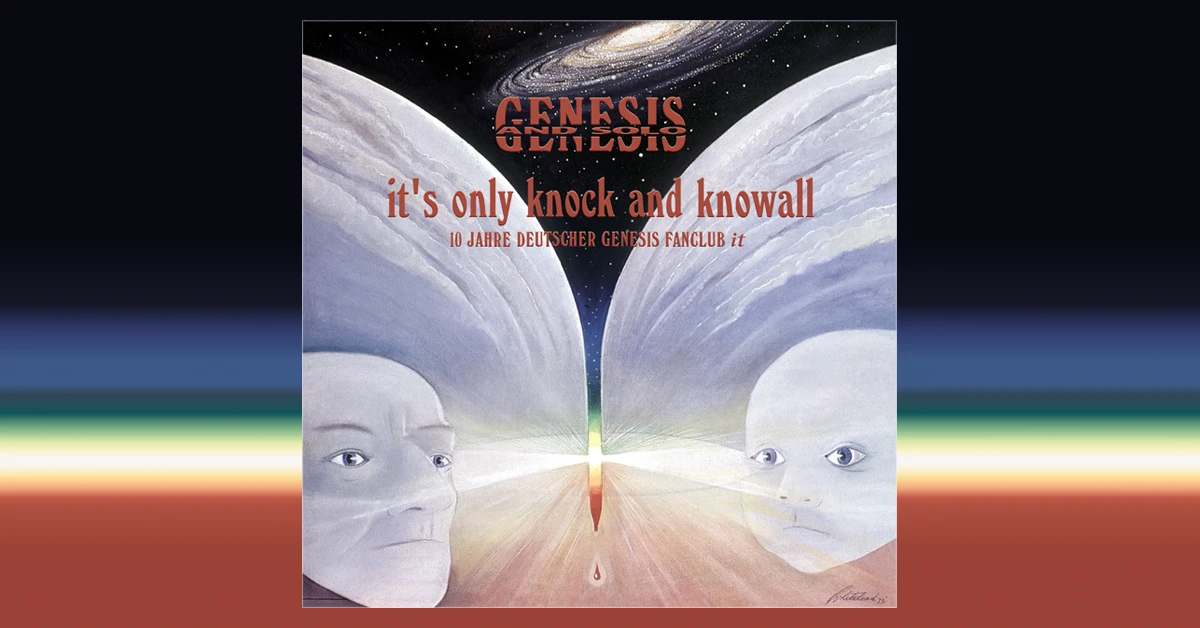
All About it
The history of Genesis fan clubs in Germany began over 20 years ago – but perhaps even earlier. The first major club was probably the Genesis Club Germany in the late 1970s. It was followed in the early 1980s by the Famous Genesis & Gabriel Club Germany and then Der Genesis Fan, which existed until 1993.
In November 1991, Helmut Janisch and Peter Schütz founded Invisible Touch (in spring 1994 it). In December 1991, the first issue of the club magazine was published and Bernd Zindler completed the editorial team, which has remained unchanged to this day.
Through classified ads in music magazines and flyer campaigns at concerts, particularly those of Genesis in 1992 and Peter Gabriel in 1993, the club attracted many members in Germany, neighbouring German-speaking countries, and also in England, Italy and France, for example.
Contact with record companies and management steadily improved, enabling exclusive interviews with various band members and artists associated with Genesis. These were published alongside a wide variety of articles about Genesis in the club magazine, which initially appeared quarterly and later twice a year. It developed from a relatively primitive, photocopied booklet into an almost professional magazine, which was discontinued with issue #27. Since 2000, the club has been publishing all current articles and news exclusively online via the website www.genesis-fanclub.de.
Since 1993, the club has organised annual meetings for its members, which offer plenty of opportunity for entertainment and information exchange, but also feature numerous rarities on display and a Genesis-specific collectors' market. In 1996 and 2001, it organised an international event dedicated to a specific Genesis album and the accompanying tour, at which unreleased video material was shown and the exhibition focused on this era.
The aim of the club was and is not only to report on the various facets of the band Genesis, both past and present, but also on the numerous solo projects of the band members and whoever or whatever was and is connected with them. The picture that emerges reveals a broad spectrum. In addition to pop and rock, you will also find jazz, world music, classical music and more in the orbit of Genesis, providing the right music for almost every mood.
Selecting the tracks for this CD was very difficult. It was not intended to be a hits album, like some previous compilations, but rather to offer a good cross-section of the different Genesis eras and the most important solo projects. Ultimately, it became a compilation of the personal favourites of the it editorial team, but it is sure to appeal to many other fans as well.
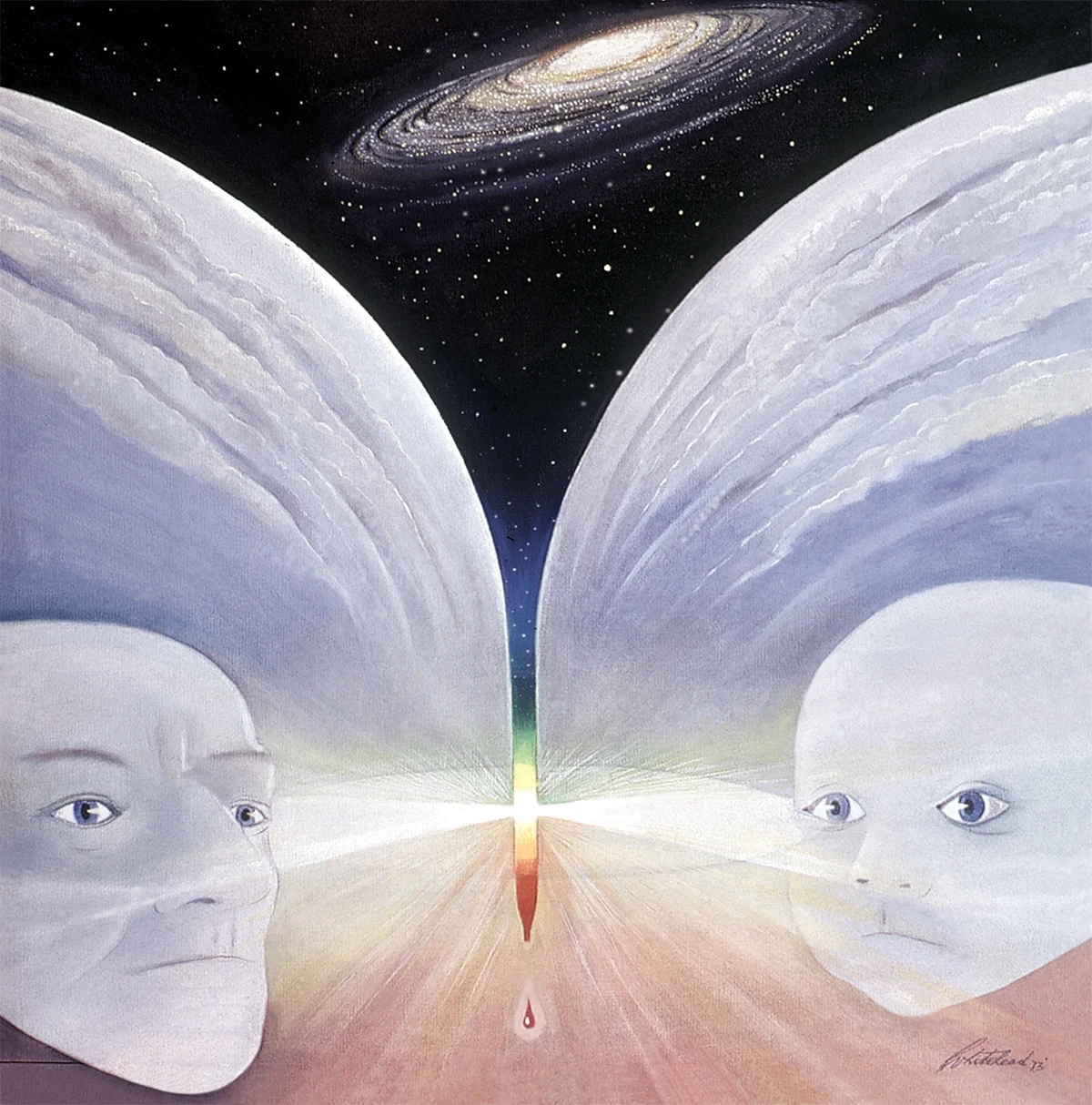
Paul Whitehead
Inner Space is White, Outer Space is Black, and Life is the Rainbow in Between
"The original painting is called Inner Space is White, Outer Space is Black and Life is the Rainbow in Between. It was the result of me taking a lot of LSD in the 1960s and exploring my inner universe. When I suggested it to Genesis for the inside cover of Foxtrot, they loved it, but it was clear that it was the wrong format. So I decided to repaint it using airbrush – similar to what I had done for Van Der Graaf Generator – and place all the lyrics on the sky.
We thought the old man and the baby were too reminiscent of 2001: A Space Odyssey. We also wanted the motif to serve as a backdrop for the lyrics rather than being too specific and distracting from the front cover. When it came out, I received many letters from fans asking me what it was all about. Of course, I told them."
Paul Whitehead, September 2001
www.paulwhitehead.com

Genesis – Can-Utility And The Coastliners
… comes from the 1972 album Foxtrot and represents the Gabriel era of Genesis, and in particular the Banks/Collins/Gabriel/Hackett/Rutherford line-up, which was very popular with 'old' fans and existed from 1971 to 1975. The song was only played live by Genesis before its release on Foxtrot, at that time still under the title Bye Bye Johnny. Both the imaginative lyrics and the mood changes in the music are a good example of this era of the band.
Steve Hackett – Spectral Mornings
… is a true classic by Steve Hackett from his early creative period in the late 1970s. It comes from the LP of the same name released in 1979, his third solo album overall and the second after his departure from Genesis in 1977. Hackett's incomparable playing style characterises this track, which, incidentally, was not originally intended to be an instrumental.
Strictly Inc. – The Serpent Said
… was written in 1995 for Tony Banks' fifth solo album (excluding soundtrack work), which was not released under his own name, but under the band pseudonym Strictly Inc. Behind this were Banks and ex-Wang Chung frontman Jack Hues as singer, co-writer (on two tracks) and guitarist on the album. The song is certainly not necessarily representative of Tony Banks' solo work, but it is nevertheless good proof of his abilities outside of Genesis.
Genesis – Domino
… was written during Genesis' most commercially successful phase between the mid-1980s and early 1990s. For example, five other tracks from the 1986 album Invisible Touch – from which Domino originates – were released as singles and became hits, some of them even huge hits. Due to its length of almost eleven minutes, this was not possible with Domino, but the track became an absolute classic at the band's live concerts during the following tours. It also represents a kind of tradition at Genesis, according to which at least one 'extra-long' track was included on every new studio album from 1980 onwards.
Peter Gabriel – Schnappschuss (ein Familienfoto)
… is one of 18 songs that Peter Gabriel recorded in German between 1980 and 1982 as an alternative to the English-language original. Schnappschuss is the German version of Family Snapshot and comes from Peter Gabriel's first German album from 1980. Of course, this song cannot and should not be considered representative of Gabriel's solo career. But the it editorial team thought that a song sung by Gabriel in German would be a good addition to a CD released by the German fan club, especially since it is no worse than the original.
Genesis – There Must Be Some Other Way
… was recorded in 1997 for Calling All Stations, the first album after Phil Collins left the band. The new singer and front man Ray Wilson gave the 'traditional company' Genesis a new touch, even though he was only involved in the creation of a few songs, such as this one. However, many fans had perhaps become too accustomed to the two previous singers to really give a 'newcomer' a chance. The album flopped in America and a US tour that had already been scheduled was cancelled. But even in their home country and on the European mainland, Genesis were unable to match their earlier successes, and so it remained a good album and some very interesting concerts in Europe.
Genesis – Entangled
… represents Genesis' new beginning after Peter Gabriel's departure. The album A Trick Of The Tail, from which the song originates, surprised fans and critics in 1976, who could not imagine a future for the band without Gabriel as the singer and central figure of their stage shows. They were wrong, because with Phil Collins on the mic, 1976 marked the beginning of Genesis' phenomenal success, which began shortly afterwards. The lyrics and music here are still reminiscent of the era that had just ended, but Collins as lead singer gives the song the mood that would characterise Genesis for many years to come.
Anthony Phillips – Pullings Faces
… from the 1978 album Wise After The Event, Phillips' second solo album, is another personal favourite of the it editorial team – no more and no less. It is difficult to choose a piece by Anthony Phillips that does justice to his stylistic spectrum. He has released nearly thirty albums since 1977 – more than any other member of the Genesis family. The majority of his output has been of a high artistic standard. In this respect, he has been unjustly overshadowed by his (in commercial terms) much more successful former bandmates.
Phil Collins – Do You Know, Do You Care?
… ended up on this CD because it was neither a hit nor part of Collins' live repertoire. Many of his other songs are simply too well known, so it wouldn't have made much sense to use one of them here as well. Regardless, Do You Know, Do You Care? (from his 1982 album Hello, I Must Be Going!) is perhaps not a typical Collins solo song, but it is nonetheless interesting.
Mike Rutherford – Compression
… is a previously unreleased track recorded for Rutherford's first solo album, Smallcreep's Day, in 1980. It was the B-side of the Working In Line 7" single, which was released in the UK, Holland and Spain. Interestingly, the final part of the song is based on a piece that Genesis apparently rehearsed in the early 1970s and was possibly intended for the Selling England By The Pound LP. Although it would be more fitting for Mike Rutherford's solo work to date if a song by the Mechanics were included on this CD, Compression was chosen because of its rarity.
Genesis – it
… is the song after which the club was named. The original version was the closing number on both the 1974 album The Lamb Lies Down On Broadway and the concerts of the subsequent tour, which ended in May 1975 with Peter Gabriel's departure from Genesis. However, this version is taken from the first Genesis box set, Archive Vol. 1 1967-75, released in 1998. It is a mix of the instrumental tracks from the 1974 studio recording, trimmed to a 'live version', together with a vocal track by Peter Gabriel, presumably re-recorded in 1996. This trick was necessary because the song was missing from the original tapes of the Lamb show on 24 January 1975 in Los Angeles, which were used for Genesis Archive Vol. 1.
Greetings
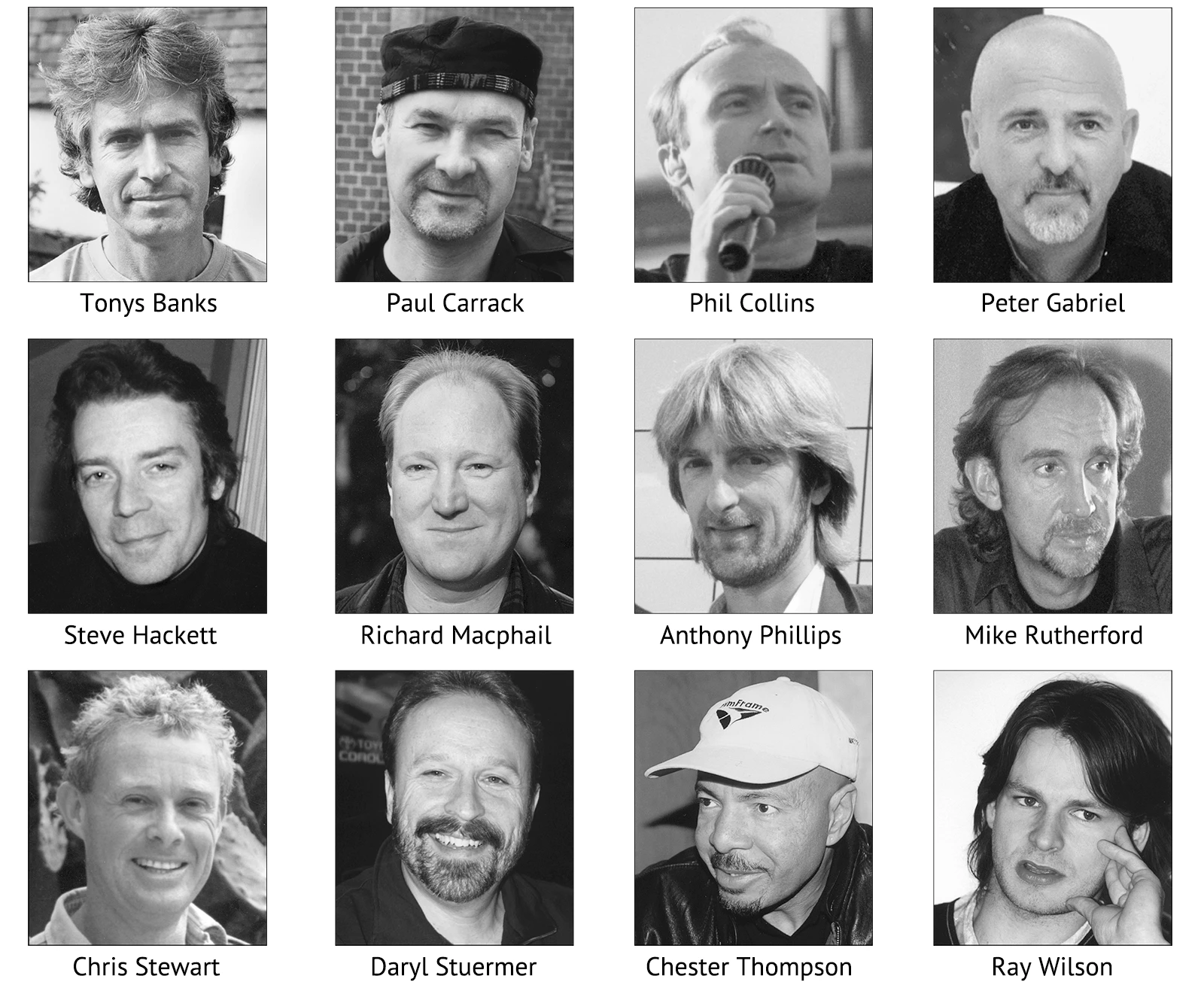
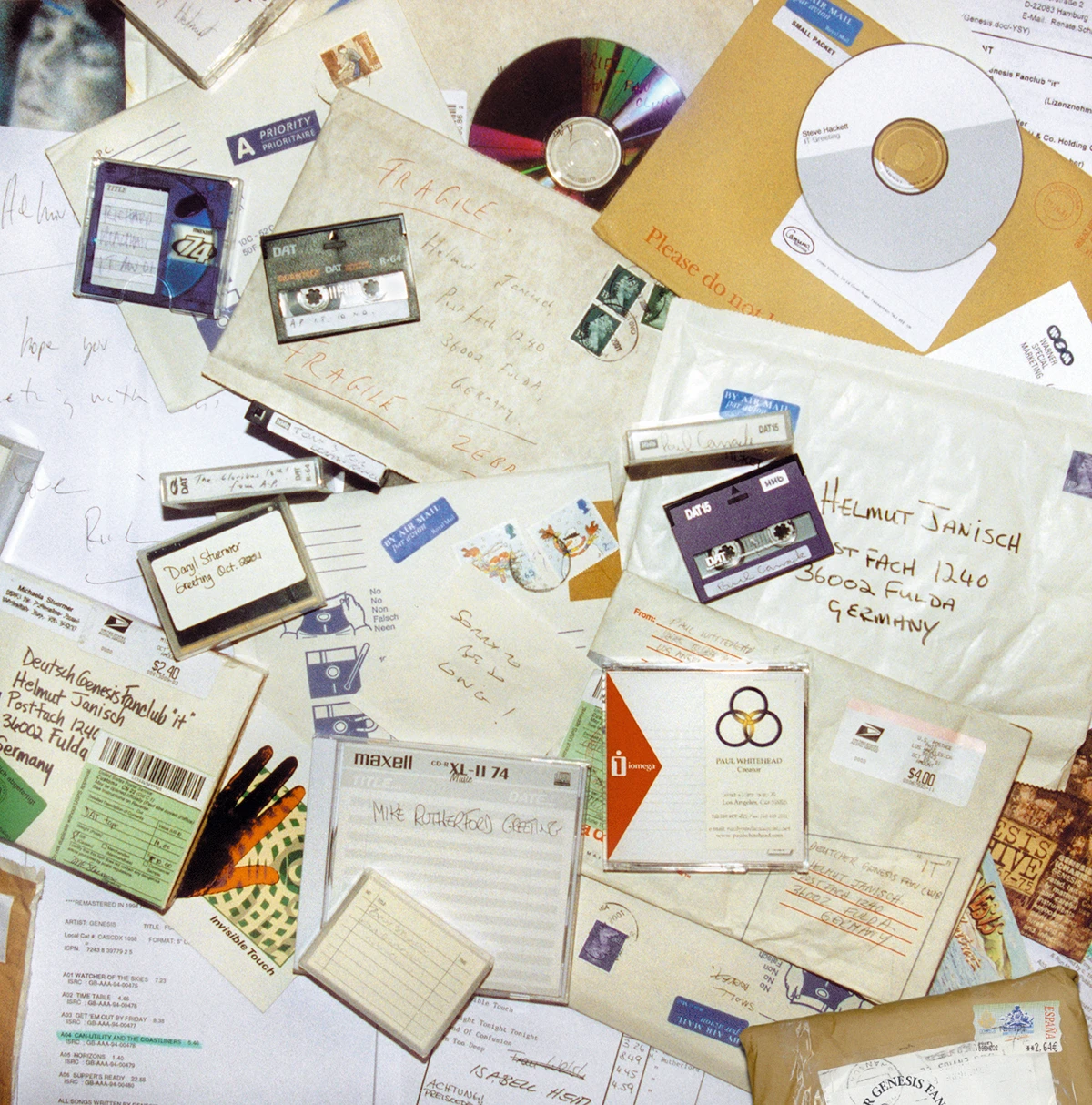
The release of this CD would not have been possible without the support of many club members. We would like to express our special thanks to:
Matthias Baumgärtel, Carsten Bossler, Uwe Brehmer, Urs Buess, Harald Dreyer, Oliver Figur, Matthias Flottron, Manfred Fricke, Jürgen Fröhlich, Rainer Fröhlich, André Garnath, Michael Geertz, Steffen Gerlach, Patrick Guldimann, Michael Jahn, Thomas Jesse, Thomas Kempcke, Gunnar Kiesewalter, Peter Klingspohn, Stefan Kohler, Michael Kreier, Andreas Lauer, Andreas Lemke, Mario Lippuner, Martin Metzler, Thomas Niebler, Anneliese Proisl, Meik Rottmann, Frank Rübel, Rouven Schad, Janine Scheckenbach, Michael Schreiber, Volker Warncke, Horst Wiesch, Stefan Woch, Karin Woywod and Heike Wurzel …
… but also to the more than 1,000 other fans of Genesis & Co. who have become members of the German Genesis Fan Club it over the last ten years and thus supported our work.
Even without official help, we would not have been able to produce the fan club album in this form. Many thanks therefore to Carol Willis-Impey, Tony Smith, Christina Roski, Renate Schreiber and everyone else at Hit & Run, Virgin and Warner, whom we probably annoyed more than once with our enquiries over the last few months.
We would like to thank Messrs Banks, Carrack, Collins, Gabriel, Hackett, Macphail, Phillips, Rutherford, Stewart, Stuermer, Thompson and Wilson for their kind greetings to the fan community and the it editorial team.
Special thanks go to Volker Sassenberg, who made his studio available to us and contributed significantly to the success of this album with his expertise and professional advice.
•••
Front cover illustration: Paul Whitehead
Album design: Helmut Janisch
Photos: Helmut Janisch, Peter Schütz, Chris Stewart and Mario Giammetti
Compilation: Volker Sassenberg, Helmut Janisch, Peter Schütz and Bernd Zindler
Mastered at Finian's Rainbow by Volker Sassenberg