

- Article
- Read in 16 minutes
Genesis – The Foxtrot release date mystery (solved!)
Genesis and the Foxtrot release date mystery – find out more about our research results on the Foxtrot release date here.
*** this article was first published in October 2022 and updated in August 2024 ***
In October 2022, we published the first part of our research on the release dates of Genesis albums. At that time, we focused on Foxtrot. In August 2023, Mark Bell's book about Foxtrot was published in German language. In it, he contradicts our finding that the album was released on 15 September 1972 and comes to a different conclusion. We took this as an opportunity to conduct intensive research once again and completely revise our article.
Introduction
For many, it's simple – the album Foxtrot was released on 6 October 1972. That's what it said on Wikipedia for a long time, and many other publications still say the same thing. Even Genesis themselves use this date, for example in the booklet for R-Kive. But the truth is: the album was NOT released on 6 October, but, in our opinion, on 15 September 1972. We will now explain why this is the case.
First of all: Why do we* invest so much time in researching release dates (or concert dates)? The answer is simple: We want to present the history of GENESIS as accurately as possible. Accordingly, we are always looking for clear evidence of such dates. Most of the time, this works very well – for example, through promotional campaigns, magazine advertisements, etc. This usually provides good evidence of a release date. Sometimes, however, the decisive clue is missing and a date remains unclear at first. We can then only narrow it down on the basis of circumstantial evidence.
In the case of Foxtrot, many people cite the chart position as the only evidence. This took place on 14 October 1972. So 6 October (a Friday, as was customary at the time) must be correct, right? No… not at all!
Historical context
The story begins with the fact that writing the new songs for Foxtrot and the subsequent recordings did not fit into the usual pattern (tour – recording – tour, etc.). Since the release of Nursery Cryme in November 1971, the band had been on tour continuously. This meant that the new songs were written between individual concerts. Two new songs (Can-Utility And The Coastliners and Watcher Of The Skies) were only written during the Italian tour in April 1972. These were then integrated into the live set and further developed on stage.
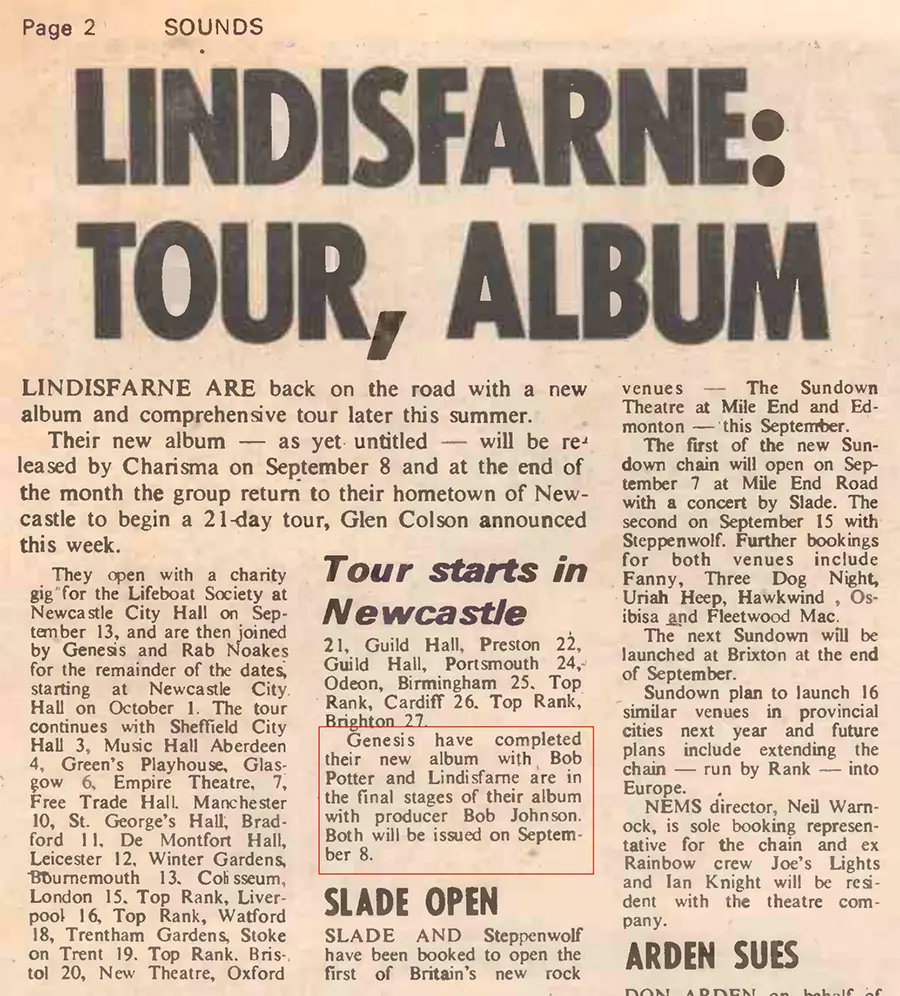
We first read about a new Genesis album in Sounds magazine on 22 July 1972. It announces a new Lindisfarne album (Dingly Dell) for 8 September and a 21-day tour by Lindisfarne. This information comes from Glen Colson, Tony Stratton-Smith's assistant at Charisma. At the same time, it is announced that Genesis and Rab Noakes will accompany Lindisfarne for the remaining tour dates from 1 October.
At the end of the article, it reads: 'Genesis have completed their new album with Bob Potter, and Lindisfarne are in the final stages of their album with producer Bob Johnson. Both will be released on 8 September.'
These last two sentences contain a lot of important information. Firstly, that it was planned from the outset that both Lindisfarne and Genesis albums would be released together, followed by a joint tour. Secondly, that Genesis was already working with Bob Potter on Foxtrot at that point, albeit only briefly. However, the statement that the album was already finished cannot be true.
The role of John Burns
At this point, it is worth briefly mentioning the producers at Foxtrot. The band does not want to continue working with John Anthony. He most recently produced Nursery Cryme and the single Happy The Man. Bob Potter, who has just recorded Dingly Dell with Lindisfarne in only three days, from 14 to 16 July, comes in handy. The record company liked this speedy approach, and so Potter became the new producer. However, from the outset, the chemistry between some of the band members and Potter was not right. He only got on well with Hackett. As a result, Horizons was the only track on the subsequent album produced by Bob Potter. After that, they went their separate ways again and John Burns took over the job and completed the album.
Steve Hackett recalls this period in an email: 'I'm not sure about the timing, but I remember that Bob Potter didn't get on with some of the band's working methods. Bob was inexperienced as a producer, but he and I recorded Horizons together, for which I am grateful.' Part of the acoustic work at the beginning of Supper's Ready was recorded with Bob Potter, and when John Burns and David Hitchcock took over the project, John Burns said, 'I don't have a bad feeling about it. To me, it sounds good.'
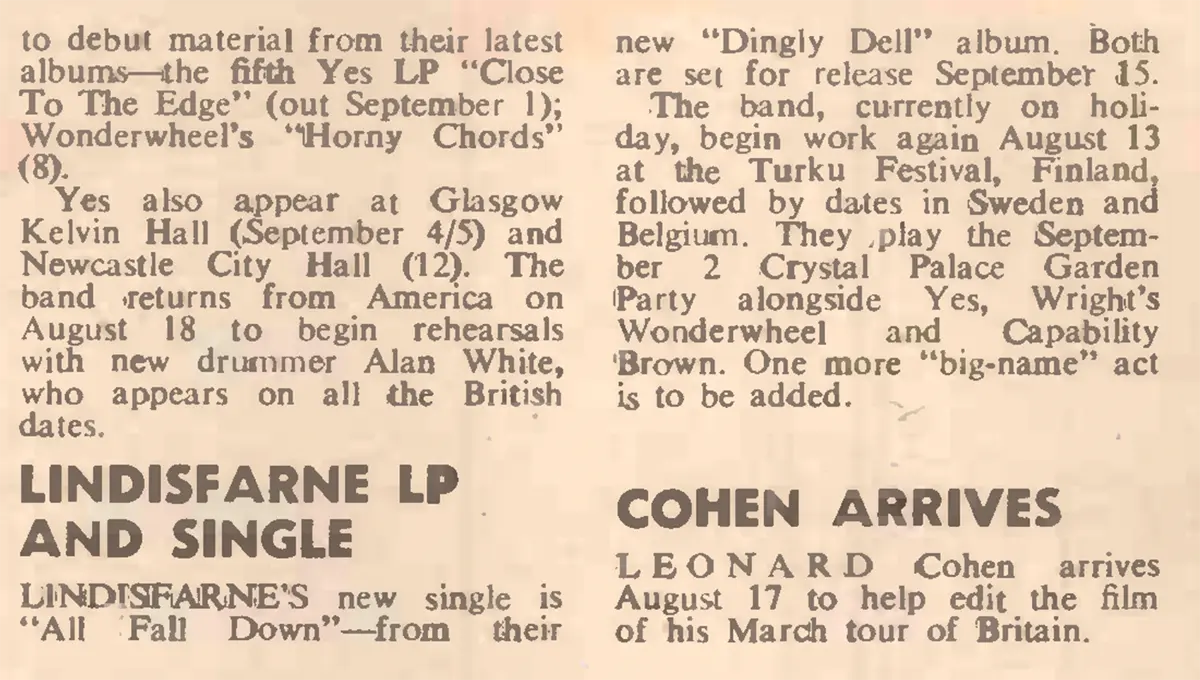
In August, there is no further news about the new Genesis album. However, Dingly Dell by label mates Lindisfarne is now announced in Disc magazine for Friday, 15 September. The same information appears in Record Mirror on 5 August, which states that Dingly Dell will be released just two weeks before the group embarks on a nationwide tour, starting at Newcastle City Hall on 30 September.
But what was happening at Genesis? At the beginning of July, recording for Foxtrot had presumably not yet begun. The band continued to play concerts and would have preferred to produce the new album themselves. But then Charisma hired Bob Potter. This must have been after 16 July, once work on the Lindisfarne album had been completed.
Concerts, Tony's wedding and recording sessions
If one believes the statement made by Sounds on 22 July, the recordings with Bob Potter may have begun between 17 and 20 July, as there were no gigs on those days. There were still a few concerts between 21 and 25 July. The following concerts scheduled for 27 July to 3 August were most likely postponed to a later date to allow time for the album recordings. However, we only know this for certain for the two shows in Worthing on 2 August and Hastings on 3 August.
On 29 July 1972, another significant event took place. Tony Banks married Margaret McBain in Farnham, in the presence of his bandmates and roadies. Tony also got a "honeymoon day" in Dartmoor, as Mike Rutherford recounts in his book The Living Years.
We assume that during the subsequent concert-free period, recording continued with new producer John Burns at Islands Studios. It was largely completed before Genesis performed at the Reading Festival (11 August), as the band travelled to Italy immediately afterwards for a short tour starting on 14 August 1972. The last concert took place on 24 August in Travagliato, and Steve Hackett flew back to England in a hurry the next day.
He writes the following in a recent email: "I flew back to the United Kingdom the next day. The others came back by car. So I had an extra day to record the overdubs for Supper's Ready, especially the multi-track parts at the end of the song. The album was pretty much finished, just not mixed yet. The reason for the delay in release was that we were on tour so much. I just quickly put the finishing touches on it, which didn't delay things."
Unfortunately, Steve cannot remember the exact date of release or when the recordings began at Island Studios.
After Hackett had completed his final recordings, the album was mixed at Apple Studios by John Burns. We cannot say exactly when this happened or how long the recordings actually took.
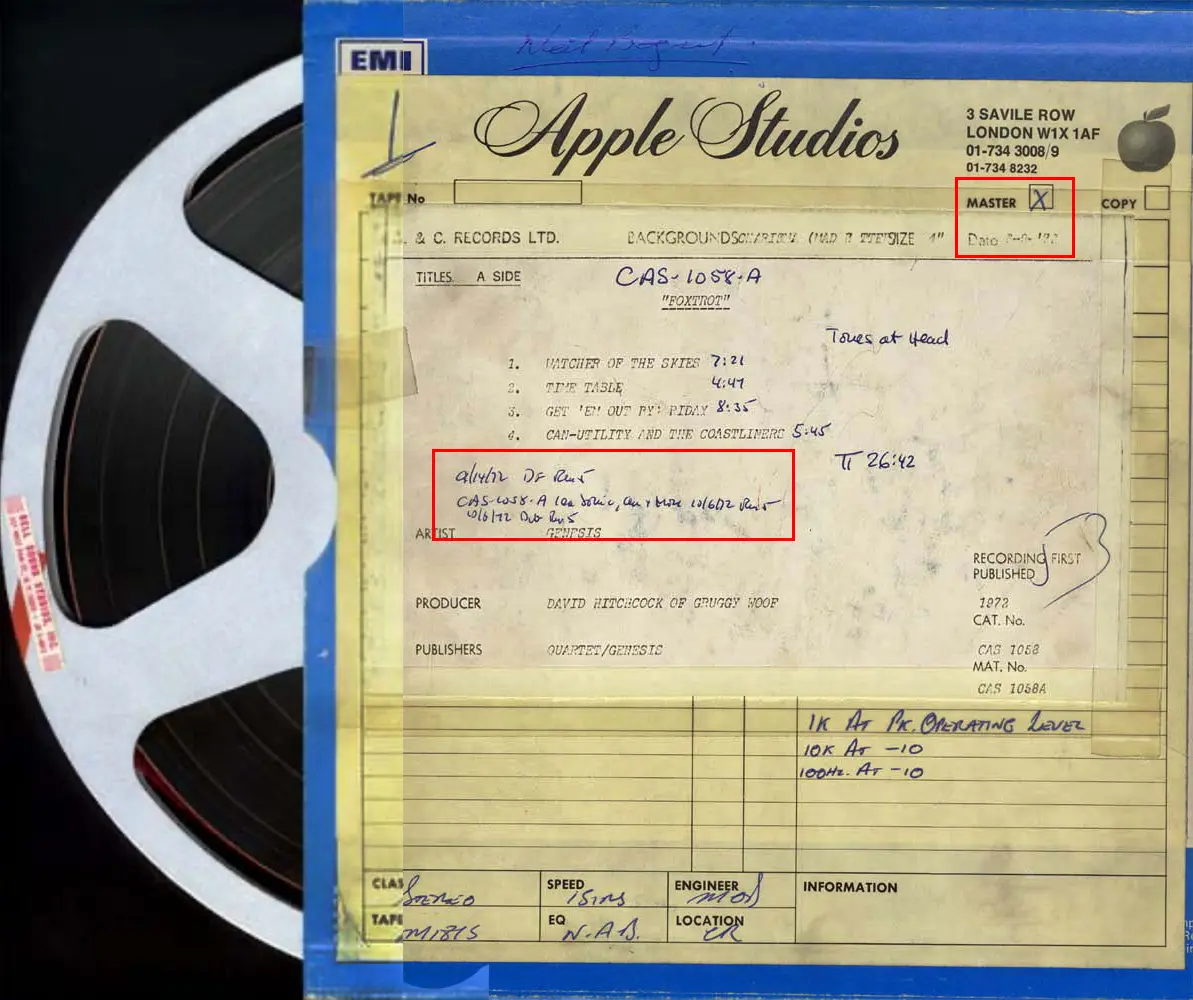
What is certain, however, is that the mix was finished by 8 September at the latest. This is because the master tape for the USA is marked "Date 8-9-'72". This most likely refers to the date 8 September 1972 (English spelling), which originates from Apple Studios in the UK. The tape was later used in the USA (Neil Bogart/Buddah Records) on 14 September and 6 October. Note the handwritten dates in American notation (9/14/72 and 10/6/72). [1]
One more word on the concept of analogue master tapes. After an album had been recorded and mixed on tape, the original studio master tape, also known as the first generation, was created. It was then copied as quickly as possible to create several backup copies. These copies are still referred to as masters, even though they are second generation. [2]
Searching for clues about the publication date based on the media
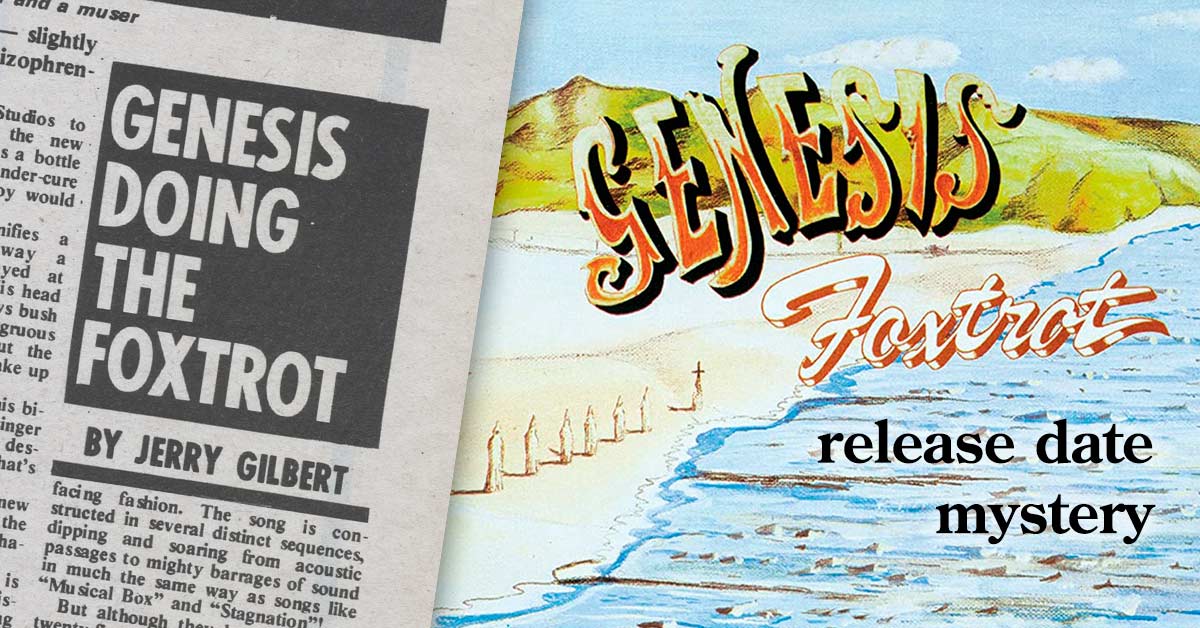
It all started with the 9 September issue of Sounds magazine, which featured an exclusive preview by Jerry Gilbert, a big fan and supporter of Genesis at the time, entitled 'Genesis Doing The Foxtrot'. This article was most likely written after listening to the finished mix.
Gilbert, deputy editor of Sounds magazine, found the new album simply sensational and described Genesis as one of the few top bands in Britain. He also discussed the album cover and the fox's head, which would later play an important role.
The first advertisements in British music magazines appeared on 16 September in New Musical Express and Sounds.
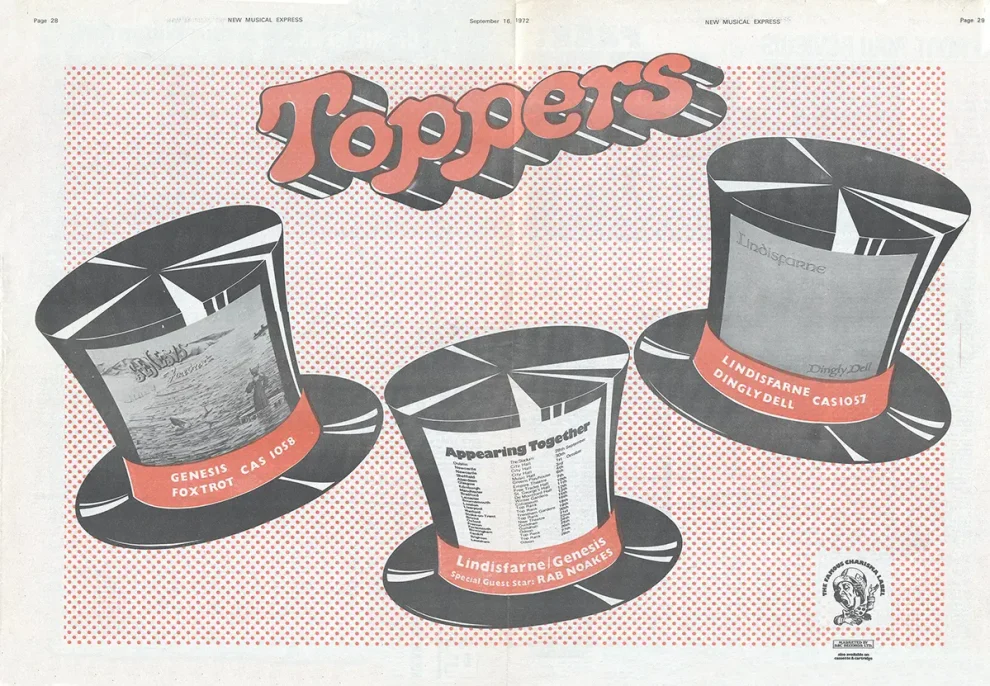
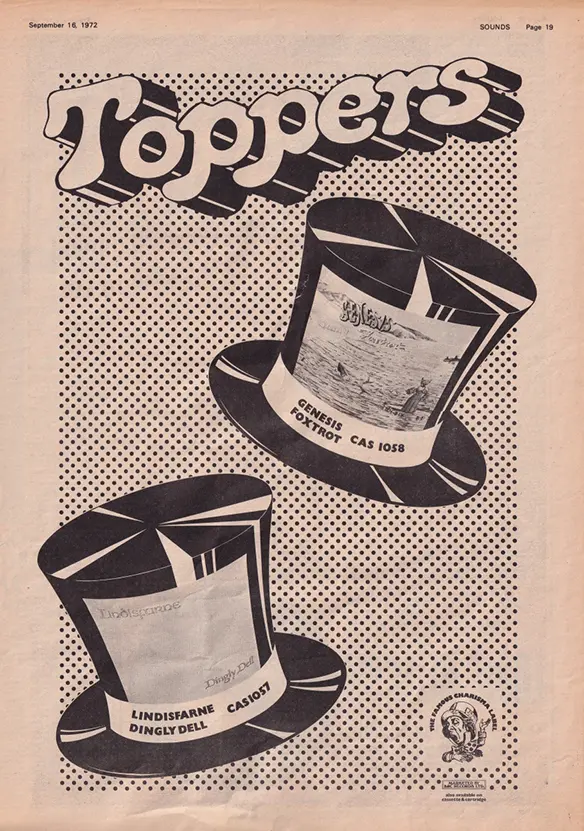
These two striking Toppers advertisements simultaneously promote the new albums by Lindisfarne and Genesis, which also suggests that both were released on the same day. The double-page advertisement also features a third cylinder with the Lindisfarne/Genesis tour dates. The headline reads 'Appearing together', which not only applies to the tour, but would also be a nice play on words for the albums.
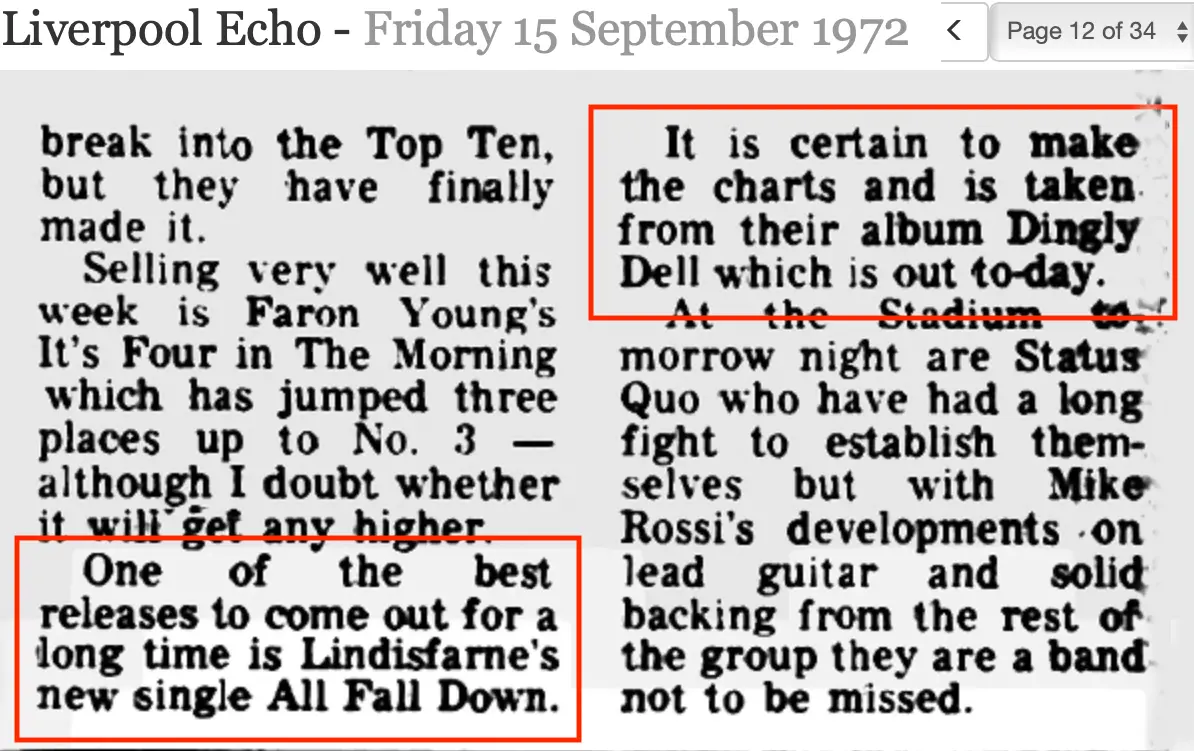
There is even evidence of the Lindisfarne album in the Liverpool Echo from 15 September 1972, where it is written 'Dingly Dell is out today'.
It is also important to note that Chrisma tried to promote their albums in a prominent position in the week before or immediately after their release, as seems to be the case here.
And a brief explanation about the British music magazine scene at the time: with normal delivery of weekly British music newspapers, these advertisements would appear in the Greater London area a few days before the possible publication date (i.e. in this case, 13 September), before being published throughout the United Kingdom on Thursday. Given the one-week delay in the planned release of Foxtrot, Charisma does indeed seem to have succeeded in promoting the album in the week of its release, although the absence of a specific date may be due more to the delay than to clever marketing on the part of the record company.
Interlude 1
At this point, we would like to briefly discuss the findings of Mark Bell, which he presents in his book Foxtrot . A comprehensive and highly readable book, as our author Martin Klinkhardt wrote in August 2023. Bell devotes just under six pages to the release of the album, arriving at 29 September.
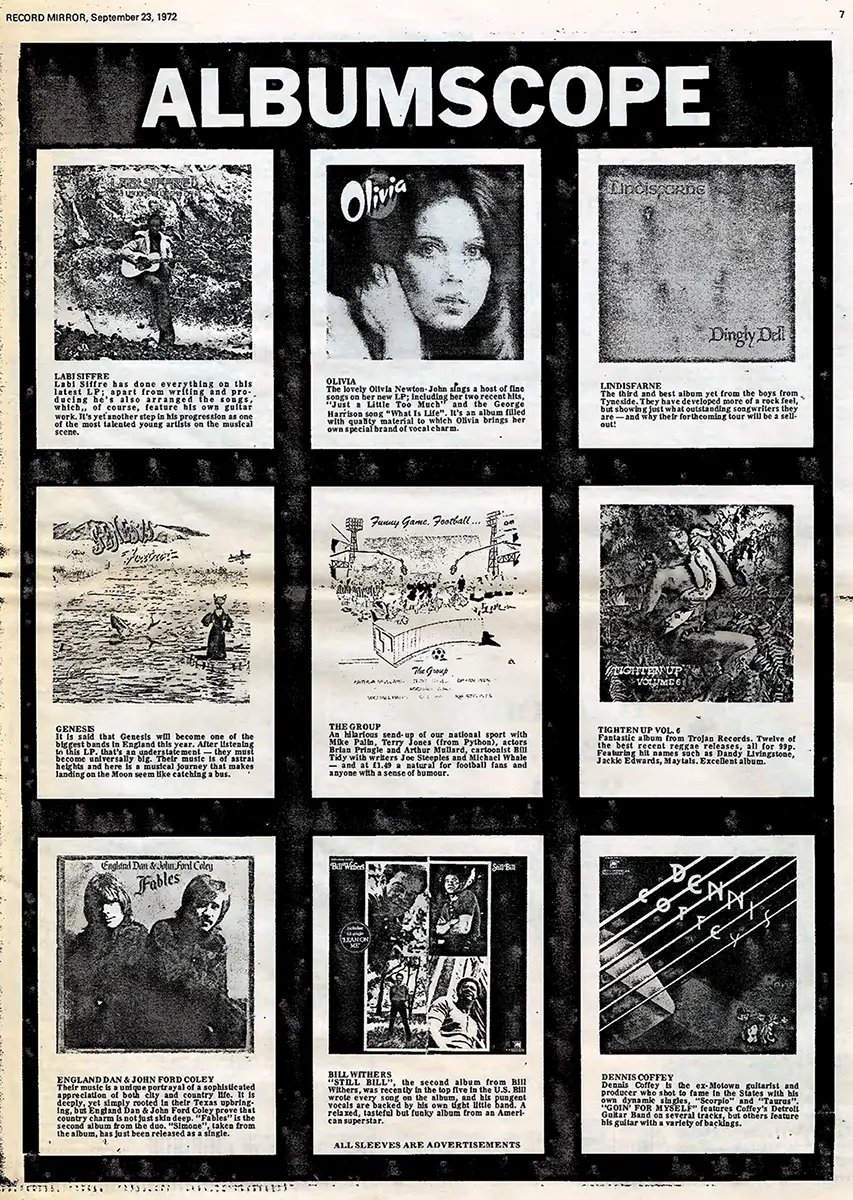
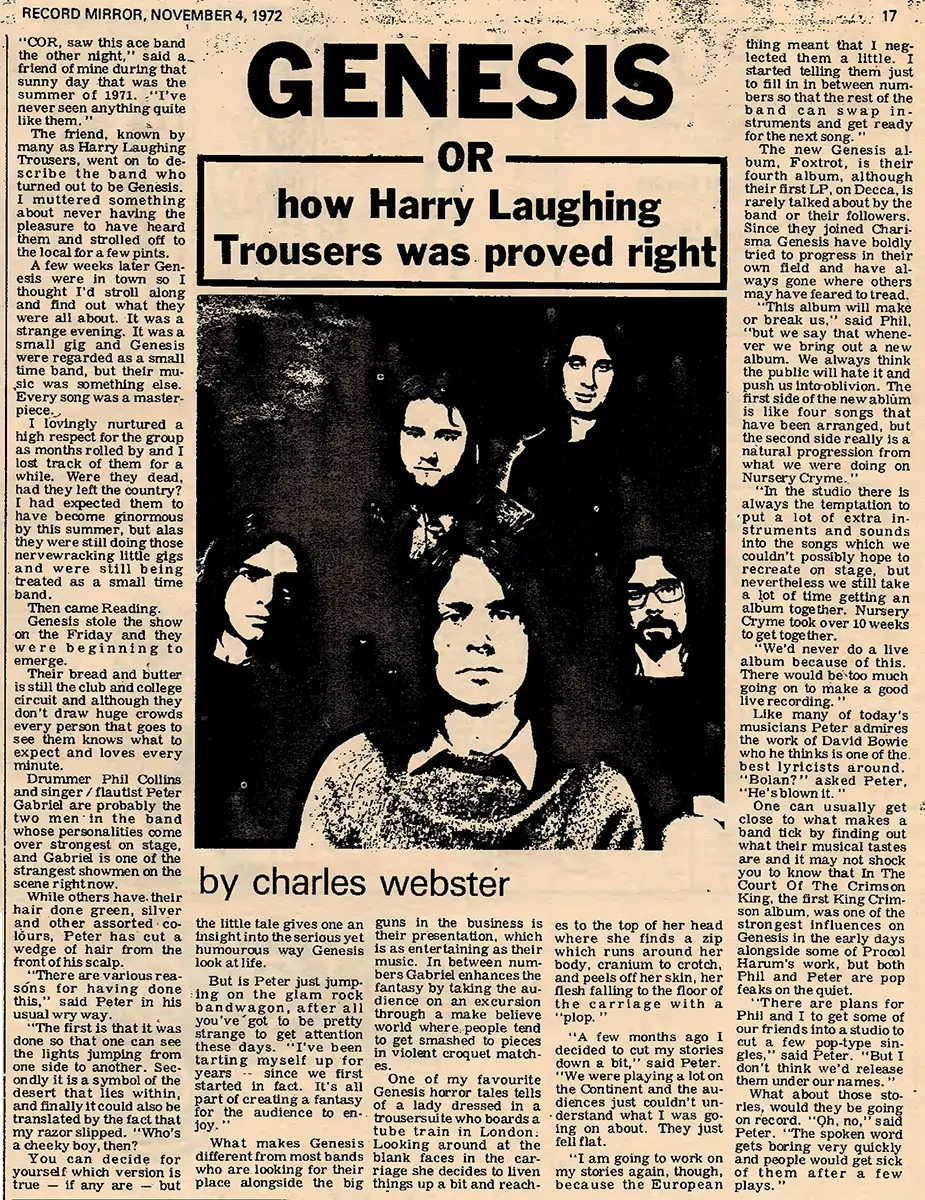
As his first piece of evidence against a release on 15 September, he cites a concert review by Charles Webster in the Record Mirror from 23 September 1972. In it, Webster discusses the concert on 17 September at the Greyhound in Croydon. Mark Bell is right, the new album is indeed not mentioned at all.
However, two short reviews of Foxtrot and Dingly Dell appeared in the same issue. For us, this is further evidence of a simultaneous release on 15 September 1972.
A major article by Charles Webster about Genesis and Foxtrot was not published in Record Mirror until 4 November.
Further advertisements and articles
Further advertisements and articles appeared subsequently. In our opinion, these contain further evidence that Foxtrot was already released on 15 September. First, there is another double-page advertisement, this time in Melody Maker on 23 September 1972. In the same issue of Melody Maker, the album is mentioned in the article 'The Band Who Want To Be Booed' by Chris Welch: 'The group recorded its first album with Jonathan King in 1966, but it bore little resemblance to the present-day Genesis, and so they like to call their latest album "Foxtrot" (Charisma), their third, although it's their fourth.' This was followed by album reviews in Melody Maker and Sounds (both dated 30 September 1972).
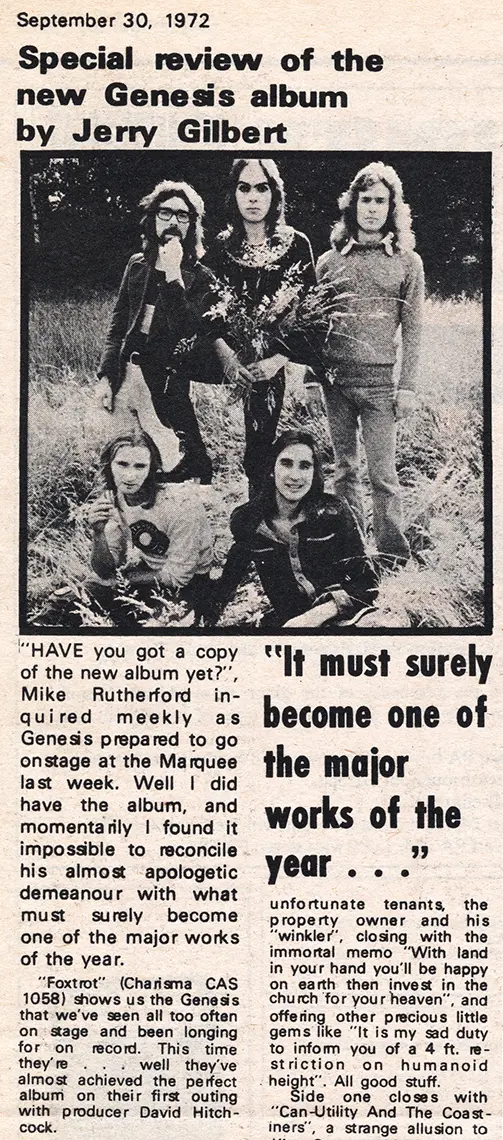
Particularly exciting is Jerry Gilbert's 'Special review of the new album' in Sounds. The article begins with the following sentences: "Have you got a copy of the new album yet? Mike Rutherford asked sheepishly as Genesis prepared to go on stage at the Marquee last week. Well, I had the album, and for a moment I found it impossible to reconcile his almost apologetic behaviour with what is sure to be one of the most important works of the year."
The gig at the Marquee Club took place on 19 September 1972. This means that Gilbert was in possession of the album on that day. We assume that this was no longer a pre-release version.
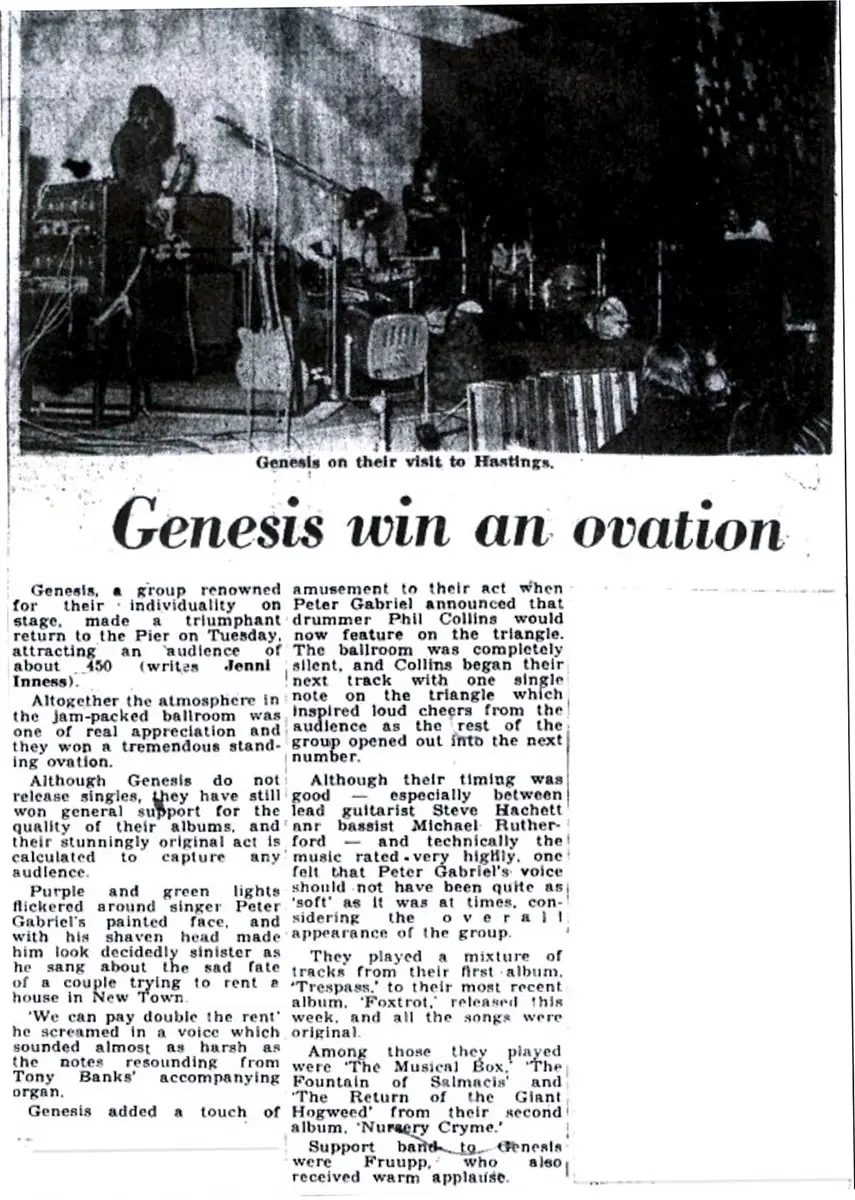
Another extremely important clue can be found in a concert review by Jenni Inness in the Hastings & St. Leonards Observer newspaper, which discussed Genesis' performance in Hastings on 12 September. The newspaper was published on Saturday, 16 September and mentions the new album Foxtrot with the addition 'released this week'. If it had already been released on 8 September, it would have had to say 'released last week'. And as a reminder, albums were always released on Fridays in England at that time.
Mic Smith, who, like us, prefers 15 September as the release date, had a very interesting chat in October 2022 on the Steve Hoffman Music Forum with a contemporary witness who corroborates our assumption that both albums were released on the same day: "Foxtrot and Dingly Dell were definitely released on the same day. I bought both of them as new releases at the time, but not on the day of release, because none of the record shops in my town had them in stock, so I had to go back the next day to get them.
I got Melody Maker and NME every week, so it must have come from there. And I saw the tour on 19 October at Trentham Gardens in Stoke, which was my first concert ever. So Genesis were literally the first band I saw live, the first band before Rab Noakes and then Lindisfarne. I'd had the album for a few weeks by then, and I'm sure it was released in September and not October, although I can't say for sure, except that it was definitely the same date as Dingly Dell."
Interlude 2
Was it possible that Foxtrot was released on 15 September? And what role did the first appearance of the fox head and red dress on 28 September in Dublin play?
The following key points are now known and documented. In the summer of 1972, the band wrote the new songs. Foxtrot was originally supposed to be released on 8 September, together with Dingly Dell by Lindisfarne. However, this did not work out because the band was constantly playing concerts and did not begin recording the album at Island Studios until mid-July/early August. On 8 September, the master tape for the United States was ready.
The release of the album on 15 September 1972 is very ambitious given this timeline. However, assuming that the album was mixed before 8 September, as evidenced by the master tape for the US, it should still have worked. It is conceivable that the final version for the UK was ready up to a week earlier.
We also assume that the cover had already been printed. And it can also be assumed that the very first pressing was only made in small quantities so that the release would only be delayed by one week compared to 8 September. This is also confirmed by the contemporary witness from the Steve Hoffman Music Forum. The album was not immediately available for purchase outside London.
Mark Bell, on the other hand, believes that the album was released on 29 September 1972, supported by a clever marketing strategy. In his book, he puts forward the following thesis: '… there is much to suggest that the appearance of the fox on stage and on the album was intended to coincide in order to generate maximum publicity for the album, which was released at the same time.' We agree with him insofar as the performance on the 28th in Dublin and even more so the one on 30 September in London at the Melody Maker Poll Award Concert caused quite a stir.
Die Idee stammte ursprünglich von Paul Conroy, der damals als Booking-Agent daran beteiligt war, einige der wichtigsten Namen des Prog der frühen 70er Jahre zu buchen und mit ihnen auf Tour zu gehen. Auf den legendären Italien-Tourneen von Genesis 1972 wurden er und die Band richtige Freunde. Conroy war eine Zeit lang für die Agentur (Terry King Associates, Anm. d. Red.) und die Plattenfirma mit ihnen unterwegs. „Und da sie nur zwei Roadies und einen Beleuchter hatten, half ich ihnen beim Aufbau und später bei der Suche nach Requisiten für Peter bei der Foxtrot-Tour."
It was also Conroy who suggested the fox-head mask to Gabriel. He wore this on stage for the first time in Dublin in 1972. It was intended to get Genesis on the front pages of the music press. 'The fox head came about during a conversation between me and Glen Colson, the press officer for Charisma,' says Conroy. "We talked to Peter and he was confused as to why Lindisfarne and VdGG were getting more press than they were. The conversation revolved around the fact that while their music was great, they needed to have more visual presence on stage. Peter went out and had the fox head made. The props department was opened and the front pages of the newspapers followed. From then on, I had to find lawnmowers and so on." [3]
This idea was then implemented by Peter Gabriel in his own way. He started appearing on stage at the end of the instrumental part of Musical Box wearing his wife's red dress and the aforementioned fox head. This not only attracted considerable attention from the audience, but also surprised his bandmates.
We also asked Steve Hackett again about the marketing strategy. His answer is clear: 'The concert was in a boxing stadium in Dublin. It was a highly effective move by Peter as we then started to get pictures on the front of magazines which helped the band's profile enormously.'
Charisma then actually used a photo of this moment for another album advertisement in Melody Maker on 14 October, which probably led to the legend that this photo ended up on the cover 'a week later'. However, this did not happen until 13 January 1973.
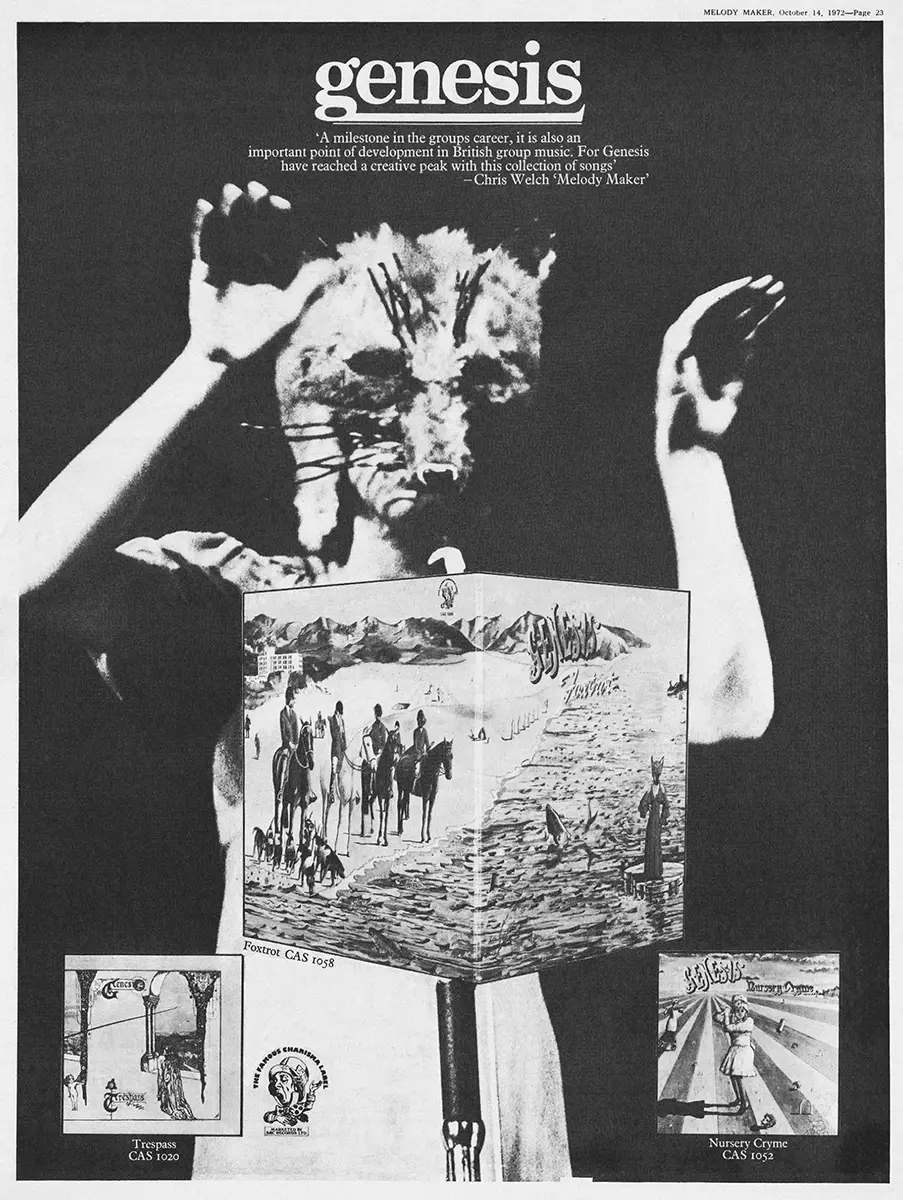
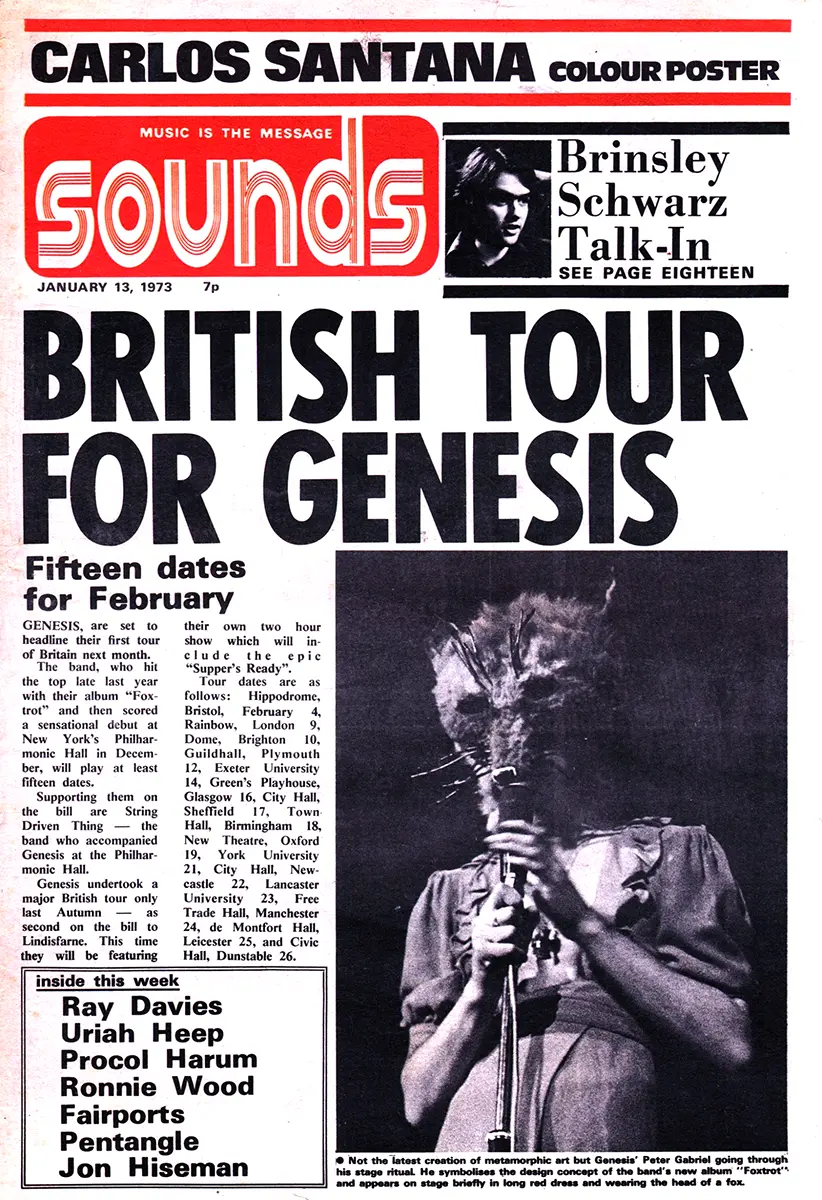
We consider the notion that this was a clever, strategically planned marketing move by Charisma to be refuted. Only Conroy, Glen Colson and Gabriel were aware of this idea, and the record company itself was not involved.
Chart entry
Finally, we want to take a look at Foxtrot's entry into the charts, but we're also very interested in Dingly Dell.
What are the Official Charts? The following can be read on the website, among other things.
The Official Charts are Britain's only official, reliable weekly measure of what's popular in music right now – as heard on BBC Radio 1 – and we've been a central part of British pop culture for over 70 years. During the chart week, sales and streams are counted from 00:00 on Friday morning to 23:59 on Thursday evening (this never stops, not even at Christmas). Every day, we count sales and streams from 8,000 sources. We then compile them every Friday for the Official Charts. Those are presented by BBC Radio 1 and published on OfficialCharts.com. [4]
The Genesis album first entered the Official UK Albums Chart at number 12 on 14 October 1972. By the following chart week, the album had slipped to number 29. It remained in the charts for a total of seven weeks. Dingly Dell, on the other hand, was first listed in the charts on 30 September.
But how can we explain the fact that Foxtrot only entered the charts after four weeks? Dingly Dell managed it after just two weeks, even though both albums were released on the same day.
Basically, this is quite easy to explain. Both albums were first mentioned in Sounds on 22 July and then released together on 15 September. On 16 September, they were advertised in the same two double-page spreads in New Musical Express and Sounds.
In the case of Genesis, however, it was obviously only the die-hard fans of the group who bought the new album immediately. It can be assumed that the album was not pressed in very large quantities right away. Instead, it was repeatedly repressed due to increasing demand. It was only the performances with fox masks and red dresses on 28 and 30 September in Dublin and London that aroused the interest of new fans. This, together with Jerry Gilbert's album review on 30 September, generated enough sales for the album to enter the charts two weeks later on 14 October.
With Lindisfarne, it was completely different. At the time, the band was a popular top act with a large fan base. Accordingly, sales of the album were good from its release on 15 September. As expected, it entered the charts after 14 days on 30 September, at number 5.
Conclusion
After evaluating all the available evidence and documentation, it is clear to us that Foxtrot was definitely not released on 6 October. Foxtrot was released in the United Kingdom on 15 September 1972! And it was released together with Dingly Dell by Lindisfarne.
Incidentally, Foxtrot was released later in Germany – according to the information currently available to us, on 27 October 1972.
* We – that means a core group of motivated fans and researchers. In this specific case, Mic Smith, Phil Morris, Peter Schütz, Christian Gerhardts and Alexander Sturm worked on the question. And of course there are further helping hands who repeatedly provide important input.
Mic Smith's essay on Genesis release dates is available at Genesis Movement. The Foxtrot information will also be added there with the next update).
Author: Peter Schütz
Editors: Alexander Sturm / Christian Gerhardts / Helmut Janisch
If anyone has any questions or additions to our article, please contact Christian. This applies in particular to questions regarding the German release date.
[1] Image and explanations of the Mastertape Foxtrot USA, courtesy of Adam Gottlob (https://genesismuseum.com).
[2] Reel To Reel Rambler
[3] Louder article
[4] https://www.officialcharts.com/about/