

- Article
- Read in 26 minutes
Interview with Mario Giammetti (DUSK)
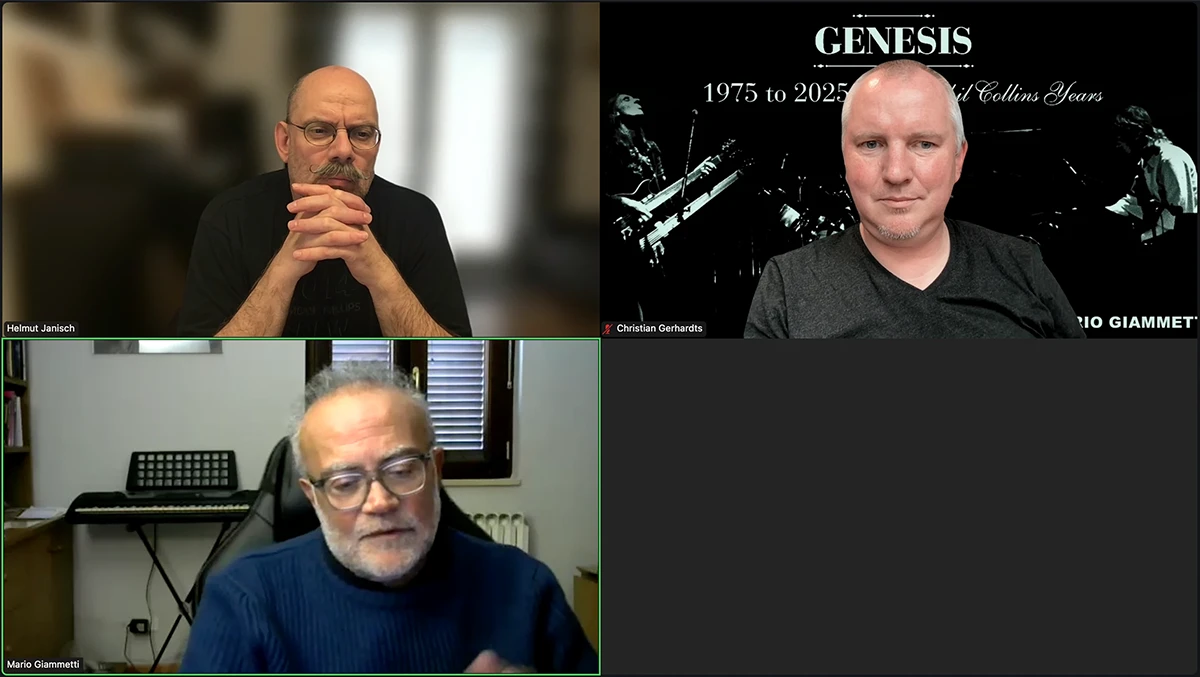
In the light of the updated edition of his book Genesis 1975-2025: The Phil Collins Years, we sat down with Italian journalist and editor of the DUSK fanzine Mario Giammetti for an interview.
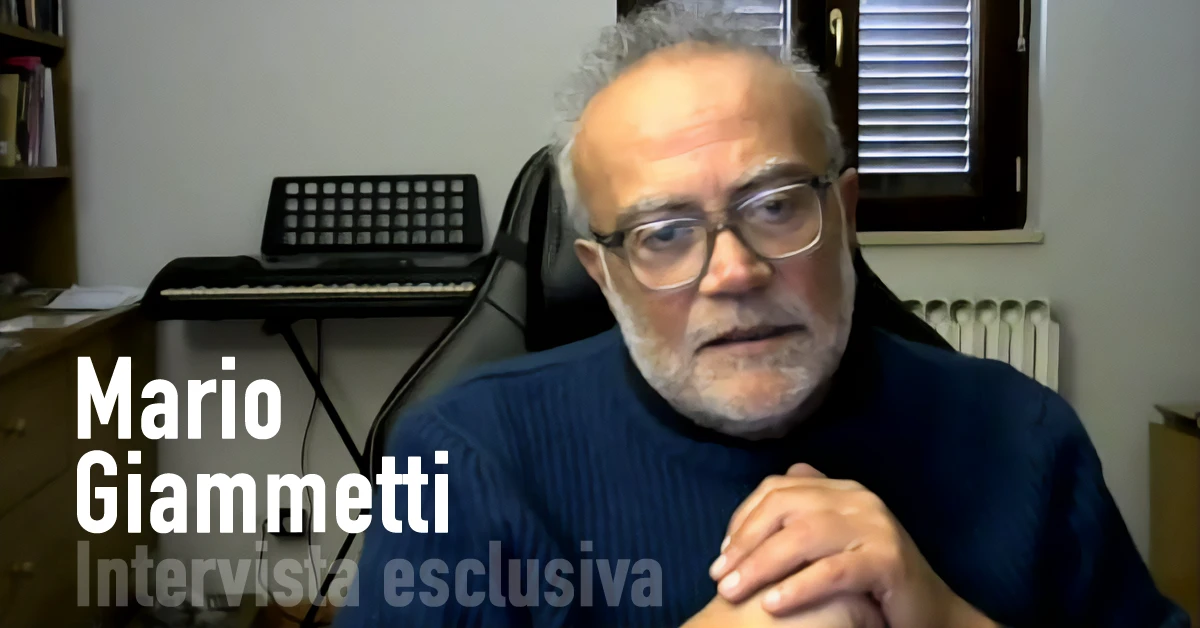
Mario Giammetti is known among Genesis fans as the editor of the Italian fanzine DUSK and has also made a name for himself as a book author. His latest book has now been revised and expanded as part of a new edition and is now called Genesis 1975-2025: The Phil Collins Years. It was published in April and we had the opportunity to speak to Mario shortly beforehand.
GNC: Ciao Mario, good to talk to you. So for us, it's also quite a funny situation because we have known you for so long now. We will also try ask questions from the perspective of people who do not know you at all.
Mario: Yeah, of course. Thank you for giving me this opportunity.
GNC: Most people might be unaware where you are from and where you live.
Mario: Yes, I was born in Naples. And I live near Naples, not in the city, but nearby.
GNC: When did you start writing about music and why?
Mario: I started to write about music, funnily enough, through Genesis because I thought about around 1988, that there was the need for a book about Genesis, which was more focusing on the music of the band. I mean, at the time, in Italy at least, we had of course Armando Gallo's biography, which was wonderful. But I felt that Genesis music was not enough investigated. I talk about the music, not the biography, because there was the great work by Armando. So I started to write something. Then at the time I sent my drafts to a couple of editors in Italy.
I think back then there were just two publishers in Italy doing music books. One of them called back and said that they were interested. So I started again to work on this book. That book (Genesis Story) was done with a short Genesis biography, and then a profile of each member, including past members like Anthony Phillips. And after that there was a short sort of a Genesis songs dictionary from A to Z. So all the songs, which were shortly commented for both music and some of the lyrics.
That was my first approach. That same year, it was 1988, I started to contribute to a music magazine in Italy called Ciao 2001. Also Armando started his job there some 15 years before me. I started to write about music in general, various kinds of music, and since then I have never stopped to write reviews of music or do interview with artists. I've written for many magazines in Italy. At the moment I contributed to Classic Rock. That is the Italian version of Classic Rock, but there were other magazines I have contributed to for some 15 or 17 years.
GNC: When and why did you start with DUSK?
Mario: This is a long story. I had the chance to interview lots of my old heroes. But the Genesis parts were always my favorite. And in 1994, I did a very small book called the Genesis Discografia 1968-1993. Helmut may remember it because you, Christian, were not part of the fan club team yet. I remember that the German fan club bought… some 200 copies of that very small book, because at the time it was a sort of discography of Genesis and all the members. That included the bootlegs and the videos as well, of course. By today's standards, it was very incomplete and full of errors, but it was quite a reference book. In the meantime, I had already started to do DUSK for fun in 1991. I didn't know that there were other Genesis magazines in the world.
And the Genesis information magazine I didn't know either. This one I discovered later, and I discovered at more or less the same time, that also Helmut and the other guys were starting the German Fanclub it. I also didn't know the Waiting Room magazine. I remember I bought all the back issues. With DUSK, I tried to do, more or less, the same thing I tried to do with my first book. I wanted to give some more room to Genesis in my country, where Genesis had their first biggest successes. But at the time in the early 1990s, they were quite forgotten, to be honest. In fact, the only concert planned in Italy for the 1992 We Can't Dance tour was eventually cancelled.
GNC: You told us a bit about how you became a Genesis fan, but when did you make the decision to found the Italian fan club dusk? When did that happen and who was involved maybe at the time?
Mario: First of all I will never call DUSK a fan club because I think a fan club does a lot of things which I have actually never done. For instance I don't do caps, T-shirts and so on – or conventions. I mean we did some conventions but not because of me, to be honest. I have to give credit to other people who are involved within the organization because I'm not good at this stuff.
My personal idea was just to write about Genesis. I wanted to give information and to have a critical approach. As I said before I started to write for a magazine called Ciao 2001 in 1988 and the first issue of Dusk came out three years later so I've done it the other way around.
Usually – I don't know in Germany but in Italy at the time usually someone started to write for a fanzine (which now could be a website or a blog) and then it could develop to write for the press which is sold in newsagents. I did the other way around. But I had a lot of happy moments with DUSK. It started as a joke maybe, but eventually it has lasted for some 34 years so far. And I'm still doing it with a lot of pleasure. And I think we tried to improve since then, we are never trying to reach, I don't know, big heights, but do it step by step.
We started with photocopied very small fanzines, very handmade. I remember the German fanzine was much, much better from the graphics and the quality of the paper. With the time I tried to improve on that side too and today we have this magazine which is not that bad. It's all in color and also the contents are up to date. I also have a lot of help from all the people who contributed to DUSK. We have experts in lyrics, someone is an expert as a collector, someone an expert in bootlegs because at the time there was a lot of interest in bootlegs and so on. So the idea to do a magazine with 68 pages which with three or four issues every year has always been what I really like. I was never thinking anything more than this actually.
GNC: Of course we started with a magazine as well and after that was gone we switched to a website, so obviously the times were changing. You decided to stick to the magazine despite having the internet so why was that? And did you have difficult times to find enough interested people to buy a magazine? Or was that never an issue for you?
Mario: No – well I mean if it was an economic enterprise, it would not be convenient at all. There is a lot of work doing this. There aren't so many people willing to pay to cover the costs, because, of course, the times are completely different now. Everybody is accustomed to go on the web and to find whatever you want. There are excellent websites in the world. Yours, of course, has always been number one. So if you want to have the news, if you want to get great interviews, you can find it online on your website.
And I am aware, of course, that nowadays you can't compete with the internet. Any information you can get will be old when it reaches the houses with a printed magazine. While on the internet what you discover now will be online in five minutes. But I think there is a time, like the Mike + The Mechanics song, there is A Time And Place for everything, you know. It depends on what you prefer. I know the importance of the web. It's even impossible nowadays to think when it was not around. But DUSK started when the web wasn't around.
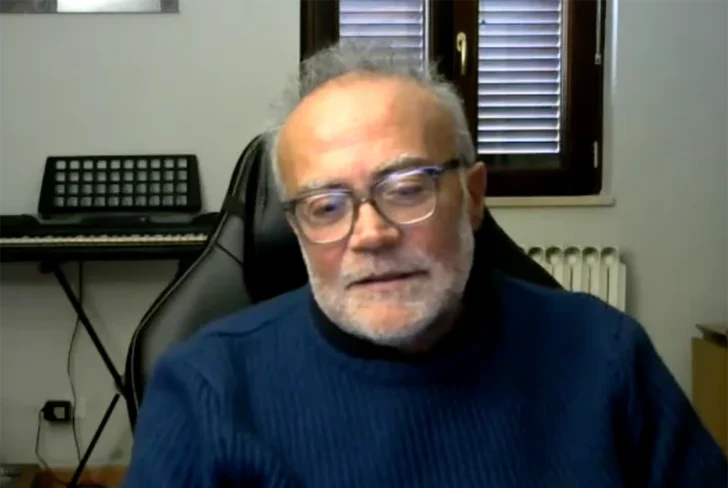
So I remember at the time, even when I used to write a review for another kind of artist, completely different artist, for instance, I had to base myself with my books, with my old magazines. And on my back [on the video screen], there is a very, very big library with lots and lots and lots of magazines which I have collected over the years. And then when you wanted to read something, you can lose the whole day trying to find the article and you won't find it probably. But it's something different. But on the internet, there are different kinds of websites.
Yours is a great, great website, which gives a lot of information, very rigorous, very serious. There is also a lot of rubbish on the web and you also have a lot of rubbish in the press, of course. But my personal priority is to have a printed product. Even with the books: I can read the book on a PDF format and I have to do sometimes, but I want a printed one. I want a book and I want a magazine and I want a record on a CD or on vinyl, if you prefer. I'm not interested in digital music. I'm not interested in PDFs. I read it, I use the web, but it's not my personal priority. I'm a very old fashioned guy.
GNC: It's maybe a nasty question, but do you have an idea how long you will continue with DUSK?
Mario: This is always a big question mark every year. I would have never thought to last 34 years.
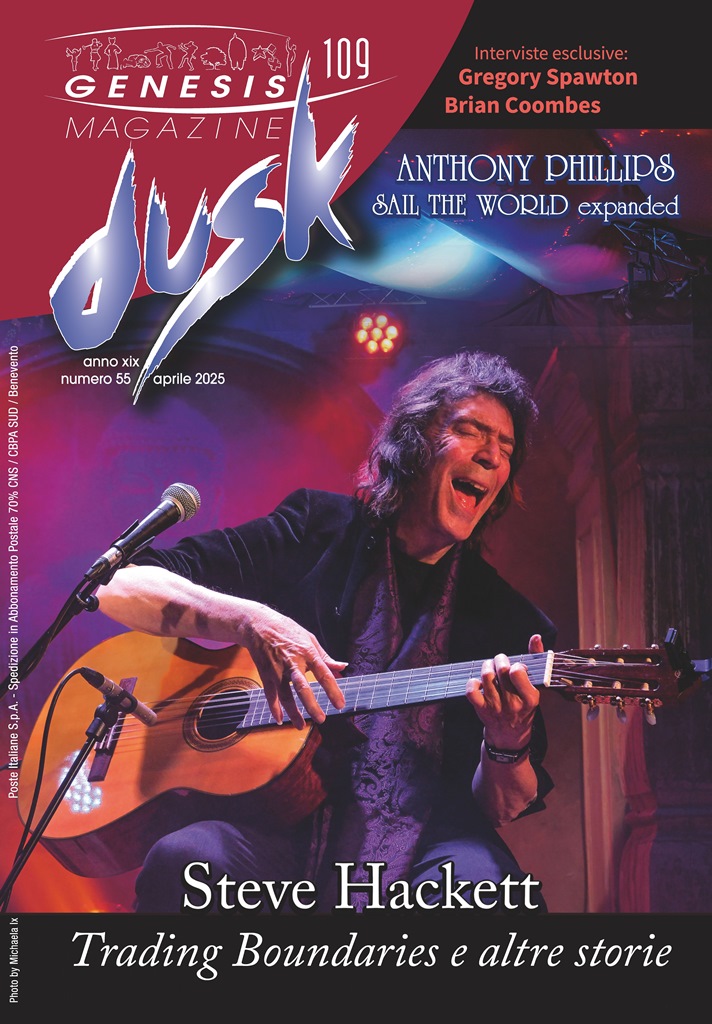
So, who knows? I remember when I had the 10th anniversary, then the 15th or issue #100. Now this is issue #109! It depends mainly on three things. First of all, the health, because I needed to stay safe and most of this job is done by me. There are lots and lots of contributors, wonderful contributors, but the hard work is done by me only. I have no other one who does this job along with me, so I need the health.
Then I need enough people willing to pay what they pay to get the magazine. I mean, if I don't cover the expenses, it makes no sense anymore. And above everything, it depends on Genesis. Or we should say, the Genesis members' activity, because I never liked the idea to be just a retrospective magazine. Of course, I love the old music, but I don't want to have a magazine where there is nothing new.
In this new one, for instance, there is the Live Magic At Trading Boundaries Steve Hackett album, there is the Djabe Freya album, there is the Rocking Horse Music Club, the reissue of Sail The World and so on. Some things are old, maybe remastered or extended, but still new info on releases. When they will really stop to produce anything more or less new, I will lose my interest.
GNC: Before we talk about your books, which is basically the main reason why we talk today. I think some people might be interested in some basic Genesis fan questions. The first one is, what was your first Genesis show that you ever saw, and where was it?
Mario: The concert? Yeah. It was in 1982, the Three Sides Live tour in Rome. Because the previous Italian tour was the Lamb tour. I was very, very young at the time. And to be honest, in 1975, I didn't know Genesis yet. So when they came back in Italy for that tour, I went to Rome and attended the first of the two Rome shows on the 7th of September, 1982.
GNC: And what about Peter, Phil and Steve? Solo?
Mario: I had seen Peter Gabriel two years before, and Steve the year before. So my first Genesis-related live concert was Peter Gabriel in Florence, 1980. And that is, to date, the most beautiful concert I've ever seen. Because at the time, Peter Gabriel was completely the opposite of what he is now. The stage was very, very minimal. They were all dressed very simple. Of course, Peter already had a few tricks because I remember he appeared from the back of the audience before starting to sing one of the songs. But the concert was pure energy. He had a four-piece band at the time.
There was no Tony Levin in his band in Italy. There was John Giblin on bass, and Jerry Marotta on drums, Larry Fast on keyboards and John Ellis on guitar. And one year later, I attended the Steve Hackett concert in Castel Sant'Angelo in Rome, which was a wonderful scenery, with this castle in the classical Rome magnificence. I even wrote a few liner notes for the Hackett box set Archive 70's, 80's, 90's. There is a small page written by me at the time in 2001 and that one was another wonderful concert. It was the first tour Steve sang himself and in his band were Nick Magnus, John Hackett, Chas Cronk and Ian Mosley.
So September, September, September – three consecutive Septembers in 1980, 1981 and 1982. And finally Genesis is the last one. For Collins solo, the first one was strangely enough was the Big Band show in 1996. Quite late because for personal reason reasons. I hadn't had the chance to go to Rome in 1990 and to Rome or Milan in 1994. So the first time I saw Phil was with his Big Band in 1996 in Perugia, Umbria Jazz. Then I've seen him with his rock band and always great shows, great musicianships from him and his fantastic bands.
GNC: Interesting. I assumed you have seen him earlier, but that's life. And what is your favorite Genesis album and favorite Genesis song?
Mario: Favorite albums. It's very, very difficult. to say because I mean the block from Trespass to Wind & Wuthering it's a pure magic. It's difficult to say but if I have to chose just one it would be Selling England By The Pound. It is maybe is the best progressive Genesis album of the progressive era. Also, I love very much the Trespass album, especially in recent times. And the song again this is a tricky question maybe I should say The Musical Box. But I like so many songs.
And I like not just the songs of the Gabriel era. I like also many, many songs of the Collins era, and even of the Ray Wilson era. For instance, I find No Son Of Mine and Calling All Stations are two wonderful songs. They are different from the Suites like Supper's Ready or The Cinema Show, but they are not less good, in my opinion.
GNC: And do you have a favorite solo album from any of them?
Mario: Yes, The Geese and the Ghost by Anthony Phillips. Yes, I prefer, should I choose just one Genesis member for the whole career, it would be Steve Hackett. But if I should choose just one album, it would be The Geese And The Ghost.
GNC: Okay, then let's talk about your books. We are in Germany and this interview will be published in English as well. And as a book writer you are quite known to the Genesis fans in Italy, because you have published some 15 books in Italian language, but not so many in the English language. So have you ever tried to translate your previous books, like the individual books about the band members and so on, into English as well? And why have you just started to publish also English books?
Mario: Yeah, well, that was one of my dreams. You know there is this series called Genesis Files, which is seven volumes. There is one book for each of the Genesis members. And my dream would have been to get to that in English because an English written book can be read all over the world.
And I tried to propose these books to a few publishers in the UK, but there wasn't enough interest in Genesis. Or maybe only in this kind of project because it was a very, very ambitious project. Actually, Genesis are a great band and they have a lot of fans. They are nevertheless not as big as other bands like Beatles, like Rolling Stones, Queen, Pink Floyd, U2, and so on.
So just to imagine to publish seven books was probably very scary. What happened is that I was in touch with Gregory Spawton, who is Big Big Trains founder and bass player at the moment (although he used to be the guitarist) and the main writer. And in 2018, we met in London, along with (journalist) Nick Shilton. They told me that they had the idea to fund a publishing company. Greg knew me for what I was doing in Italy.
And what I proposed to them at the time was to do The Phil Collins Years. I wanted to start with the Phil Collins years, because I had done the Peter Gabriel years in Italian, called Gli Anni Prog, and I was supposed to do the Phil Collins years in Italian as well. But then the Italian publisher Giunti very strangely changed his mind. I say very strangely because for a Genesis book, the Gabriel years book in Italian was a huge success.
But the CEO just didn't like Genesis, He is the most important Italian music journalist and he has never liked Genesis at all. But while he can tolerate a bit of the Peter Gabriel years, he really didn't like the Collins years. He was tempted to do it because the first book was successful, but eventually he said the publisher was not interested anymore.
So the most I could have obtained was to do a book without pictures or with a not good graphic layout. I refused this because I said I want a book which is the same quality as the first one. If I can't have it no problem, I won't do it. So I proposed this one, the second part, to Gregory and Nick. They said we can do this but we want to start with the Peter Gabriel years because it makes more sense. They were right of course. The problem was that they had to buy the rights from the Italian publisher and it was not easy.
They publish a lot of stuff (on different subjects) and music is just a small part of them. They do all kinds of books and so it was quite complicated for Gregory and Nick. Eventually they managed to get the rights and then started the translation. They proposed a lady called Octavia Brown which is English born but she lives in Italy. She speaks a perfect Italian and she did a wonderful job because she managed to translate everything with a big precision. She did also a lot of work doing research on the web and discuss with me. We had the chance to improve several things on that book.
So the first book was published in the UK sadly, at the same time when the pandemic arrived in Europe in May 2020. So all the plans to do a big promotion were cancelled. But despite this, the book went very, very well. It was slightly updated and reprinted a couple of times. And one year later, more or less, we did the second part, which arrived in 2021. It was published before the last Genesis tour.
GNC: Funny enough, I don't know if you remember, we had a review from your first book on our website. Of the Italian version, actually, because someone I know, I think he has Italian relatives. So he speaks fluently Italian, and he did a review of your Italian book
Mario: Yes, I remember.
GNC: And what what I learned from from your books that you rely to a large part on interviews you did on your own with the band. Can you review maybe some special moments from those interviews that might be interesting for readers to share?
Mario: Yes. Actually, both books are completely done with interviews done by me. And from Mike Kaufman, which is the British journalist, who did the Genesis videos of 2007-2008. Part of these interviews were used on various CD/DVD-Sets of the time, as you remember. They are also on YouTube, I think. But he was kind enough to give me the full transcript of the interviews. So there were a lot of things which were not used on those releases. And this was particularly good for getting quotes of Peter Gabriel and Phil Collins, which are, of course, the less reachable people, because they are more famous, of course.
The special moment: For the first book I had this idea to listen to the albums with the Genesis members when available. For the first book, the Gabriel years, I managed to have these dreamy moments for all the albums. I listened to From Genesis to Revelation and Trespass with Anthony Phillips. And it's funny to say that Anthony Phillips told me that he had not listened to the album for 40 years when he did this.
And I listened to Nursery Cryme, Foxtrot and Selling England with Steve Hackett. The Lamb Lies Down On Broadway I listened to at the Farm Studios with Tony Banks. These were very, very, very special moments. Just imagine you are seated next to one of them listening to what they did so many years ago, and it was funny to watch their faces. Especially when they listened to something that they hadn't listened for so many years, to discover the surprise on their faces, the smiles, or maybe sometimes even a bit of resentment, who knows.
Some very special moments for me were when some of them said, oh, okay, this part is Tony's, or this part is Phil's. For instance, I remember Steve Hackett told me that there is a bit of The Cinema Show which is written by Phil Collins. It's difficult to tell which one is, but you can recognize this because actually he would have used some of that on a song on Moroccan Roll with Brand X. It's a small part of keyboard, which was Phil Collins' idea. You would have never thought about this because you were used to think that Phil Collins, during the Selling England By The Pound years, was anything but a composer. Still he did that bit.
Or Steve told me how Tony Banks did one part on Time Table, the solo on Time Table, because that sound was done through playing with the plectrum. They opened the grand piano, and Tony played the piano strings inside the body of the grand piano with the plectrum. This is the reason why the piano sound is in that strange way. So there were bits here and there which were very, very revelatory. When I listened to the album with them, I tried to find the precise moment on the CD and to indicate it in the book so that one could take them the chance to listen to that particular part, to understand what they were saying in that moment.
It was, in all, a very cathartic experience, especially the first book. For the second, it wasn't possible to do the same. I just listened to one album with one of them, and it was Wind & Wuthering with Steve Hackett in Naples. For other members, it would have been impossible because Michael Rutherford is not the musician with the best memory in the world.
And Phil Collins, of course, was not available. So I had to make it in a different way, but I did a few interviews on that purpose. I went to Tony Smith's office for a long interview with Tony Banks in 2016, and it was used on the Phil Collins year's book. There were some songs for which I had no comment for at all, because they hadn't commented on them for the DVD interviews. So I concentrated on that to get some particular, any particular thing related to that song, to give something new to the readers. I think, eventually, the books are written by Genesis themselves in a way.
I just tried to put the things in order. The only part completely done by me is where I do the critic of that particular album, which is always located in the particular historic period of the time related to the values, to the music which was around in those years.
GNC: The Collins years book came out in 21, I think just in time for the for the UK leg of The Last Domino? tour. Why did you decide to update it and even republish it? Because now it's called 1975-2025. With the first one you said it has been updated like silently when you did like new editions but this one is a really major re-edition now with a with a completely new title. So why did you decide to upgrade the Collins years book?
Mario: Well, I think one of the reasons was that the first edition of The Phil Collins years, which was published in 2021, went sold out in, I think, maybe in one year. At the time, the publisher was considering several ideas. We even talked about the possibility to do a unique book, a big one, bigger size with both the books together, and all updated. But it became probably too expensive. And also, the price would have been probably too high.
And maybe some readers could have been upset because one could say, I bought the first one, I bought the second one. Now I should buy again, the same stuff, just because it's in different size and so on.
But anyway, the Collins years book needed to be pressed again, because there were requests to do it. Rather than do just, a reprint with minimal amendments, the idea was to update it. And so now, the time is right, probably, because sadly, as we know, there won't be Genesis shows or records anymore. So the last tour needed to be covered and also what happened in the meantime. There was other stuff, there were box sets, another one is coming soon. There was a Richard Macphail's passing and there were Phil Collins growing health problems.
So in a way, we took the opportunity to add a couple of new chapters at the end. At the same time, I also took a very careful look at everything. There were several misprints we corrected – it happens all the time. We had integrated stuff which were missing in the first edition. We added some quote here and there by Hugh Padgham in the previous chapters like Abacab, Invisible Touch and the Genesis album.
I completely reworked along with your friend Peter Schütz the list of the concerts. We tried to make it as accurate as possible even knowing that probably there is not the chance to have a completely definitive list because it's changing all the time. I've just seen recently the great article on the Brazilian tour that Peter Schütz did for your website. There's always so much to discover but we improved the previous list. We changed it quite a lot and now it's much more accurate than before. And there are also new photos for the new chapters.
GNC: You said that you are much more in favor of books rather than PDFs and magazines rather than websites. When we post something on the website and I misspell something or there's a mistake, then Helmut would call me and say, you know, there's a mistake, please correct this. But of course, you cannot do this when you write a book. I mean, if you have like a list of concerts, and then we have new findings over the next year or so, which happens all the time at the moment. Peter is also going back to the Trespass phase and stuff is doing a lot of research at the moment. Is it frustrating for you? Or do you say, well, that's, that's the negative side of printing books?
Mario: Yeah, yeah. It may be frustrating. What's really frustrating is when you discover a misprint or when you have just given the okay, the green light to go to press. And this happens every time. This happens with the DUSK as well. So I think you can read these books and magazines you will always find something which could have been done better, but what's important to me is to give all the best, all the greatest commitment to do things in the best way you can. Then perfection is not of this world, I'm afraid. So you have to accept this.
GNC: Okay, we talked a lot about your Italian books and why they have not been translated to English, so the obvious question is: will the Collins years book be in Italian as well, or is that only an English book?
Mario: At the moment it's only an English book, but who knows, maybe in the future there could be an Italian version as well. I hope so.
GNC: Actually, we have someone in our fan club, who asked us a couple of times whether he can translate your books into German. He did the Richard Macphail book, he did the German translation of that book actually. But if you have interest in doing something like this, I'm pretty sure we can provide you with people who are willing to do this, and I think Martin did a great job on the Richard Macphail book.
Mario: It would be wonderful, because Germany is such a big market for Genesis. And there are so many fans, which I hope would like some of my job so it would be a dream of course, When it's related to other publishers I don't know how is the legal situation at the moment with the first book. The second one is just a Kingmaker product so no problem.
GNC: By the way, do you read other books about Genesis not written by you? And if you do, what books would you recommend?
Mario: Oh, well. Yes, of course, there are books, interesting books – like Armando Gallo's biography. It's a starting point. And there is so much to say about Genesis and every approach can be different and can reveal something new. It can be complimentary of other jobs, other works. I would not recommend any Genesis book, actually. I do have my preferences, like everybody. But I don't think it's right to suggest one book or another, because everybody does this job because there is a very big love for Genesis. So there are the official part of the biographies. It's obvious that Mike's, Phil's and Steve's books must be in everybody's library, as well as Richard's, because they give a perspective from the inside.
GNC: Do you have any projects planned for the future, book projects? Do you want to write more? Maybe, you know, update on the Ray Wilson book or something?
Mario: Well, the problem of the Genesis Files series, where there was also the Ray Wilson book, is that very, very sadly the publisher died unexpectedly a few years ago. And so they still do books, but they're on another area. So I don't know, to start again, to think about another book about Genesis. There is a lot more to investigate further. But I think I have now done most of my job as for writing books. But perhaps I could do more English language books.
GNC: Okay, maybe you have something you want to share with us we didn't discuss yet?
Mario: So well, not in particular, I thank you very much for the interest. And I congratulate with you for the fantastic job you're doing with your website. I hope that the Genesis management is supportable with you,
Well, I would finish this interview just saying thank you to Genesis, because they have done the most beautiful music. And they are also, in general, beautiful people. I have had the chance, as you, to know all of them a bit. And I mean, everybody has his own behavioral characteristics.
They definitely deserve all this love that I, from Italy, you from Germany and millions of other fans worldwide are giving them. They did the most beautiful music, and they did the most various, different, intriguing and interesting solo careers. As I have written many times, even in my books, in my articles for the Italian Press: There is no other band in the world, which has so many talented composers. Not even The Beatles or Rolling Stones. There is at least one member, which can be a great musician, but is not a great composer. He has not a real, a really strong solo career. Genesis added this top quality, which makes them different from everybody else.
GNC: I remember a discussion when I joined the team in 2002 when they said, we don't know how long this will last.
I mean, there was a Peter Gabriel tour, but we thought it could be the last one. And that was 2003 or something. And now we're 20 plus years down the road. So who would have thought they would tour once more in 2021/22…
Mario: One thing, maybe as a final comment: It's a pity Genesis never recorded new music after 1997. They had the chances, either with Ray or Phil, to record new music, but sadly they never did.
GNC: Thanks for this interview, Mario!
Mario: Thank you, it was a pleasure!
Genesis 1975-2025: The Phil Collins Years is available to buy at Burningshed and AmazonUK *.
Interview: Christian Gerhardts, Helmut Janisch
Transcription: Christian Gerhardts

Books by Mario Giammetti:
Genesis Story (1988)
Genesis Discografia 1968-1993 (1994)
Peter Gabriel – Il trasformista (1999)
Genesis – Il fiume del costante cambiamento (2004)
Phil Collins – The Singing Drummer (Genesis Files Vol. 1) (2005)
Steve Hackett – The Defector (Genesis FiIes Vol. 2) (2005)
Tony Banks – Man Of Spells (Genesis Files Vol. 3) (2006)
Anthony Phillips – The Exile (Genesis Files Vol. 4) (2008)
Musical Box – Le canzoni dei Genesis dalla A alla Z (2010)
Mike Rutherford – Silent Runner (Genesis Files Vol. 5) (2011)
Genesis – Gli anni Prog (2013)
Ray Wilson – Gypsy (Genesis Files Vol. 6) (2014)
Genesis – Gli anni Prog (2015)
Peter Gabriel – Not One Of Us (Genesis Files Vol. 7) (2016)
Genesis – Tutti gli album, tutte le canzoni (2020)
Genesis 1967 to 1975 – The Peter Gabriel Years (2020)
Genesis 1975 to 2021 – The Phil Collins Years (2021)
Genesis 1975 to 2025 – The Phil Collins Years (2025)
* Affiliate Link