

- Article
- Read in 12 minutes
Interview with Tom Morgenstern about the new Ant Band album
Prior to the release of Ant Band's album "From Genesis To Reimagination", we had the opportunity to interview Tom Morgenstern.
The Ant Band is back. With From Genesis To Reimagination, the band presents its second album after A Light On The Hill (2021) (not counting the bonus album Bonus Bits & Blunders from 2022). It is a reinterpretation of Genesis' debut album From Genesis To Revelation in its originally conceived form. We discussed the background to this in an interview with the band's frontman, Tom Morgenstern.
Genesis News Com: It had been known for a some time that the Ant Band was recording a new album. Why did it take so long?
Tom Morgenstern: There was no deadline like there was for the first album, which had to be finished in time for Ant's 70th birthday. So we weren't in any great hurry. But there was another complication: It is now known that Esoteric Records, Ant's record company, is to re-release From Genesis to Revelation in remastered and perhaps even remixed form. At the beginning of 2024, I received an email from Mark Powell, the head of Esoteric Records. Ant had informed him about our project. He advised me to release our album after the Esoteric re-release, as he believed it would be overlooked if it were released shortly before.
At that time, we were aiming for September 2024; Esoteric was planning for the fourth quarter of 2024. A postponement suited us at first, because we were still missing some promised deliveries. Later, I learned that Genesis' management had asked Esoteric for a postponement because the The Lamb Lies Down on Broadway box set was originally scheduled for release in November 2024. However, this was subsequently postponed several times, and with it, presumably, the Esoteric box set – and, at the end of the chain, our album. The Lamb box set is now available, but Esoteric has still not announced a release date. We didn't want to wait any longer. However, it wasn't easy to pick up where we left off after a break of more than a year, because life had moved on.
GNC: Why a re-recording of From Genesis To Revelation of all things?
Tom: A band's second album always has a harder time if the first one was successful. The two albums are compared with each other, and the second one usually comes off worse because people have heard the debut much more often and therefore know it better. So the risk is lower if you venture into more obscure territory with the follow-up album. In any case, we can't be accused of producing a 'weak copy of the debut'.
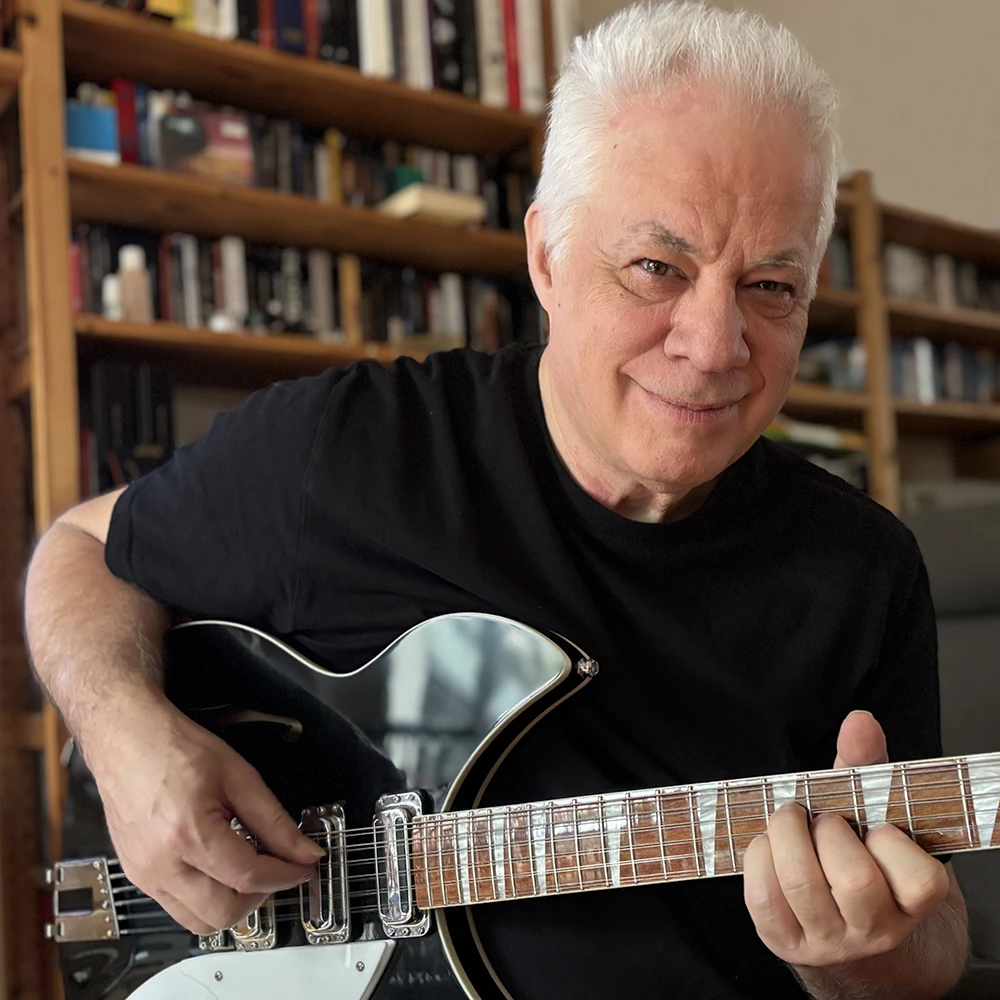
The initial conditions for the Genesis debut album are quite similar to those for the Anthony Phillips demos: The songs are technically far from perfect and hardly finalised in terms of arrangement – and therefore have a lot of potential for further development. However, it is a very diverse, varied album full of good songs that unfortunately didn't get a real chance back then. These are by no means simple pop songs, as has often been claimed or even criticised, because they have a relatively high degree of harmonic complexity. Or to put it more simply, the guys used much more than just the three standard chords of pop music, and they did so so skilfully that most listeners would hardly have noticed. To be honest, we were also a little surprised when we took a closer look at it.
At first, I wasn't quite sure whether we could approach the album songs in the same way methodologically, so I first made a demo for myself, which I then presented internally and it was very well received by the others. That was in September 2022. We then had a video conference and although not everyone was convinced, there was no further discussion. Perhaps because no one had a better idea.
GNC: The album is not well-liked among Genesis fans; many do not even consider it part of the canon of later Genesis albums.
Tom: Yes, it generally has the status of a youthful indiscretion; many people ridicule the out-of-tune guitars, the choirboy-like backing vocals and the late-adolescent lyrics. And the strings and brass added later by Jonathan King completely ruined the album, not only for the band itself, but also for many listeners. This was partly due to the studio technology of the time. While the Beatles were already able to record their current ('White') album on an 8-track machine at Abbey Road Studios, Regent Sound only had an ageing 4-track.
Moreover, King was no George Martin, who recognised the potential of the material and could have got the most out of it. I think you can also hear that the studio situation was not ideal for the band, because the overall mood of the album turned out to be rather melancholic and depressive. We wanted to bring some fun back into it – without overdoing it, of course, because that would have seemed disrespectful to us.
GNC: Whose idea was it to call your album From Genesis to Reimagination, and how did you come up with the cover?
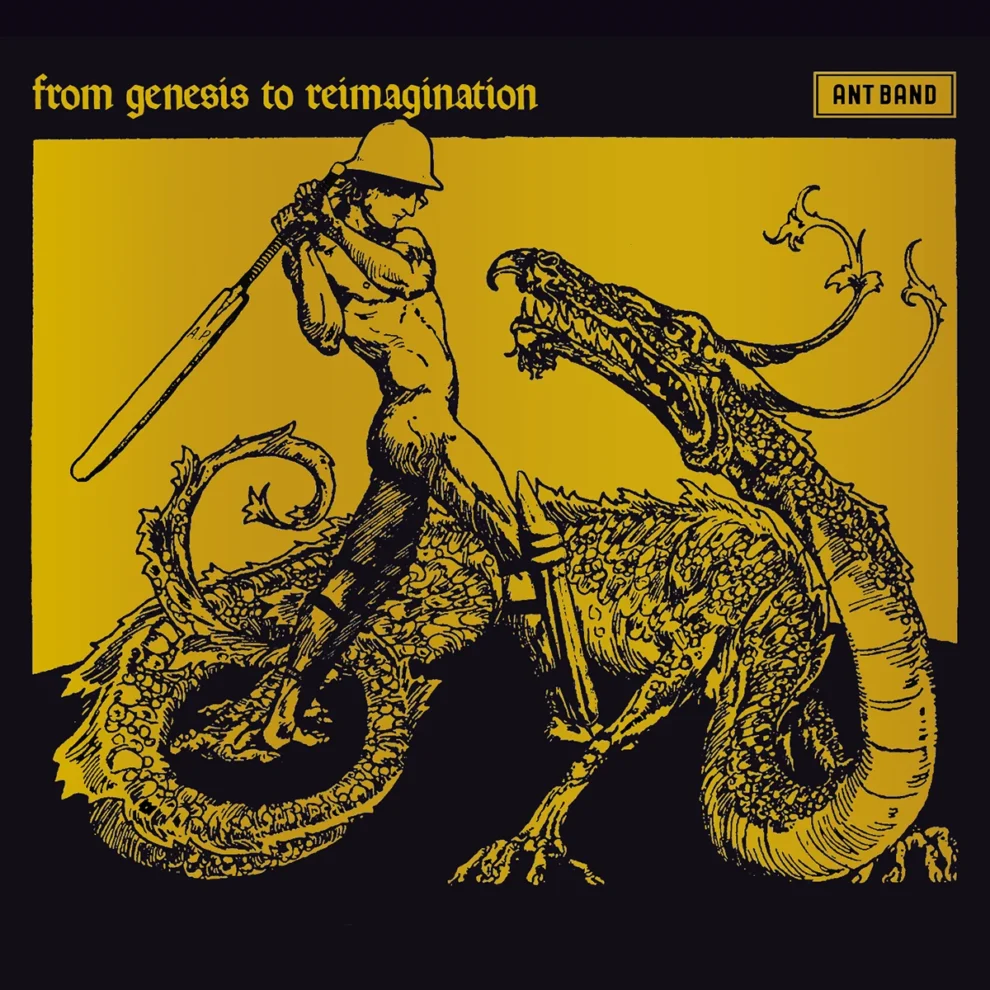
Tom: The title was Nina Morgenstern's idea, and it looks quite similar to the original when printed. I definitely wanted to get away from the big boring black area and experimented a little with pictorial motifs. Finally, I came across the Hungarian-American Art Nouveau artist Willy Pogany, because Paul Whitehead's Trespass cover is based on one of his illustrations from the book Tannhäuser. The book contains many other interesting motifs, including the one with the hero and the dragon. Until the early modern period, the biblical serpent was usually depicted as a dragon or 'lindworm,' which is why the English term 'serpent' is also synonymous with this type of mythical creature. I modified the illustration a little. Ant liked it, as he's a cricket fan.
it: So Anthony Phillips was in on it from the start this time?
Tom: I've been in regular contact with him since the A Light on the Hill album. He invited me to visit him in London in August '22, and over dinner at a nearby pizzeria, I told him about my various ideas for the future of the Ant Band. Covering From Genesis To Revelation in its entirety was the idea he seemed least keen on; he wasn't enthusiastic about it, anyway. In the end, he agreed to support us with advice and assistance. When we had problems with the piano chords for A Place To Call My Own a few months later, he went to great lengths to explain them to us in detail.
He sent me several long voice messages, in which he even sang some parts. That was very helpful when comparing them with Martin Brilla's notes, who was already working on the piece. In the summer of '23, I met with Ant again, this time having sent him our demos on CD a few weeks earlier. At that point, four songs and most of the interludes were still missing, but I think it was enough to give him an impression of our project. He had put a lot of effort into it and made notes on each of the songs, similar to what he had done in 2014 at Welkers during the live performances.
I was a little concerned when he mentioned our version of In Hiding, because I knew it was his song: 'So, you've turned the 3/4 time signature into 4/4,' he said with a frown and a dramatic pause, '… and it works!' he added with a broad grin. This time, he seemed much more impressed, and his general 'thumbs up' encouraged us to continue in the same direction. In August 2024, I sent him another demo CD with the mixes, which were almost finished at that point, because he had agreed to write the liner notes.
GNC: Did everyone who was involved in the first album participate again?
Tom: A few people left us at the very beginning or later on for various reasons, but the core has remained stable. There were two new additions: my brother Roland Manns (formerly of "Reggatta de Blanc" and "Die Zinnförster") now plays the drums on almost half of the songs, and I was able to get Christoph Piel from Dawnation to play a great guitar solo.
It was clear to us from the outset that we had taken on a lot. That's why we wanted to take the time to discuss the demos of each song internally first and develop them together before we started the actual recordings. Six of the demos this time are by Sascha Krieger and, as with A Light on the Hill, one each by Peter Musto and Martin Brilla. And as with the first album, we had laid down a few basic 'rules':
We record all songs and interludes in their original keys. The transitions between songs and interludes should be significantly improved. The song structures should be preserved as much as possible; the songs should still be recognisable. The tempos of the songs should be based on the original versions and only occasionally be slightly faster. We don't fade out, but come up with proper endings where the original fades out.
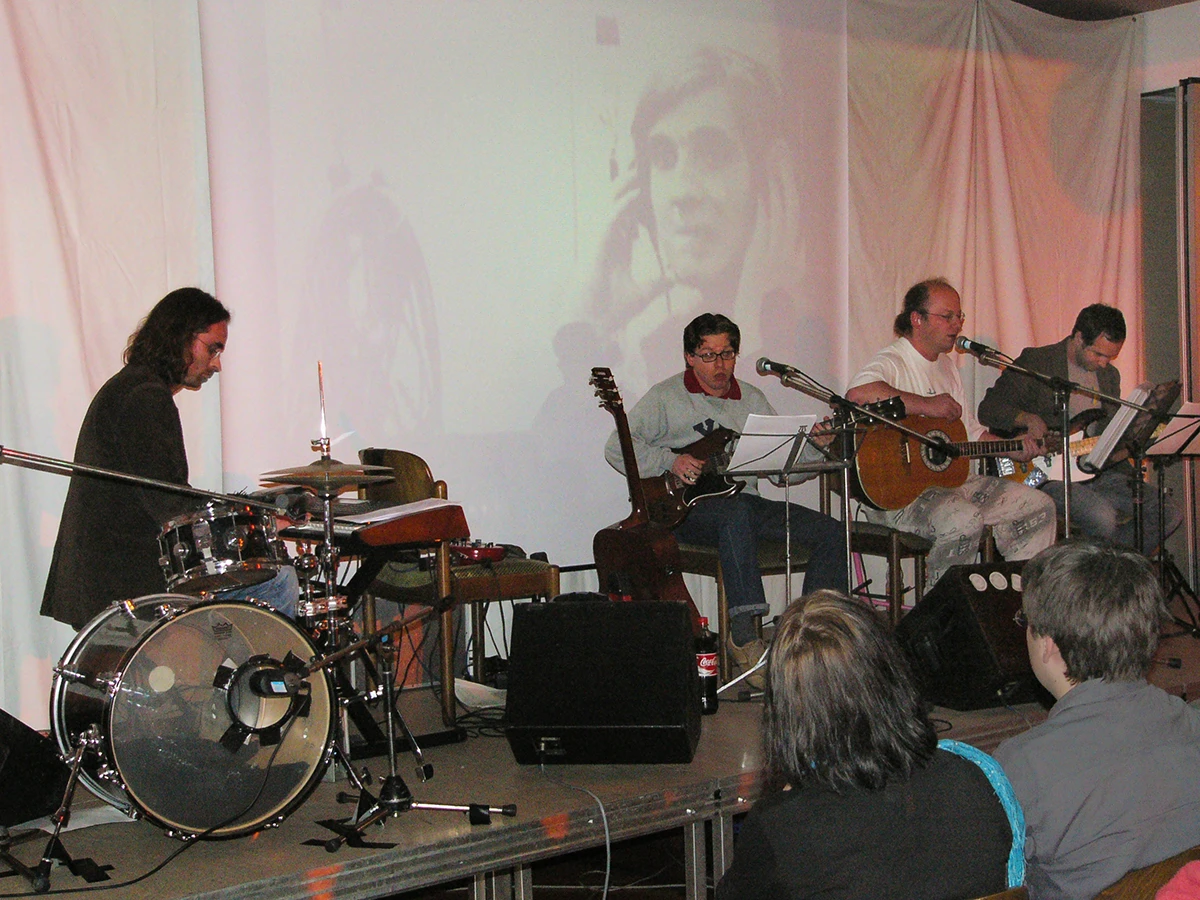
At first, however, it took some work to figure out the chords and write everything down. In some cases, we were able to rely on Bernd Vormwald, who, together with Steffen Gerlach as the band Champagne Meadow, had played a few songs from From Genesis to Revelation live at the 2005 Genesis Early Years fan club event, arranged for the Genesis three-man era. He kindly sent me a few carefully completed chord sheets.
GNC: Did you see Champagne Meadow back then?
Tom: Unfortunately not, I only heard the recording later and was amazed at how well some of the songs worked in the style of the 80s and 90s. Which was a super cool idea in itself, but also seemed quite amusing to me, almost parodic. We preferred to take the songs as they were and develop them further from within, without forcing them into arrangements that were alien to their nature. We knew that the guys were fans of the Beatles and Motown. For example, with The Conqueror, it was obvious to play the piano riff with a 12-string Rickenbacker, and the arrangement then leans more towards the sixties, when this guitar was made popular by the Byrds and the Beatles.
But there's also a bit of Oasis in there, because we remembered that Noel Gallagher had once praised this piece highly in an interview. Other songs also lean more towards the alternative direction, partly because it seemed appropriate, but also because some of us have that kind of background. Sure, a few times the comparison to later Genesis songs was obvious, and of course we tried to transfer a few ideas that the guys actually had later on. So there are a few reminiscences of the later Genesis, but I don't want to give too much away here.
GNC: Why the changed track list?
Tom: There were a few questions I had asked Jonathan Dann right at the beginning. For example, I had never understood why In The Beginning wasn't the natural opener, but rather Where The Sour Turns to Sweet. After all, there can't have been anything before creation. A copy of the acetate single of Build Me A Mountain had also been on my mind for a long time.
Most of the songs on From Genesis to Revelation have special instrumental introductions or interludes as transitions between songs. This was probably intended to give the impression of a continuous concept album, which was already very fashionable in 1968. Build Me A Mountain was released as an 'outtake' from the album session on the first Genesis "Archive" sampler, but without its instrumental intro, which remains officially unreleased to this day: Tchaikovsky's Swan Lake theme in a piano version by Tony Banks. And at the very beginning of the acetate recording of this intro, you can faintly hear the end of the fade-out of The Conqueror. This is an unmistakable indication that there must have been a master tape version in which both songs were connected by the Swan Lake interlude.
Jonathan not only confirmed this, but also provided the track list of this original master, which differed significantly from the version released later and came as a real surprise to me. Instead of the single Silent Sun, which is somehow out of place on the album, there are three songs that later fell victim to the editing process: in addition to Build Me A Mountain, there is Image Blown Out, also known from Archive 1967-1975, as well as the original version of Visions of Angels, which was re-recorded almost two years later for Trespass. And for me, it was a revelation: In The Beginning was, of course, the album's opener! However, with all 15 songs, the album would have been too long for two LP sides, so it's clear that this original master could not have been the final version.
GNC: So that's why the vinyl edition will have the same track list as the original album?
Tom: I decided on vinyl quite late, as I'm anything but a fan of this antique recording technology, but unfortunately there's a lot of demand for it. Unfortunately, only 22 minutes per side fit on an LP, hence the shortened and rearranged track list. It's a bit of a shame that the three outtakes and the Swan Lake intro, wonderfully arranged for guitar by Gereon Schoplick, had to be left out.
Further changes compared to the CD edition: Where The Sour is a few bars shorter at the end, In The Wilderness is a completely different, slightly shorter mix with lead vocals by Nina instead of Robin. A Place To Call My Own consists only of the vocal part, but Bert plays the piano instead of Martin, and there is also bass and drums by Sascha and Roland – so it's a different mix as well. And Silent Sun is of course also included.
Actually, we were glad that it was out, because no one really liked it. In August 2024, however, Nina recorded three of the four early Genesis single tracks live with guitar in my studio, including Silent Sun – so I was able to use that recording. However, it should be clear that, for us, the song is an outsider on the album, so I considered how to reflect this in the arrangement. Some will be surprised.
GNC: Visions Of Angels is also likely to be a bit of a surprise for many fans, as this song is associated with Trespass.
Tom: Unfortunately, the original version from the From Genesis to Revelation sessions has been missing from all reissues dealing with this phase of the band's history. One reason for this was certainly that Anthony Phillips finds this recording terrible and has always vetoed it whenever he was asked. However, Ant told me that the structure is quite similar to the Trespass version and that only the long instrumental passages are missing. We used that as a guide, because it fit in well with the other songs. The lyrics also fit seamlessly into the album's concept with its biblical motifs. Even better than some of the songs that made it onto the album, such as Am I Very Wrong?, which is about a very mundane birthday party.
GNC: You have now expanded A Place To Call My Own into a long track. What was the reason for that?
Tom: Ant and Jonathan told me a few things about the song. That's how I knew that the released recording of A Place To Call My Own was only the final part of the song, which was originally over five minutes long. On the tape box of the original master, there is a handwritten note on the track that says 'being cut in half'. However, since the recording in the 2017 '50 Years Ago' download release has a count-in ('one, two, three, four'), the decision to record only the last two minutes must have been made before the album sessions, so it wasn't a subsequent cut.
Ant later elaborated on this in his liner notes for our album: it was written in a style somewhat reminiscent of MacArthur Park (1967) by Jimmy Webb and Richard Harris (who later played Dumbledore) and Eloise (1968) by Paul and Barry Ryan.
Martin and I finally came up with the idea of moving the final part with the da-da-da chorus to the front. Of course, the three minutes had to be filled. Martin then delivered an instrumental demo that was practically finished. We then replaced some of his synths with real guitars, basses and drums. So now the album has a proper finale.
Interview: Deutscher Genesis Fanclub it / Genesis News Com
From Genesis To Reimagination by the Ant Band is available for pre-order at Bandcamp.