

- Article
- Read in 5 minutes
John Hackett – Another Life – review
The follow-up to John Hackett's rock album Checking Out Of London is Another Life. It features some interesting guest musicians.
Background: Ten years had passed since the release of John Hackett's last rock album, Checking Out Of London, when Another Life finally hit the market in September 2015. In the intervening period, John Hackett mainly produced albums rooted in classical and acoustic music. Particularly noteworthy here is the magnificent collaboration with his brother Steve, Sketches of Satie.
It was time to gather some musicians and go into the studio. In addition to John (flute, guitar, bass), three outstanding protagonists in particular were to shape the album: Nick Clabburn, who wrote the song lyrics1), Nick Magnus, who not only contributed keyboards and drums (programmed), but was also responsible for production, and Steve Hackett, who delivered beautiful guitar solos and a statement on the harmonica. We don't want to overlook one special guest: Anthony Phillips. More about him below.
What has changed since the previous album? Well, the compositions are more mature, the album feels more cohesive and the melodies are even more beautiful. John Hackett's vocals have gained in expressiveness. You can tell he's been taking singing lessons. Nick Magnus' production is sensitive and beautifully attuned to the music2).
Steve Hackett fans will recognise that John, Nick and Steve, two-thirds of the original Steve Hackett band, are playing together. This is evident on the album, which evokes memories of Spectral Mornings and Defector, but also Cured.
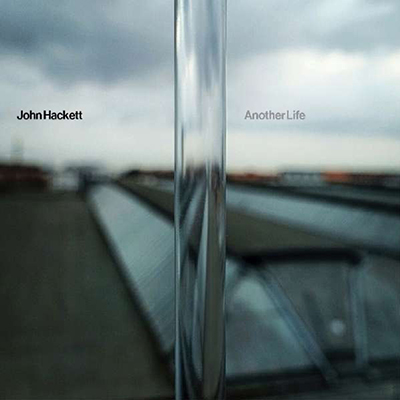
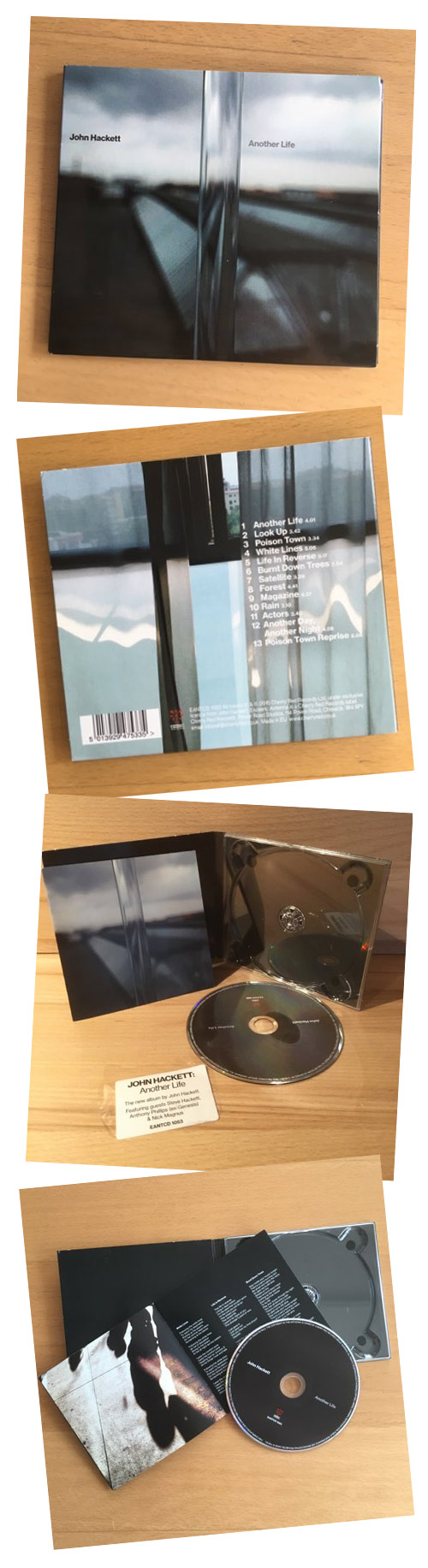
The CD is released in a digipak with a booklet. The artwork shows a view through a curtain hung with gauze curtains onto a dreary, grey concrete landscape. The image is divided by the seam where the curtains meet. But one could also imagine a stream of water rushing through the image. The back cover, however, where the curtains are slightly open, seems to shed some light on the matter, or does it? Grey-blue are the colours of Nick Clabburn's photos, matching the melancholic lyrics.
Another Life (4:01)
The opener and title track begins with guitar chords embraced by a sombre keyboard. John's vocals kick in and rise to the chorus after just under a minute. He sings almost imploringly about breaking out of normality when a car accident forces him to reflect on his life so far. The vocals are accompanied by a beautiful flute solo and great bass, before blossoming into a magnificent guitar solo at 2:32. A comparison with the highlights of Spectral Mornings is appropriate here. Elements of the album In The Court of the Crimson King can also be heard. The opener already establishes the lyrical thread that runs through the album. After an entertaining four minutes, the spook is over. The listener first has to catch their breath. The song has nothing to do with Steve Hackett's 2017 piece In Another Life.
Look Up (3:42)
Guitar arpeggios, initially restrained vocals paired with Steve's singing solo guitar create a short rock song that ends in a magnificent finale reminiscent of Genesis' Wind & Wuthering era.
Poison Town (3:34)
Gloomy, echoing keyboard sounds, melancholic vocals with dreamlike lyrics and canned strings form the framework of the music, which spreads out in waves, telling of the flow of life. A beautiful, thoughtful ballad, which is unfortunately somewhat marred by the synthetic drums.
White Lines (5:06)
A fanfare, guitar arpeggios, pumping bass, subdued keyboards, Steve's wonderful singing solo guitar and John's almost hypnotic vocals set the mood for the Defector album. At five minutes, it is the longest and one of the few fast songs on the album, its beautiful chorus almost cheerfully singing about the way to a huge shopping mall (Junction 8) through Singapore. A critique of capitalism?
Life in Reserve (3:17)
A quiet, sentimental piano ballad is crowned by a wonderful flute solo. John sings soulfully about being abandoned and waiting for the return of his beloved.
Burn Down Trees (2:54)
A lost track from Peter Gabriel's So, or a new Paperlate? The synthetic brass section is reminiscent of Sledgehammer or Big Time. A delightful, tongue-in-cheek pop song with Steve Hackett playing as if liberated.
Satellite (3:29)
What does music sound like when Steve Hackett's harmonica plays alongside Ant Phillips' 12-string guitar and John Hackett sings along? A wonderfully relaxed gem, somewhere between blues, bluegrass and Neil Young. Memories of the acoustic, pastoral Genesis of the Trespass era come to mind. Especially when Ant's harpsichord transports the music into wonderfully melancholic worlds. Alongside the opener, for me the song of the album, which most beautifully conveys the lyrics about the inner conflicts in people's lives. A little gem and a highlight of the album!
Forest (4:41)
John begins with slightly distorted acapella vocals, which are replaced by a beautiful melody. The song progresses in a restrained manner and evokes thoughts of Cured. The opening theme is repeated again and again. John shines on guitar and bass, and the drums, which do not sound synthetic at all, blend nicely into the song.
Magazine (4:37)
The listener can expect another piano ballad. Nick Magnus works with strings, creating an entire orchestra. Guitars are only heard in the finale. A piece that would also have found its place on a Nick Magnus solo album. No wonder, since he co-composed it. It is hardly inferior to Hammer in the Sand.
Rain (3:10)
Rain continues in a melancholic, calm and thoughtful vein. The piece, once again beautifully sung, is dominated by Steve's guitar. It leads, with organ parts, to a wonderfully prog-heavy finale. The Hackett band of the 70s comes to life.
Actors (3:40)
… picks up where its predecessor left off. In the middle of the song, it briefly speeds up until the guitar begins to sing, interrupted only by vocals and sombre keyboard parts. The lyrics are reminiscent of the song Divided Self from the Squackett album, which was also written by Nick Clabburn3).
Another Day, Another Night (4:08)
Finally, things become more cheerful again, brass instruments sound, the keyboard and vocals take over and guide the listener through a lively pop song in the style of the 80s. The flute makes another appearance. The album comes to a relaxed and easy-going end, doesn't it?
Poison Town Reprise (2:08)
Steve's guitar plays bluesy notes and John quotes verses from the song Poison Town: 'I never wanted to be happy, I never wanted sad, I never wanted good, I never wanted bad.' An invitation to the listener to reflect on their life?
All in all:
John Hackett has created an album full of exciting contrasts. Music ranging from prog rock to quiet, almost meditative songs, from pop to even folk. His voice has gained in expressiveness, making you wonder what it would have been like if he had taken over the vocals from his brother Steve. The lyrics tell of life outside the mainstream, of change, despondency, lost dreams and hopes. They have autobiographical traits, because John is also stepping out of his previous life as a musician and slipping into the role of a songwriter. Steve's song-serving guitar work is a revelation. His solos blend harmoniously into the songs, complementing here and there the flute playing of his younger brother, who also shines on guitar and bass.
The result is a successful album that showcases the lighter side of progressive rock without neglecting other musical styles. At first glance, it seems somewhat austere, requiring repeated listening to be fully appreciated, but once you do, it stays with you.
A must-have for fans of Steve Hackett's early solo albums. Anyone who likes the music of Genesis should give it a listen.
John went on tour with the album in his luggage. This led to the formation of the John Hackett Band, which was to attract a lot of attention4.
Author: Thomas Jesse
Remarks:
1. Nick Clabburn also contributed lyrics for Checking Out Of London and wrote Steve Hackett's Sleepers
2. See this Interview
3. see here – compare the Refrain!
4. John Hackett Band