

- Article
- Read in 5 minutes
Mario Giammetti: Tony Banks – Man of Spells. The Magician of Genesis – review
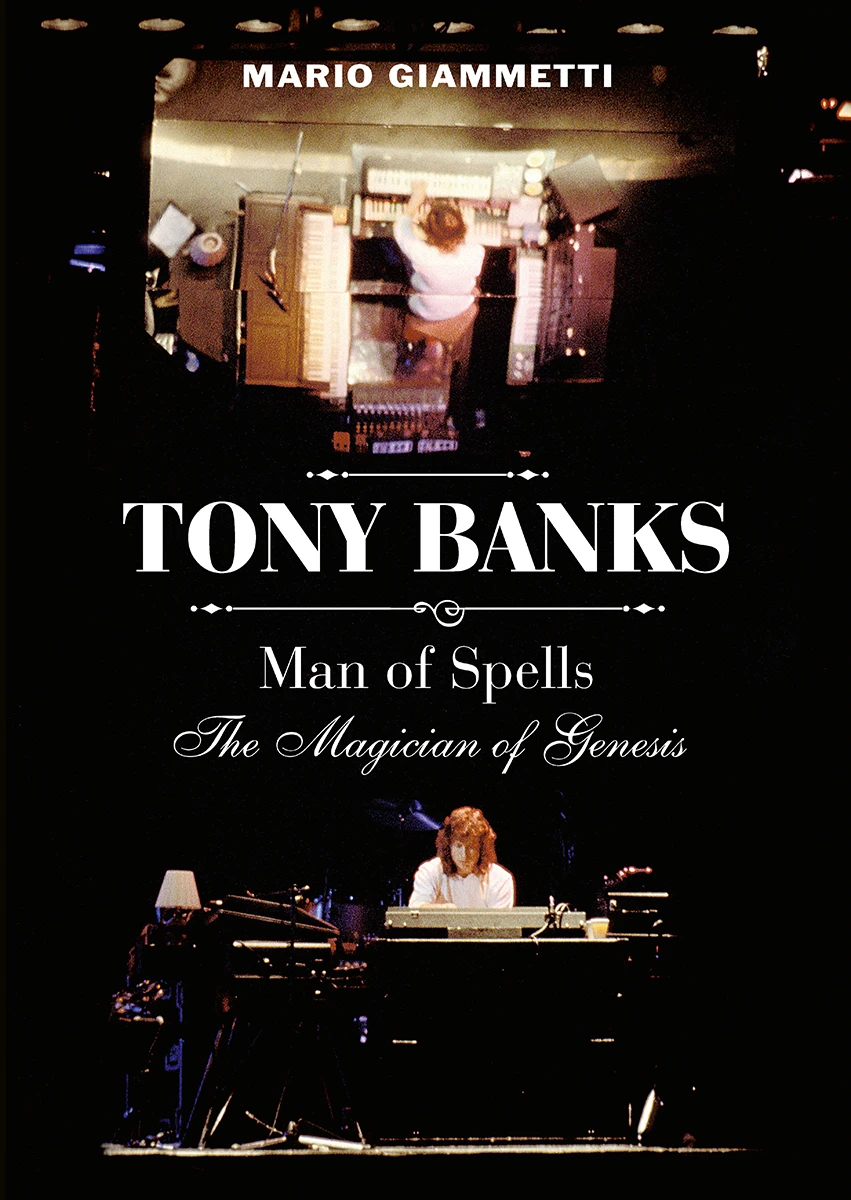
In early 2026, Kingmaker Publishing released the book "Tony Banks: Man Of Spells – The Magician of Genesis" by journalist Mario Giammetti.
Mario and the Magician
Mario Giammetti is likely to be well known to many readers of these lines as the editor of the Italian Genesis fanzine Dusk and as the author of two authoritative Genesis biographies in English. He has been writing about Genesis since the late 1980s and, according to a list in the book, has so far published 17 books (mostly in Italian) about the band, including, under the series title 'The Genesis Files', one publication each (in Peter Gabriel's case, even two) on the individual members of the 'classic line-up', as well as one each on Anthony Phillips and Ray Wilson.
He is now presenting a thoroughly revised English edition of the volume on Tony Banks, originally published in 2006, and quotes a song title from Banks' second solo album The Fugitive in the book's title – namely Man of Spells. To ensure it is clear which Tony Banks is meant, and presumably to make the book easier to market, he is again specified as "The Magician of Genesis". In doing so, the author alludes to the extent to which Tony Banks is seen as a sound and composition artist and as the "musical soul" of Genesis.
The book's design follows that of the two other Genesis volumes also published by Kingmaker Publishing, which is pleasing because the layout is familiar and easy to read. In this book, Giammetti once again draws on his massive archive of interviews and extensive (often previously unpublished) photographic material, having interviewed not only Tony Banks himself but also a number of his friends and collaborators over the years. The material he uses spans the period from 1996 to 2025; he has also drawn on texts from other publications (e.g. it magazine) and websites.
Man of Spells is a documentation of Tony Banks' musical career, with the focus clearly on his solo work. His early development during childhood and adolescence (somewhat of a must in musicians' biographies) is dealt with at the outset, and fortunately we are not presented with yet another exhaustive Genesis biography packed with every possible detail. The sections dealing with the development of Genesis are rather cursory and concentrate on the most important aspects. This is very welcome; anyone picking up this book will, in the vast majority of cases, already know quite a bit about the band's history and has no need for a repetition of what Giammetti has already achieved in impressive detail in the two volumes mentioned at the outset.
The basic structure of the book therefore consists, on the one hand, of chapters focusing on the development of Genesis and, on the other, of (significantly more detailed) chapters on the history of the creation of the respective solo albums, from the debut with A Curious Feeling in 1979 right up to the (to date, latest) release Five from 2018.
As a reader, one gains many insights into Tony Banks' solo work, and I, for one, can say that reading this book has allowed me to engage with it in real depth for the first time. The comments from the master himself, but to a great extent also those from his many collaborators, shed (for the first time in English) comprehensive light on Banks' solo work, which has, after all, long stood in the shadow of his 'mother band' Genesis, as well as the activities of the other (former) band members.
One learns in great detail how Banks himself feels about his solo work (though his view of his own productions often changes with the passage of time), how he feels about creating new music and working on recordings in general, why he chose certain singers for his productions, and much more besides. Whilst reading, I always felt a little for Tony Banks when, in his quotes, he expresses disappointment, even disillusionment, at the lack of recognition for his solo productions.
In the chapters on the individual solo productions, the author goes through the albums song by song, with individual analyses of the music and the lyrics. I found the lyric analyses and the accompanying explanations of the content particularly enriching. I must admit, for instance, that I had not previously given much thought to the theme of A Curious Feeling (a story about a man who is gradually losing his mind) or the narrative structure of the album. This is merely the most striking example of the many insights Giammetti has to offer in this publication.
Reading the book reveals a multifaceted picture that illuminates a side of Banks which, unfortunately, has largely gone unnoticed in the public eye. Whilst his first solo album was reasonably successful (reaching number 21 in the UK charts, after all), his pop productions of the 1980s and 1990s were hardly bought by listeners outside the Genesis fanbase. His soundtrack work remained isolated; a career in the film music industry, which he had hoped for, never seriously materialised. All the more satisfying, then, was the respect he received for his orchestral works released between 2004 and 2018. What a pity that not only his pop songs (with two exceptions, both of which Giammetti mentions), but particularly his compositions for orchestra, were never performed in concert.
It is precisely the many quotes from interviews that paint a picture of Tony Banks as an ambitious musician, torn between hopes of major chart success and deep-seated frustration. With his five pop/rock solo albums between 1979 and 1995, Banks always harboured the ambition of achieving chart success and, even after failing to do so, always picked himself up to try again. This determination to gain recognition as a pop musician also sheds an interesting light on Genesis – contrary to popular belief, Phil Collins was not the one, or at least not the only one, who wanted to steer the 'mother band' towards chart success from the late 70s/early 80s onwards.
At the same time, one gets the impression that Banks was, at times, not only disappointed, but almost hurt – particularly after the high hopes for the joint production with Jack Hue's Strictly Inc. in 1995. I am inclined to believe his statements that he was happy for Phil Collins and Mike Rutherford's great successes. But one cannot help but feel that the lack of own solo success left wounds that did not heal so easily.
The main text is supplemented by two appendices featuring essays by guest authors that shed further light on Banks's keyboard work. The first of these (by Alessandro Berni) reads in places as a veritable philosophical reflection on Banks' virtuosity; the second (by Francesco Gazzara), whilst referring in its title to Tony Banks' 'classical piano art', also discusses, amongst other things, three of his Genesis synthesiser solos and the evolution of his keyboard equipment over the decades. These are fine additions that further enrich the overall picture.
All in all, Mario Giammetti's achievement with this biography is remarkable. He brings Banks' solo work out of the shadows, highlights little-known aspects and thus sharpens the image of Tony Banks as an exceptional musician with great compositional talent. Tony Banks – Man of Spells is a major success that significantly enriches our view of Banks in particular, but also of Genesis in general.
Author: Jan Hecker-Stampehl
Tony Banks: Man of Spells – The Magician of Genesis is available now. Either from Burning Shed (UK) or the Band Wagon USA. It is now also available via amazonUK*.
* Affiliate-link. When using this link, we receive a small commission for your order.