

- Article
- Read in 4 minutes
Mark Bell: Face Value (Phil Collins 1979 – 1981) – review
In the third book of the Album Age series, Mark Bell examines the beginning of Phil Collins' solo career. Heino Rhoden has read it.
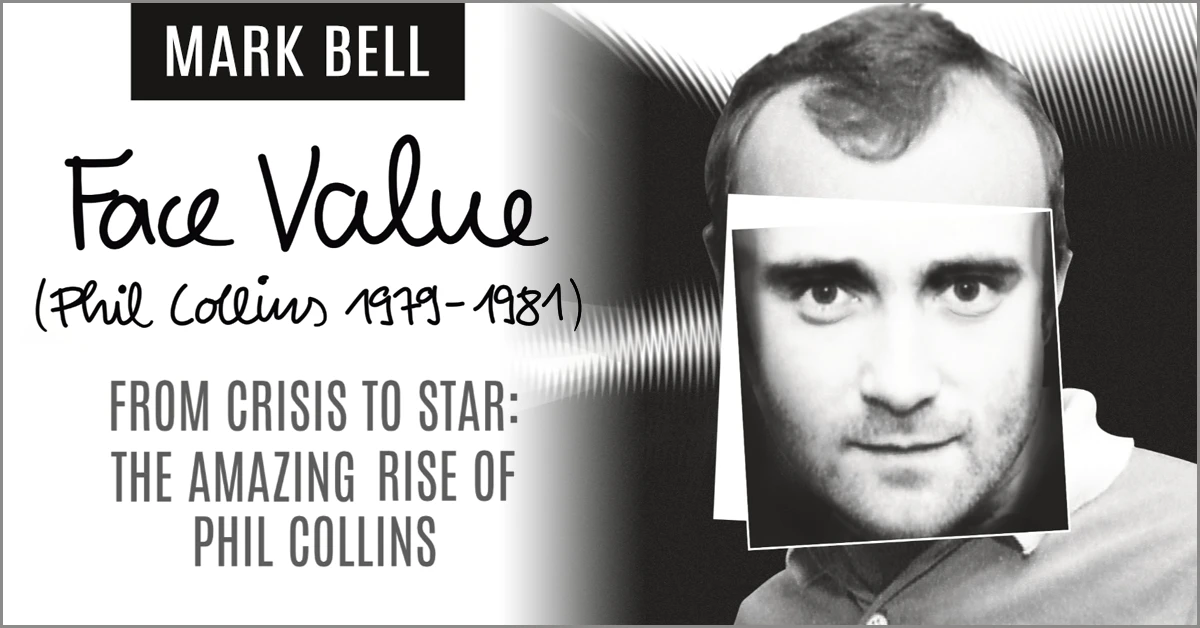
From Crises To Star: The Amazing Rise Of Phil Collins
After Mark Bell had dealt with the Genesis albums The Lamb Lies Down On Broadway and Foxtrot (so far, only available in German), the book about Phil Collins' first solo album was first published in German in early 2024. Before a concert by the tribute band The Musical Box, I met the author at his sales stand in the foyer. When I said I was surprised that, after the two Genesis books, he had now published a volume on Face Value, Mark Bell replied, 'Me too!' But during his research on the works of Genesis, he had accumulated so much material on Phil Collins that it was only logical to bring this work forward.
Now, nearly two years later, the book is finally available in English! The new English edition contains more photos compared to the German edition from 2024.
The content of the individual chapters
The first chapter is essentially a short biography of Phil Collins. It briefly outlines his life from birth to 1978. But brief does not mean superficial! It highlights all the important stages of his life that have shaped him both personally and musically. Mark Bell also goes into details that may be new even to long-time Phil Collins fans!
The second chapter describes the personal background to Face Value. The 1978 marathon tour with Genesis (during which Phil Collins was given the Roland CR-78 drum machine by Mike Rutherford in Japan) put a strain on his marriage. After the tour, Phil put his work with Genesis on hold to save his marriage to his wife Andrea in Vancouver. Tony Banks and Mike Rutherford used the time to release their first solo albums.
The third chapter begins by refuting the often-repeated narrative that Face Value was solely the result of the breakdown of his marriage. It describes how Phil Collins had already been harbouring a desire to release a solo album in order to realise his musical ambitions. In 1979, he began working in his home studio, which he had set up in his estate 'Old Croft'. This is where the Roland CR-78 was used for the first time.
Incidentally, Phil rejoined Brand X and got in touch with Peter Gabriel. While working with Peter on his third album, the gated reverb drum sound was created. It was first used on the track Intruder!
The creation of the Genesis album Duke and the subsequent tour are described in the fourth chapter. During the studio work, Phil had a large number of demo recordings at his disposal. He played some of them to Tony Banks and Mike Rutherford. Misunderstanding and Please Don't Ask were immediately well received and were used on the album. Whether Phil also played In The Air Tonight to his fellow musicians or not could not be conclusively clarified here. During this time, Phil met his second wife, Jill.

In the fifth chapter, Mark Bell describes the actual creation of Face Value. After Hugh Padgham was hired as producer, the band began searching for fellow musicians. Phil already had clear ideas about who he wanted. Townhouse Studios was chosen as the main recording studio. Even the technical description of the recording techniques and the refinement of the gated reverb drum sound are described by the author in a way that is understandable and entertaining, even for non-musicians.
The second most important recording location was Village Recorder Studios in Los Angeles. This made sense, as the members of Earth, Wind & Fire Horns, as well as Stephen Bishop, Alphonso Johnson and Daryl Stuemer, were based in Los Angeles.
Finally, in Chapter 6, Mark Bell describes the music and lyrics piece by piece in his usual style. The passages described are specified down to the second so that readers can find the passages described when listening to the song. With over 30 pages, In The Air Tonight takes up a large part of the chapter. The description of the rhythmic elements alone (use of the CR-78 drum machine, the iconic drum fill and the gated reverb drum sound) is very interesting!
The last main chapter provides details about the promotional campaign and the release of Face Value. It also explains why there was no tour to promote the album. Finally, the surprising chart success and the reception of the album in the music press are described.
The epilogue concludes by discussing the continued life and significance of Face Value. It shows that this album was not only an important work in Phil Collins' creative phase, but also had positive repercussions for those involved and had a special influence on the music world.
All in all
Mark Bell has once again succeeded in writing a well-researched non-fiction book. It is a pleasure to read despite its high academic standards. All sources are neatly listed in footnotes. This means that the book can also be used without restriction for further research.
I found the book thoroughly exciting and read it almost in one sitting. I am already looking forward to the next book in the Album Age series. And Mark Bell assured me in the conversation mentioned above: 'There's more to come!'
Author: Heino Rhoden (10/2024), translated for the English publication in 03/2026.
Mark Bell – Face Value (Phil Collins 1979 – 1981) From Crises To Star: The Amazing Rise Of Phil Collins is available at amazon worldwide, i.e. amazonUK*, amazonFR*, amazonDE* and others.
Discuss this book with other fans in our forum in this thread.
* Affiliate-Link: By purchasing through these links, we receive a small advertising reimbursement.