

- Article
- Read in 6 minutes
Mechanics Lights and Sound: Interview with Paul Howling and Steve Carr in Berlin
Before the final Mechanics show in Berlin, we conducted a behind-the-scenes interview with Steve Carr (sound) and Paul Howling (lights).
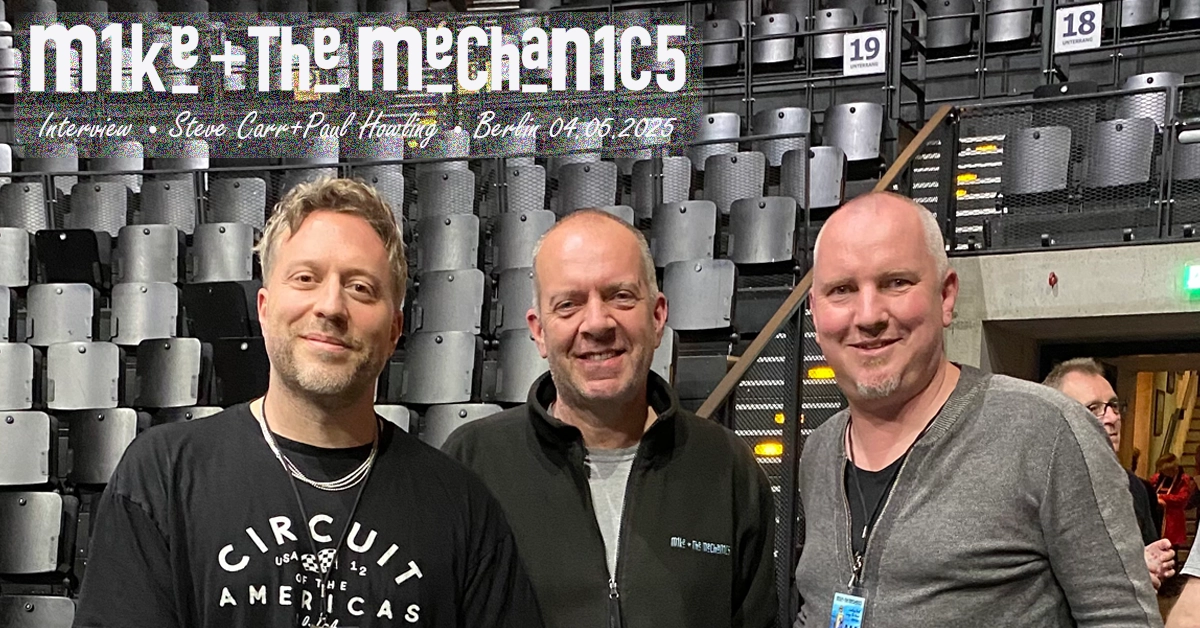
In the afternoon before the final show of the Mike + The Mechanics – Looking Back: Living The Years Tour in Berlin, we sat down with Paul Howling (Lighting designer) and Steve Carr (Front Of House sound) for a chat about working for Mike + The Mechanics and beyond. After interviews with Mike Rutherford and Tim Howar, this is the third Mechanics-related interview we conducted during the tour.
GNC: Paul, Steve – thanks for this opportunity! We usually do interviews with Mike or musicians in the band but sometimes we also want to talk to the people who actually rund the show. So, lights and sounds are both important for any live show. How did you get in touch with Mike?
Paul: I am responsible for the light show and I met Tony Smith through Nick Mason. We've been working with Nick Mason and his Saucerful of Secrets shows since 2018. And there are a few of us who have been working with several artists over the years, so we know each other well. And I actually have already worked with Mike before.
Steve: I'm doing the front of house sound and I started working with Mike + The Mechanics for this run of shows. And I also got the job through this Tony Smith connection and working with Nick Mason.
GNC: So you are basically from the Nick Mason crew and now you work for the Mechanics for this tour
Paul: Yes, exactly.
GNC: What's the difference between working for Nick Mason and Mike + The Mechanics from your perspective?
Steve: I suppose audio-wise it's just the content, as it's practically a similar line-up technically. But the content makes it different. Nick Mason's show is much more focused on sonics and psychedelia. And with the Mechanics it is much more about the structure. It's a pop/rock show and therefore it's much more about the vocals and the lyrics, the melody and simply about the song. With Nick Mason it's more about the atmosphere, the mood and the sonics. We have a lot less emphasis on the vocals. And a lot more emphasis on the soundscape. So from the sound perspective, that sums it up I think.
Paul: It's similar from the lighting point of view, actually. The early Pink Floyd music is very psychedelic and very organic and it's also different every night, for us lighting people. And the Mechanics are, as Steve said, much more structured, a pop/rock show. And it tends to be the same formular for every performance.
GNC: If I am not mistaken, both Nick Mason and Mike + The Mechanics don't change their set a lot during a tour ..
Steve: It's quite locked in, yes.
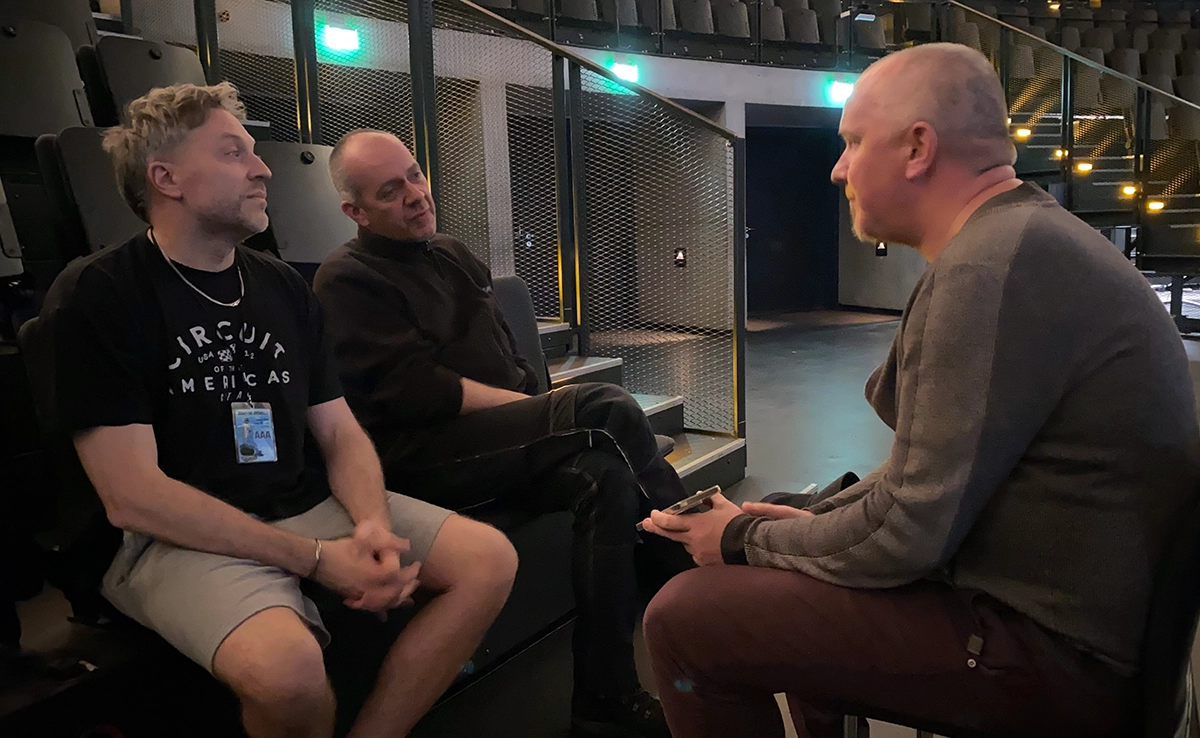
GNC: Is this an advantage for you or would you rather have more flexibility to try something?
Paul: I wouldn't mind changing it around. There's something to be said about having things familiar, day to day. You have to keep the quality of the output quite high. When it's locked in, you could argue that maybe you lose a bit of excitement and freshness, but that's not the case.
Steve: I think for something like Mike + The Mechanics, having the same set every night, we can fine tune a lot of the lighting sequences because we know exactly what is coming next.
GNC: I saw the Leipzig show and Mike already told me before the show that you had some limitations with the lights set…
Paul: Oh yes! We have three set of those curtains – or let them call blinds, but we only could put up two of them in Leipzig.
GNC: So what are you doing then? What is your reaction and you find such limitations at the venue, maybe finding out about this on the show day only?
Paul: Well we usually put up as much lights as we can but obviously in Leipzig we couldn't, as there were a couple of limitations in the venue with the ceiling and so on, but we are very flexible. These blinds wee Mike Rutherfords idea. And they are actually very flexible, so we can do big venues and small venues and venues with special limitations as in Leipzig. And still it looks quite impressive.
GNC: I have seen Mike + The Mechanics every time they were on tour here since 2011. And they were always great but during this tour, they just sound better than ever. And that seems to be the case in every venue. Nevertheless, some fans of course are critical about certain venues. Do you also have some sort of "I wouldn't recommend" list for venues?
Steve: Different venues present different challenges. But that's part of my job and I have to come up with solutions. So Paul might not get everything in he wants in certain venues, but still wants the show to look great.
And basically, I work the same way when it comes to a good sound. Some days, the room has some sort of characteristics for the sound. And that might affect the way I mix the sound. I give you a quick example. Maybe you have a specific reverb on the voices but the hall has such a big reverb that I can't hear my reverb. So I have to make a compromise. So like today, I won't use my reverb, I just use the hall's reverb. It works like that. On this tour, I enjoyed every show. Because that's what we do during the day. We make the room and the mix work for the live show. So different rooms have different challenges, some I enjoy more than others.
GNC: And how is it regarding lights? How important is the height of the venue for you?
Paul: Well obviously I prefer a setting like here [Tempodrom Berlin] where we have everything out. It's high and it's big. And this is my favorite setting, of course. But as Steve says, we quite like the challenge sometimes, when it's unusual or smaller, and we usually have a satisfying result.
Steve: That's the point, isn't it?
Paul: Exactly. You always get out what you put in. I think all the shows on this tour have been really good.
Steve: For instance – the Royal Albert Hall in London is notorious difficult regarding acoustic, but it was one of the best shows. As long as you don't fight it and go with it, it will work.
GNC: Is this ceiling here in Berlin a challenge?
Steve: Yes this could be a tricky room! But again, it has a great atmosphere, the crowd is usually really good. As long as we can do our job during the day it will be a great show. The trick is really don't fight the room, sit in the room and then build it up. Just take your time.
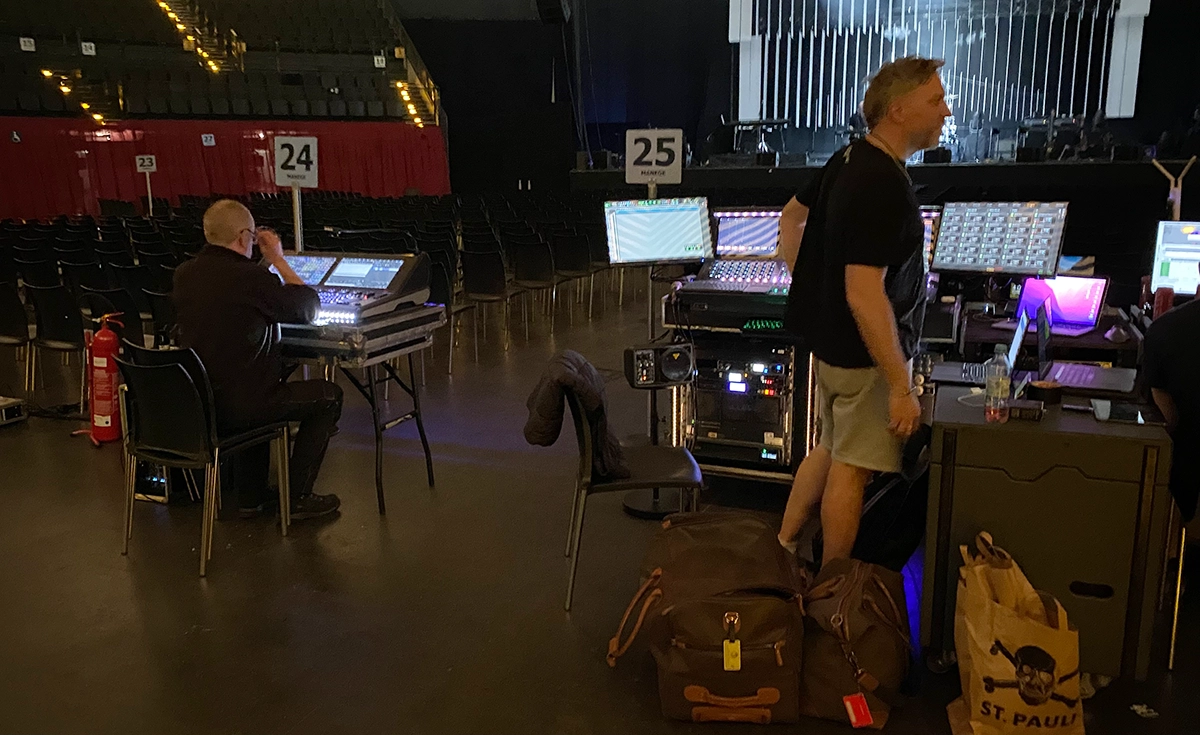
Jo Greenwood from the management joins and throws in:
And how about the "monkeyshit" place in Munich?
Steve: Yes Circus Krone is also tricky, but a great venue. And it really was a great show.
Paul: It certainly was a challenge, I was in dialogue with the Munich riggers for weeks in advance. Can we do this? no, how about this? yes, why not that? We have to check. That was quite a challenge but as Steve says it was quite rewarding. Great audience, great atmosphere. We enjoyed it very much.
GNC: How do you develop a concept for the tour, Paul? Do you come up with an idea and present it to Mike or do meet him first and develop something afterwards?
Paul: Every Mechanics-Tour has a different theme. And those are Mike Rutherford's ideas. So he came up with the idea to have these blinds. And then a guy called Paul Kell who was the original lighting designer then built a lighting rig to go with the blinds, so that was a Paul Kell and Mike Rutherford collaboration.
GNC: What's coming next for you after the tour?
Steve: I will be back at the Royal Albert Hall for a one-off show, the VE Day 80: The Party show. And then I will work with a DJ over the summer, DJ Cargo. And then Dire Straits Experience later in the year.
Paul: I will have a couple of weeks off at home.
GNC: Well deserved after 45 shows…
Paul: Yes exactly and then a European tour with John Legend.
GNC: So in case the Mechanics decide to tour again, you'd be happy to join the crew again
Steve: Oh absolutely!
Paul: Yes we want to and we asked him already, when is the next one?
Steve: Yes, it's a lot of fun to mix.
GNC: So, that's it. Thanks guys for the chat, much appreciated!
Paul: Perfect – thanks as well
Steve: Yes we enjoyed the chat. So enjoy the show, bye.
Interview and transcript: Christian Gerhardts
Photos: Peter Schütz
Special thanks to Jo Greenwood!