

- Article
- Read in 6 minutes
Phil Collins – Hello, I Must Be Going (2016 Deluxe Edition) – review
After Face Value, Phil Collins' second solo record became a defiant album. Though he looked forward he also kept dealing with the divorce. 2016 saw the re-release of the album, and we have checked it out.
Note: This article discusses the re-release of the album Hello, I Must Be Going!. A detailed review of the album itself can be found at this link.
The artwork
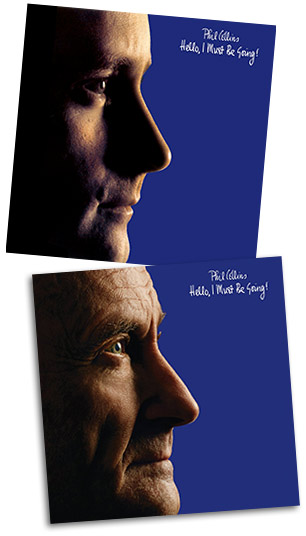
Hello, I Must Be Going! also underwent a 'cell rejuvenation' treatment, and so the aged Phil is also featured on the cover. Once again, the reproduction is very detailed and it is fun to look at these covers again and again. As with the other albums, the back cover has also been re-recorded. The digipak is structured in the same way as the other 2CDs in the series and is completely in bright blue. It also includes accompanying text by Phil.
The remaster
As with Face Value, we also have a purely 'perceived' gain in clarity with Hello, I Must Be Going!. The album is now louder without destroying too much. In some places, for example in The West Side, you can notice a gain in clarity in the high frequencies and in other songs a minimally more powerful bass reproduction.
Overall, less was gained from Hello, I Must Be Going! than from Face Value, but this is by no means a bad thing, as the original already sounded very good. However, if we look at it from a technical point of view, it becomes clear that the dynamic range has also been reduced here. This is a normal effect when the overall volume is increased.
Even though the edits were rather subtle, there are still noticeable differences. The jump from the original album to the so-called Hoffman Remasters (24-carat gold CDs at High Fidelity) was relatively clear and also meant a certain loss of dynamics.
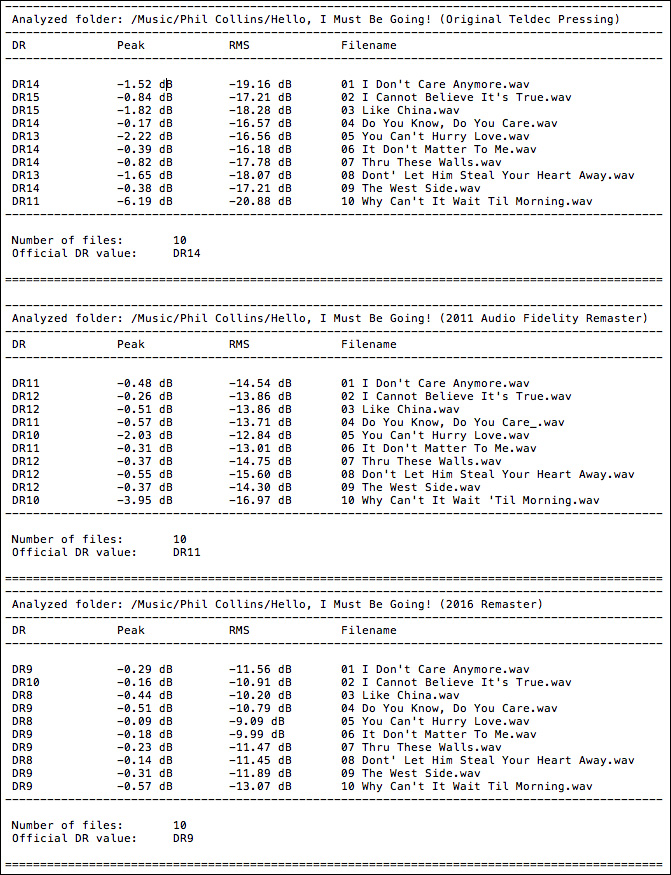
Let's look again at the dynamic range (DR) value, which represents the lowest and highest peaks (or the distances between them). The higher the value, the better. The original CD (in this case, the German pressing) had a very good DR value of 14, while the peaks ranged between -0.39 and -2.22. The outlier is Why Can't It Wait Till Morning, which is of course due to the instrumentation. Here, the peak is only -6.19. The 2011 Hoffman remaster is louder, but the boost shows clear differences. For example, the value for It Don't Matter To Me and Why Can't It Wait Till Morning has jumped quite a bit, while it has remained almost the same for You Can't Hurry Love.
This also affects the DR value, which is still a good 11, but significantly lower than on the original release. The remasters are now louder, which is most noticeable on You Can't Hurry Love and Why Can't It Wait Till Morning, where the peak boost is around 2 and 3.5 dB respectively. Of course, this has an effect on the overall dynamics – in the 2016 remasters, this is only 9, which is a comparatively poor value (even compared to Face Value). You can see the results in the graph (click on the graph to enlarge).
However, from a purely subjective listening experience, this cannot be confirmed. Here, the 2016 remaster impresses with its clear and powerful sound. In normal use, this should not matter, but when using high-end equipment, it could be more audible.
The bonus tracks
I Don't Care Anymore (live)
It's a classic. I Don't Care Anymore is one of those songs that is 'played live far too rarely'. This version was recorded in Melbourne, Entertainment Centre on 13 April 1985. And Collins' aggressive vocals reveal why he didn't play it later on. Alternatively, a (vocally much less aggressive) version from the Both Sides Tour would have been possible – or MTV Unplugged or the 'stadium version' based on the Unplugged show, which we were able to experience at the concerts in Hanover.
I Cannot Believe It's True (live)
This version was most likely recorded in Pasadena, Perkin's Palace on 19 December 1982.
Like China (live)
You Can't Hurry Love (live)
It Don't Matter to Me (live)
All songs are from Dallas, Reunion Arena on 29 May 1985. That's where Phil's concert video No Ticket Required was recorded. Fans have long been familiar with the tracks in this version, as they were already available on various bootlegs and torrents. Now some of them are getting an official release. Let's hope that we'll get to see the entire show on Blu-ray at some point… It Don't Matter To Me could of course have been taken from a later tour.
The West Side (live rehearsal)
This is where it gets interesting. It was known in advance that this was a rehearsal version, but it was not clear where it came from. Now it is clear: this version comes from Montreux 1996 – the Big Band Tour! In addition to Hand In Hand, Collins also refined his second great instrumental piece – The West Side. This is really great stuff. Terrific! The question remains as to why he didn't also include Hand In Hand as a rehearsal version on Face Value…
People Get Ready (live)
This song by Curtis Mayfield was the final piece of the show at the time, a kind of finale. On the bootlegs, Phil's 'thank you everybody goodbye – that's all we know' always followed, which is unfortunately missing here. But then the piece would have had to be included at the end. With this track, he once again deviates a little from his concept (showing how the album songs developed live), but so what. A great piece!
Thru These Walls (live)
In this order of bonus tracks, it seems a little strange to place Thru These Walls after People Get Ready. Another track from the Pasadena concert. And another classic that is played far too rarely.
It's Alright (live)
Here we have another logical break, similar to And So To F on Face Value. It's Alright was probably only played once on the tour, and the version here is also the well-known version from Dallas in 1985. Fans will already be familiar with it from the live video and various bootlegs. This track should have been on No Jacket Required.
Oddball (demo of Do You Know, Do You Care?)
This demo is also not unknown and was previously available on CD as the B-side of You Can't Hurry Love. It also sounds as if the demo has a little more noise than the already known version.
Don't Let Him Steal Your Heart Away (demo)
Another beautiful demo of a 'forgotten' Collins song. Although it was a single and was also played live at the time, it apparently didn't feature in Collins' world anymore. In his accompanying text, he writes, 'As far as I can remember, we didn't play the song at all back then.' He's wrong about that. Still, it's nice that this demo is now being officially released. And it's a shame that the live version didn't make it.
Evaluation of the bonus material
Compared to the first batch (especially Both Sides), there is a significant leap in quality in terms of the selection and sound of the material. What remains, however, is a certain inconsistency and also a strange sorting. Theoretically, And So To F should have been on this album and It's Alright on No Jacket Required. Strictly speaking, however, none of these songs should have been included, as Collins wanted to use the bonus tracks to show how the album tracks 'live on' in concerts. It would also have made sense to include more versions from later tours (such as the magnificent The West Side, the big band version of which is simply fantastic).
There is also a version of Why Can't It Wait Til Morning by the band Fourplay (Nathan East), on which Collins sings. That would have worked well here too. The B-side The Man With The Horn also comes from the album session, but at the time it was only released as part of the singles from No Jacket Required. So it's quite possible that we'll soon find this track elsewhere, as a continuation of the inconsistency in the bonus track selection. The demos on offer are fine. Overall, the material makes up a little for the Both Sides disaster.
Conclusion
A purely emotionally improved remaster and consistently good sound quality on the bonus tracks. That's what you'd expect, and that's what you get here. Occasionally, one wishes for a more creative selection of live tracks, especially in terms of the recording location. In the end, many of the songs will come from the concert films that have already been released – and it's certainly worth considering reworking those as well. It is somewhat irritating that Collins, given the wealth of concert recordings he claims to have, does not draw on them – perhaps it is just a matter of time and logistics – but it is a shame in any case. Nevertheless, we have once again been treated to one of the better new releases.
Author: Christian Gerhardts