

- Article
- Read in 5 minutes
Simon Collins – Becoming Human – album review
In autumn 2020, Simon Collins released a solo album after a long break. Siegfried Göllner took a closer look at the work.
Seven years ago, Simon Collins and his band Sound Of Contact released their highly acclaimed album Dimensionaut. A European tour as the opening act for Spock's Beard, including a performance at the Night Of The Prog Festival, followed, and everything seemed set for the project to continue. The social media channels were filled with updates about writing sessions, but then things got confusing. Break-up, reunion and finally an arrest for drug possession made the tabloids (no criminal charges were brought). But musically: nothing. The protagonists Simon Collins and Dave Kerzner ultimately went their separate ways. The latter has since released an almost unmanageable number of albums, all tailored to a retro prog audience. Simon Collins needed more time before he was able to release Becoming Human in September 2020, the follow-up to his third solo album U-Catastrophe (2008).
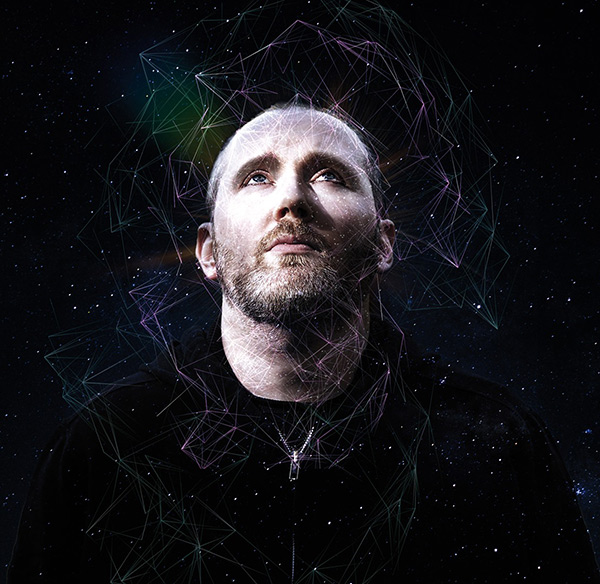
In an interview with the internet portal Sonic Perspectives, he revealed that the complicated band situation was compounded by a difficult personal period: problems with addiction (which had often been hinted at) and a divorce. Simon moved to Ireland, where he found the peace and quiet he needed to finish his solo album in his own studio. He was able to enlist Robbie Bronnimann as his most important collaborator, producer, sound designer and co-composer of eight tracks. Bronnimann is primarily active in the field of electronic music and as a remixer. This influence is very evident on the album, although electronic music is not new territory for Simon Collins, who already explored these realms on his solo debut and also worked as a DJ.
Although Collins reinforces this soundscape through the exclusive use of V-Drums (electronic drums), this is not a pure electronica work, as both his drumming and vocal style are clearly rooted in rock. His progressive side is also evident in the structure of the songs and in the instrumentation, which also includes piano touches and guitar. Last but not least, three songs written together with his Sound of Contact bandmates provide additional influences. Collins' goal was to create a hybrid of his electronic and progressive influences.
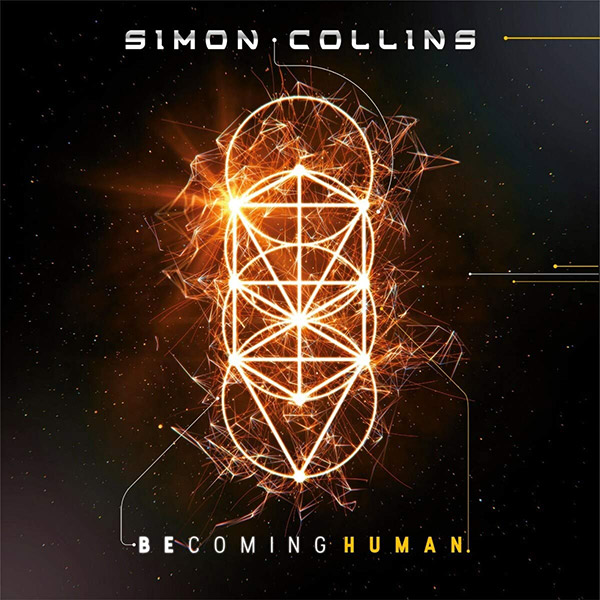
In the lyrics, Collins addresses both personal issues and big questions about humanity. As on Dimensionaut, science fiction themes are also well represented. Above all, it is a very personal album, as he opened Sonic Perspectives: 'I'm not just writing songs about who I am, I'm writing songs about who I'm striving to be. It's a very personal album.'
The album kicks off with the short, spacey synth intro Into The Fray, which could easily be used as background music for a sci-fi film featuring a spaceship hurtling past. This is followed by the title track, Becoming Human, which was also released as the first single. In terms of structure, the song anticipates much of what can be heard on the rest of the album. A hymnal chorus alternates with sparsely instrumented verses in spoken word, giving the extremely catchy song a lot of dynamism and building up a hypnotic tension. Lyrically, Becoming Human deals in a sense with the spiritual becoming of humanity. Collins shows himself to be inspired by the astronomer and author Carl Edward Sagan ("We Are Made of Star Dust"), whose quote 'We are a way for the universe to know itself' he has tattooed on his arm.
The Universe Inside Of Me is perhaps the most varied song on the album. After a spacey start with percussive synth effects, the tempo picks up in between, and after about three minutes an instrumental section kicks in, in which Collins really lets loose on the drums and also shows off his vocal abilities, before the song enters a quieter, more atmospheric section at 4:15. Just a minute later, you feel like you're at a rave (the author vaguely remembers the 90s) and Collins shows that he used to be a DJ. This part will probably make some traditional rock fans want to switch off. Before it gets too steep, however, the track returns to the chorus and finally to an atmospheric fade-out.
These changes of direction may seem a little too deliberate, which is why the song falls apart a little into its sections and, of all things, the most electronic song on the album suffers an old prog fate.
Man Made Man starts with an intro reminiscent of Nine Inch Nails or later Muse and thrives on the alternation between tempo and atmosphere. This Is The Time, on the other hand, oscillates between awkwardness and apparent beauty. At just under four minutes (apart from the intro), the shortest track on the album is again very personal, told from the first-person perspective of a drug addict. Thoughts Become Matter also can't do without an intro with swirling synths, which reveal a beautiful stereo panning when listened to on headphones, then the drums kick in with a driving rhythm, creating a Depeche Mode feeling. The vocals remain in spoken word throughout, which is resolved melodically in the chorus.
I Will Be Waiting starts with sparse accompaniment in the background. This is then mixed into the foreground and, with piano and distortion effects, is reminiscent of newer Gary Numan songs before the drums kick in halfway through the song. Here, Collins skilfully demonstrates how he knows how to use the interplay of vocals with minimalist accompaniment and overwhelming walls of sound to bring dynamics and tension to his songs.
No Love is a poppy, up-tempo song with excellent drumming, which would perhaps be even more impressive if played acoustically. Living In Silence is another extremely dynamic song with percussive synth bass and sound effects. Once again, the chorus is skilfully staged in an anthemic style. In 40 Years, Simon Collins describes his 40-year journey to contentment and self-acceptance. Acoustic and electric guitar work provide variety in the arrangement. In places, the song is more reminiscent of his father's work than any other on this album. Next, So Real shines with tasteful electric guitar work and a Coldplay feel, a potential radio hit.
Simon Collins saves the best for last. The nine-minute long track Dead Ends builds up a menacing, dark atmosphere, then relies on piano and very restrained spoken vocals to convey the dystopian sci-fi theme. It's not until 3:30 that there's an outburst into a storm of sound, in which Collins also lets loose with his vocals. With these contrasts, which have already been observed several times on the album, he creates the greatest effect here, a brilliant finale.
With Becoming Human, Simon Collins has succeeded in creating a mature album that combines pop appeal and atmosphere. It offers both potential hit material and long tracks with enough variety and dynamics to entertain fans of proggy sounds and, with Dead Ends, perhaps the best piece of his career to date. The production is first-class, and while the soundscape and some of the effects are certainly not to everyone's taste, pleasing everyone – and possibly all fans of his father – can never be the goal of an independent artist.
Line-up:
Simon Collins – vocals, drums, key
Robbie Bronnimann – keys, programming, sound design
Gaz Williams – bass guitar
Kelly Avril Nordstrom – electric & acoustic guitars
Robin Boult – electric & acoustic guitars
Author: Siegfried Göllner