

- Article
- Read in 8 minutes
Nick Fletcher – An Unfolding Of Miracles – review
With "An Unfolding Of Miracles," Nick Fletcher is already releasing his sixth album in his sixth year. Thomas Jesse reports.

Preface
Now Nick Fletcher has struck again for the sixth time, producing a new jazz-fusion-prog-rock album. It is very difficult for this reviewer to resist the fascination of this exceptional artist's body of work. So, dear readers, we must be careful that this reviewer does not completely succumb to this fascination, become utterly captivated by the music, and lose sight of subjective objectivity. Let's listen and let the wonders unfold.
Background, Album Title, and Cover
With An Unfolding Of Miracles, Nick Fletcher builds on his previous album, The Mask Of Sanity. Once again, he explores the theories and psychology of the Swiss psychoanalyst C. G. Jung (see also an English Wikipedia article). Across nine songs, he tells the story of a journey inward—into the unconscious—leading to fulfillment in harmony with oneself. Rooted entirely in Jungian psychoanalysis, this journey leads through conflicts and doubts toward insight and personal growth. With this work, Fletcher joins the ranks of artists such as Peter Gabriel, Genesis, and Peter Hammill, among others.
The songs form a cohesive whole, building on one another, so that thematic and musical repetitions (even in relation to the previous album) are intentional. The journey, which feels like a cinematic work, begins with a look back at the past thirty years before shedding light on the current developments that stem from it.
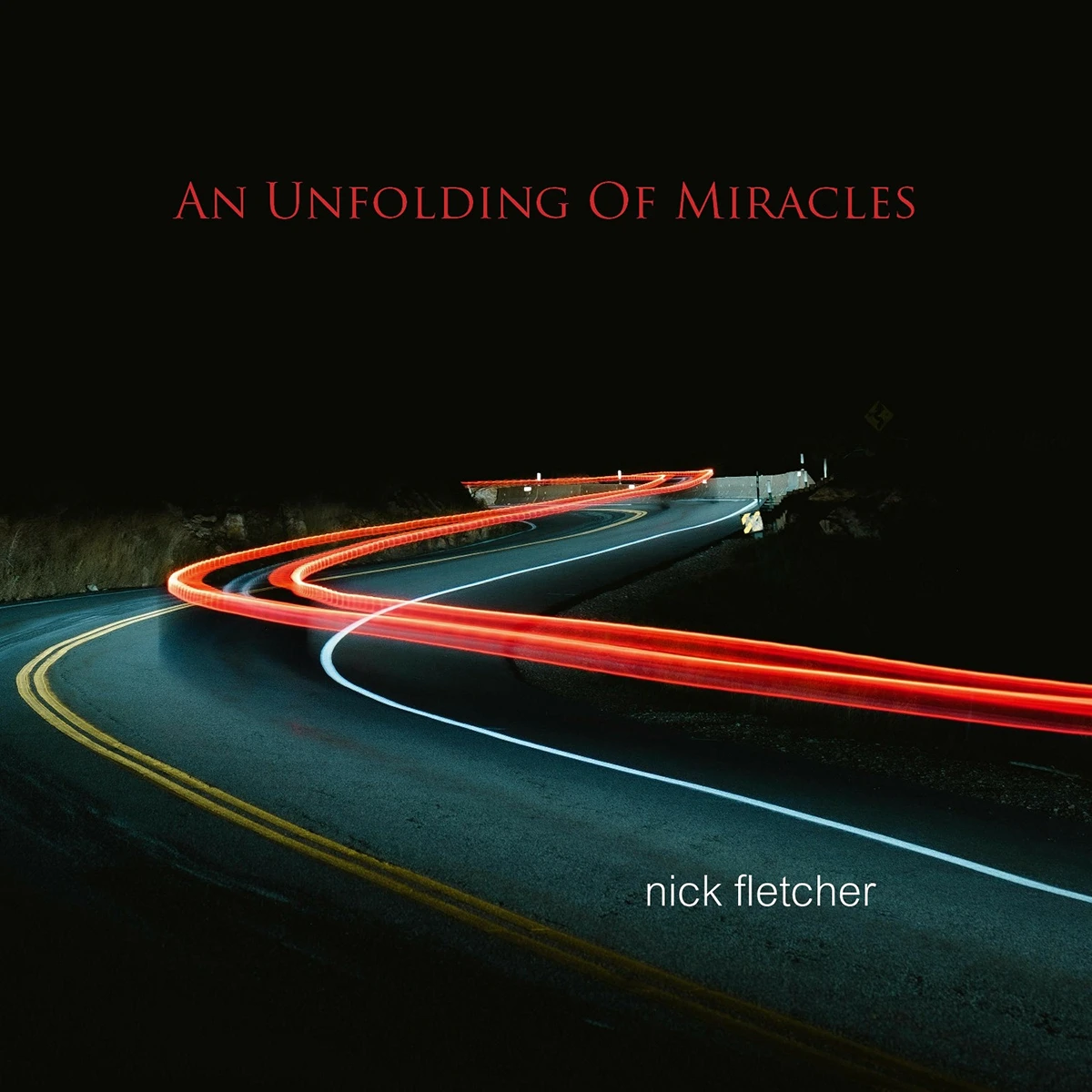
The album cover symbolizes the journey. We see an S-curve in a road shrouded in darkness, with a double red ribbon floating above it. Are those the taillights of a car speeding by at high speed? A dreamlike image in which we see our lives flying by as if in fast motion? Where is the stopping point? Where is the moment of inner reflection? As usual, a poem by Samantha Turner, "Rebirth," adorns the liner notes in the booklet.
In addition to Nick (guitars, guitar synthesizer*, bass on Track 5), the album's contributors are:
Co-producer and mixer Caroline Bonnett: keyboards (Tracks 5 & 8) plus loops
Roberto Porta: drums
Jonathan Ihlenfeld Cuniado: 5-string bass, fretless bass
Olga "Dikajee" Karpova: vocals (tracks 4, 5, and 9).
A new addition is Tomasz Bura on keyboards (tracks 2 and 3).
Songs
At the beginning of each song's interpretation, the reviewer provides brief insights into the concepts of Jung'ian's psychology alluded to in the respective song titles.
Song Of Acceptance (Thirty Years Earlier) [2:01]
For Jung, acceptance is an active path to self-knowledge. It is a prerequisite for psychological healing and personal growth. Only self-knowledge leads to inner freedom. It is the key to bridging the divide between the conscious ego and the unconscious self. This path leads to psychological balance.
The recollection of this state—or rather, of what it was like thirty years ago—serves as a kind of prelude. Nick's solo guitar plays a dreamy, melancholic melody, accompanied by distant sound collages. It brings to mind Alan Holdsworth. Steve Hackett might also have served as an inspiration.
To Be Seen, To Be Heard [6:46]
According to Jung, being seen and heard is a need that is closely linked to the development of one's own self. It goes far beyond mere social recognition.
A drum roll brings us back to the present. Musically, the song evokes the past. Lyle Mays and Pat Metheny would love this song. Fanfare-like sounds accompany a solo guitar. A guitar synthesizer and keyboards—brilliantly played by Tomasz Bura—create an exciting atmosphere. Nick's wonderful guitar floats above it all, carrying the piece along in a relaxed manner. Thus, the music floats sophisticatedly between cheerful playfulness and sophisticated jazz-fusion rock. The finale ends abruptly…
Light Of Becoming [7:43]
According to Jung, light is defined by the shadow (unconscious, dark, repressed aspects of the self). These aspects must be accepted and understood. Recognizing the wholeness of light and shadow—and thus integrating the shadow—leads a person to their inner center.
… but it picks up again here. The cheerful, playful jazz-fusion rock flows into a brilliant fretless bass solo by Jonathan Ihlenfeld Cuniado. Percy Jones is the inspiration here. It's no surprise that the music is reminiscent of laid-back tracks by Brand X. The realization that our light and shadow are to be viewed as a whole doesn't come with a bang, but is a slow, harmonious process of discovery. The song reflects this with its gentle ebb and flow. It sounds like a wonderful symbiosis between Pat Metheny and Brand X and is a highlight of the album.
An Unfolding Of Miracles [6:01]
According to Jung, the greatest miracle is individuation—the lifelong development of the human being toward wholeness. Become who you are. For Jung, miracles are phenomena that are not causally linked but are connected by a deeper meaning. He coined the term "synchronicity." They are not supernatural events originating from outside, but rather the result of inner transformation (individuation).
The title track begins slowly, weaving dreams, warm and relaxed like the setting of a psychotherapy session. A magnificent bass line, caressed drums with gentle cymbal play, and a guitar synthesizer envelop Olga Karpova's elfin, murmuring vocals, which begin around the 2-minute mark. A minute later, the bass and vocals perform a duet. Time and again, the sound threatens to drift away, but the drums bring it back. We're drawn into this wonderland as if by magic, as though our unconscious is taking over from rational thought. Let's dive back into our childhood, when miracles were an everyday occurrence, fairy tales were real, and every new discovery was a sensation. The title track is a prime example of Nick's musical style. Simply outstanding.
Unravelling Of Illusions [6:56]
Unraveling illusions (sensory deceptions, errors) is at the heart of the (painful) process of individuation. Jung speaks of social illusion (persona), the illusion regarding others (projection), and the collective (societal) illusion. These are components of psychological reality. This disillusionment is crisis-ridden (loss of familiar protective shields) but is an act of liberation.
The illusions are blown away musically. The pain of realization is created by offbeat guitars reminiscent of Robert Fripp. The result is a staccato-like chaos à la Van der Graaf Generator. Jazz meets metal meets prog. Frantic drums form the foundation for swirling instrumental arabesques. Yes, it takes on a slightly oriental feel until, at 2:30, a guitar solo brings a bit of calm—though this calm is deceptive. The guitar's floating sound lasts only a minute. Then, with Olga Karpova's vocal outbursts—which are almost drowned out by the cacophony of the instruments—the song returns to the theme of the beginning.
The bass, which remains more in the background, is played by Nick himself. The dismantling of illusions comes to an abrupt end. We, the listeners, find ourselves back in the real world. The veil of illusions has been blown away. The outbursts of the tormented subconscious have come to a temporary end.
Only Now in Dreams Pt 1 [2:49]
For Jung, dreams are messages from the soul. They reflect deep knowledge, serve as a source of balance, and guide us in maintaining emotional equilibrium. A series of dreams often follows an inner plan and plays a key role in the process of individuation. They lead to holistic maturity and self-knowledge.
Our ears are now soothed by a beautiful, transcendental, dreamy solo on an acoustic guitar, set against a floating tapestry of Frippertronic-style soundscapes. Faint touches of percussion can be heard in the background. A piece like a gentle, liberating awakening after a nightmare.
The Path Of Fire [5:48]
For Jung, fire symbolizes the process of transformation, inner purification, or the journey through a crisis. In this process, the ego is dissolved and the true self is revealed.
Drifting, flowing sounds dominated by a sobbing guitar—supported by a guitar synthesizer—evoke the image of a journey toward the self. Starting at 3:25, arpeggios emerge, enveloping a beautiful, Pink Floyd-esque solo played by a jubilant guitar. Here, Nick sounds very much like the late Steve Hackett. The path of fire seems to have been traversed. The journey to the self is complete.
The Abscission Zone [4:48]
The title is actually a term from botany. It describes the area of tissue where parts of a plant detach. For example, where leaves detach from tree branches in the fall. Applied to psychology, it refers to the process of letting go of the old (e.g., certain behaviors) in order to grow, find oneself, and heal.
This transition is conveyed through the drums, combined with energetic guitar riffs and melodies reminiscent of Weather Report, Bruford's Earthworks, and Holdsworth, as well as Caroline Bonett's keyboards. After a minute and a half, the guitar synthesizer returns until the song loops back to the beginning. A drum roll brings this beautiful jazz-rock piece to a close.
Only Now in Dreams Pt 2 [3:50]
The second movement of Träume picks up on the calm, ethereal mood of the first. The melody features a Pink Floyd-style guitar, accompanied by Olga Karpova's ethereal vocals and Roberto Porta's percussion. The healing is complete. In harmony with oneself and nature (a distant thunderstorm can be heard), the journey comes to an end.
All in all

Nick Fletcher attempts to musically accompany his protagonist's journey toward self-knowledge and inner maturity, in the spirit of C. G. Jung. In doing so, he goes a step further than on his previous album. He wants to see Jung's theories put into practice. The concept album depicts the process of psychotherapy. The journey of individuation spans over three decades. The ups and downs of this journey are masterfully portrayed through the music in an almost cinematic way. Fletcher creates instrumental soundscapes that turn our unconscious outward. He becomes one with his guitar, using it as a voice that masters every form of human expression, from whispers to screams.
With An Unfolding Of Miracles, Nick Fletcher has created a gem that is, by his standards, rather subdued and very melodic. The tracks are primarily shaped by his use of the guitar synthesizer. With it, he follows in the footsteps of Pat Metheny or Bill Frisell, without copying them. Only three tracks veer into his usual interwoven, magnificent blend of jazz, prog, metal, and rock. The others evoke almost ambient-like soundscapes of incredible, soulful intensity. This time, Nick Fletcher proves himself not only a virtuoso guitarist but also a master of the guitar synthesizer, from which he coaxes wondrous tones.
His entire body of work is permeated by the question of how we can find ourselves and, in doing so, achieve peace not only within ourselves but also with the entire world. In doing so, he takes us on a journey around the globe, into the past, through a wide variety of religions and philosophies, and now into the field of psychotherapy. Along the way, he reveals himself to be an intelligent, humorous humanist. His universal language is music, which illuminates his quest and points to possible solutions without being patronizing.
Thus, An Unfolding Of Miracles is once again a conceptual work blending imagery, poetry, philosophy, psychology, and music. He is supported in this endeavor by the musicians who also contributed to his last album.
If you like Alan Holdsworth, Bill Frisell, Pat Metheny, Steve Hackett, or David Gilmour—combined with his unique style as a composer, arranger, and producer—you should give him a listen. His new album is a great place to start.
Author: Thomas Jesse
Remarks
* see: https://en.wikipedia.org/wiki/Roland_GR-300
Nick plays a Boss Synth that uses the same software sounds as the legendary Roland GR300, that Pat Metheny also used.
Starting October 12, 2026, the album will be available on the artist's website (where it will also be available in digital format).