

- Article
- Read in 9 minutes
Peter Gabriel – So – album review
With his fifth solo album, Peter Gabriel made the leap to superstardom in 1986. So was catchy without ever being trite, and enjoyed huge success on both sides of the Atlantic.
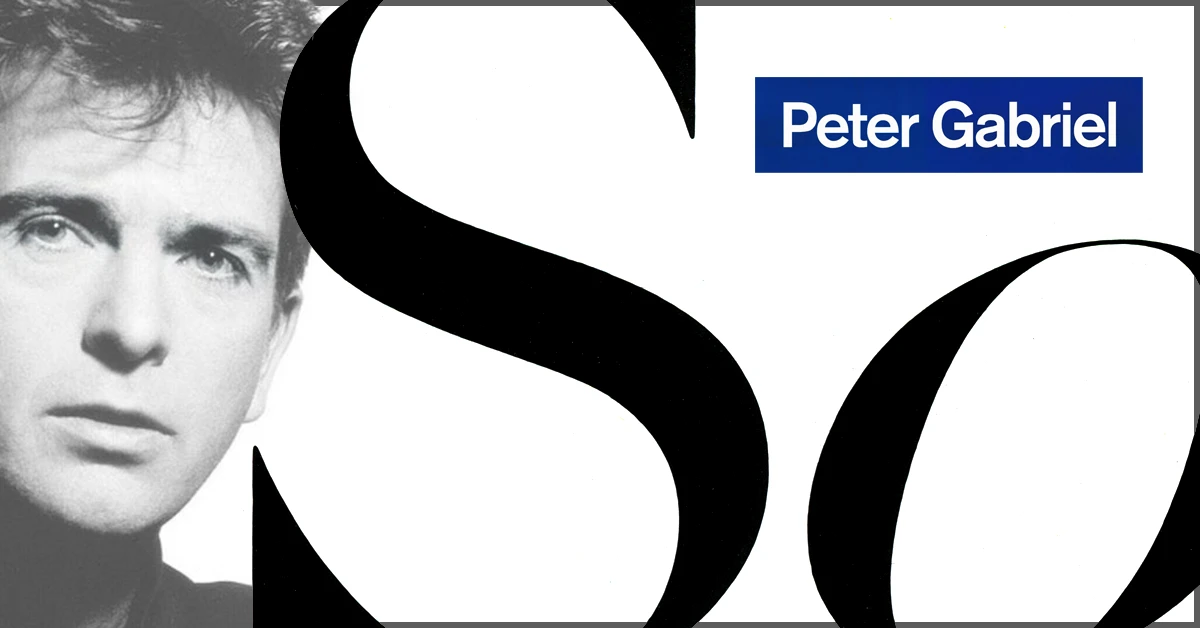
With his fifth solo album So, Peter Gabriel made the leap to superstardom. And that wasn't really surprising. The moving, melancholic underlying atmosphere remained, as did the thoughtfulness of the lyrics, the experimental music and the dense arrangements. But never before (and never again since) has Gabriel sounded so clear, so accessible, so elegant and, as a result, so widely appealing.
So was the first Peter Gabriel album to be given its own title. However, much like the fourth album in the US, the name was only indicated by a sticker – if you peeled it off, the album was once again untitled (at least on the front). This remained the case later on with US and UP. Only the CD edition of So has the title permanently printed on it. Incidentally: the album was originally supposed to be called 'Good' – but Peter had changed his mind…
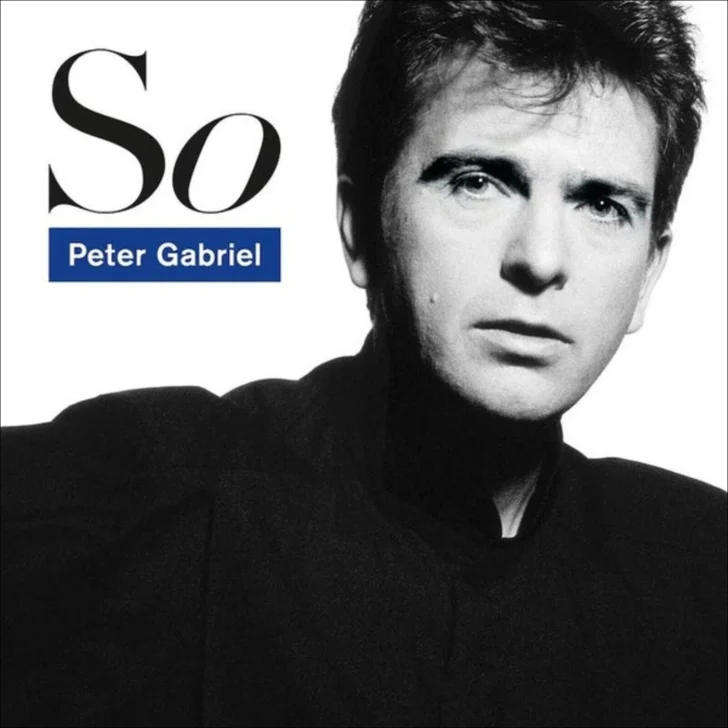
The cover featured a sophisticated-looking black-and-white photograph of PG. It was unusual to see him looking so unadorned – almost elegant – though still vulnerable. Furthermore, for the first time, the traditional Peter Gabriel lettering was no longer used. These were the first outward signs that this album would be different from the previous ones.
In fact, it's surprisingly straightforward for Peter Gabriel. You can sense the ever-present quest for catchiness – without, however, compromising the song. To strike this balance, Gabriel had spent an unusually long time on the recording. In producer Daniel Lanois, he had a man at his side who, following the Birdy soundtrack, once again helped him to bring emotion and intensity together. There were many (seemingly) acoustic sounds to be heard. The sequencer experiments were no longer as obvious as on the previous album – they blended more harmoniously into a rather smooth overall sound. Gabriel had thus finally moved away from classic rock music.
Four years had passed since the last album. Gabriel's production cycles were becoming noticeably longer. This time, he had used the time to gather musical impressions and sounds whilst travelling (in Africa and Brazil). Gabriel's interest in ethnomusicology grew and became increasingly influential. He skilfully drew on these sources without any awkward aftertaste: the new musical structures blended in quite naturally, and for the most part they were not perceived as something alien, but as organic.
The line-up of musicians included some illustrious guests: first and foremost Kate Bush and Laurie Anderson, who each performed a duet. Then there were Stewart Copeland (the drummer from The Police), Jim Kerr (the singer from Simple Minds), Wayne Jackson (The Memphis Horns), the Indian violinist L Shankar and, of course, Youssou N'Dour, who was enjoying his first taste of success at the time. In some cases, they made only minimal contributions, having simply accepted an invitation, as Gabriel was clearly no longer a nobody. Otherwise, the usual crew of Tony Levin and David Rhodes were at work, this time bolstered by Manu Katché on drums. He was to remain Gabriel's regular drummer for the next few years, only handing over the batons for the (Still) Growing Up tour.
The album and its five singles became Gabriel's greatest commercial success. He even managed to overtake Genesis in the charts. On the subsequent tour, there were screaming teenagers in the audience for the first time. With the money he earned from all this, he was able to buy and renovate an old watermill in the small village of Box, near Bath, which formed the foundation of his Realworld Studios.
And, of course, Sledgehammer wasn't just Gabriel's biggest hit single; it also came with a music video that was met with a storm of enthusiasm. Indeed, the charming jumble of plasticine figures, objects and landscapes was highly entertaining without being silly. But five other songs also got videos; in the case of Don't Give Up, there were even two different ones. The first is better known, in which Peter Gabriel and Kate Bush hold each other in an embrace throughout the entire song. The second relies more on tranquil imagery, similar to that of Mercy Street. The video for Big Time unsurprisingly draws on that of Sledgehammer, the one for Red Rain features mysteriously beautiful portrait studies of Gabriel and a dancer, and the one for In Your Eyes presents a bewildering mix of images (it was never very well known and appears on Play in yet another reworked version).
The Album
Change to the track listing
The track listings vary from one release format to another. The original LP contained just eight tracks. As this seemed a little sparse for a CD, a bonus track was added – This Is The Picture. However, this rather unusual, experimental song felt a bit out of place following the ethereal closing track We Do What We're Told. Things became even more confusing when, for the remastered and later the SACD edition, the order of the now nine tracks was changed so that In Your Eyes was moved to the end.
The following is based on the track listing of the first CD release.
Red Rain
The album opens on a decidedly sombre note, yet it also sounds energetic and passionate; despite all the despair, it doesn't feel quite as shattered as the third album presumably would have. Gabriel said of the lyrics that they deal with repressed emotions that are released in an outburst of red rain. The sheer force of the song makes this abundantly clear. Nevertheless, it has a thoroughly enjoyable groove to it.
Sledgehammer
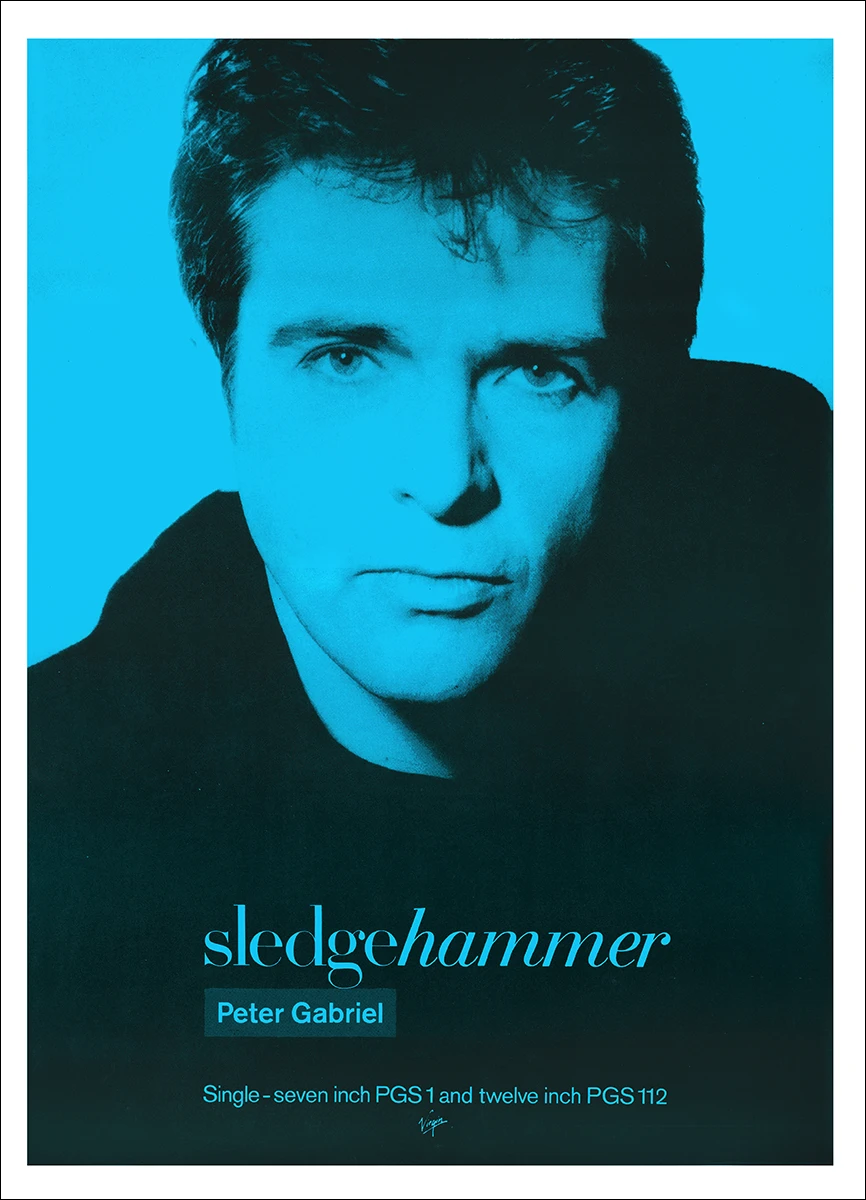
It's quite astonishing that, time and again, the biggest hits of certain musical legends are actually rather atypical or even intended to be satirical. Sledgehammer is really just one big joke. Gabriel has revisited his fascination with soul music, which had left a deep impression on him ever since the first concerts he attended in his youth, and whose groove and theatricality he incorporates here. The energy and vitality are unrivalled – and, for Gabriel, absolutely unusual. You've never heard him so hyped up and bouncing around before. – Yet the lyrics do have a contrite tone to them – but are, above all, an endless string of innuendos.
Don't Give Up
At first listen, the song – sung in duet with Kate Bush – sounds like a run-of-the-mill lovey-dovey blues track. Yet it is a far cry from the usual formula. Right from the start, Tony Levin's restless, pulsating bass line envelops the listener. Against a warm backdrop of chords and piano touches, Gabriel's voice expresses a sense of despair at having lost the will to live due to unemployment. In the rhythmically calmer chorus, Kate Bush takes over, attempting to instil confidence with a restrained plea. In the middle section, a relaxed, jazzy piano comes to the fore and the song rises to an emotional peak before fading out with a gentle, buoyant feel. Gabriel wanted a female backing vocalist for the two "voices" in the lyrics. Unusually, his first approach was to the American country star Dolly Parton, who turned him down. Choosing Kate Bush was certainly the right decision. Her touching yet almost otherworldly voice lends the song the necessary emotional depth without descending into schmaltz.
That Voice Again
Track four always seems to get overlooked. Yet it is packed with drama and perhaps contains the album's most powerful expression of desperate longing. The song flutters restlessly through brooding and self-flagellation until it reaches its climax in a drawn-out scream. That Voice Again belonged to the context of the Mozo character, whom Gabriel has repeatedly brought into several songs (most notably 'On The Air') and who was originally intended to form part of a larger overarching narrative. Mozo is an outsider who has fallen out of society, yet must continually grapple with it and his place within it.
In Your Eyes
The song falls a bit short on the album in its shortened version (due to space constraints on the LP) and really only reveals its true energy in the longer maxi-single version or when PG performed it live in 1987 (a version he has been performing ad nauseam ever since). Regarding the lyrics, Gabriel said that in certain parts of Africa there is a tradition of singing songs that can be both a love song to a woman and to a god. Consequently, he incorporated African elements into the music: rhythms and the powerful voice of Youssou N'Dour, which unfortunately comes into its own far too little in the final section.
Mercy Street
A very melancholic song, inspired by the poem of the same name by Anne Sexton, who took her own life in 1974. Its appeal lies in its mythical, tranquil yet shimmering atmosphere, underpinned by a slightly slowed-down Brazilian triangle groove. Even in the poem itself, the search for a street called Mercy is vividly portrayed as a search for compassion amidst the turmoil of life. Gabriel brings it to a poignant climax in a poignant final passage.
Big Time (suc cess)
The contrast with the previous song couldn't be greater. Big Time blares its way over anything delicate and delivers (in a manner that is unusually dripping with irony for Gabriel) the monologue of a self-important, successful person. Is this also meant to be an expression of concern for his own career? In the chorus, at any rate, Gabriel pays tribute to soul music once again.
We Do What We're Told (Milgram's 37)
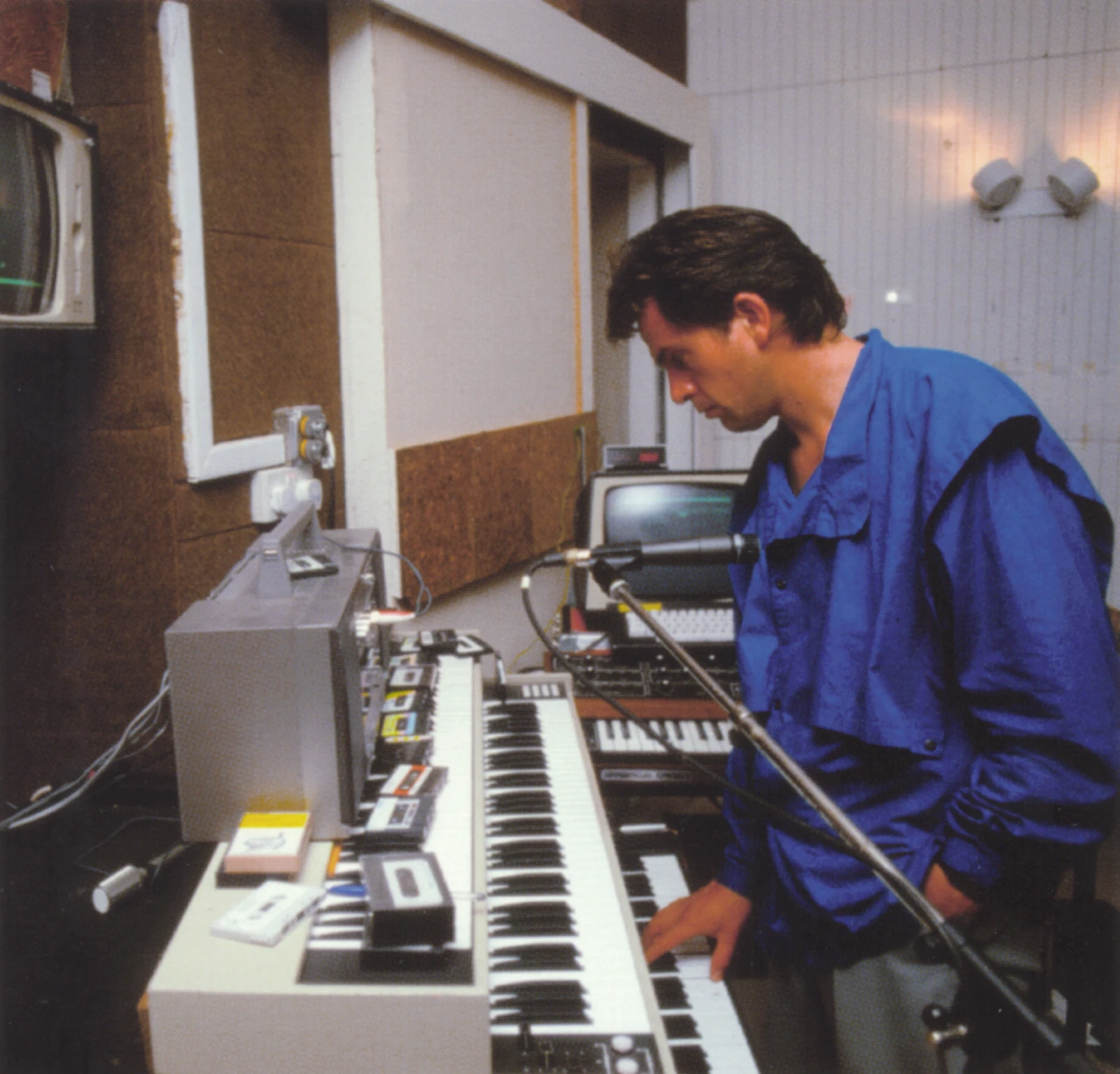
The most unusual and experimental track on the album. Peter Gabriel had been tinkering with it ever since the days of his third album. Only loosely drawing on Dr Milgram's experiment from the 1960s, the piece manages almost entirely without lyrics, building its sense of menace from tinkling sounds and hollow-sounding rhythms, intensifying into a tense atmosphere before finally slowing down to present five concepts whose contextual meaning one must decipher. The song has a sort of matured counterpart in Fourteen Black Paintings, which would be released in the US six years later. So ended with We Do What We're Told in its shortest version. Or so it seemed. But what follows is
This is the Picture (Excellent Birds)
This is a collaborative composition with Laurie Anderson. Originally produced for one of her television specials, the track does not strictly speaking belong to the So canon. It can already be found on Anderson's album Mr. Heartbreak (1984) – there under the title Excellent Birds, which is only included here in brackets. In contrast to that version, where the song comes across as rattling and full of restlessness, here it has been given a somewhat ethereal and unreal quality. Nevertheless, the track stands out somewhat from the velvety overall atmosphere of So, with its reflections on gazing out of the window. It is no coincidence that Gabriel chose In Your Eyes as the closing track for later releases.
All in all
The light notes amidst the melancholy – perhaps the most succinct explanation for the success of this mega-seller. Or is it, after all, the weightiness within the lightness? The American edition of Rolling Stone at the time remarked: "An emotionally and musically extremely complex record". In any case, with his sensitive empathy for hardship and suffering, Gabriel was fully riding the wave of the mid-80s.
Author: Thomas Schrage
Tracklist
1. Red Rain
2. Sledgehammer
3. Don't Give Up
4. That Voice Again
5. Mercy Street (for Anne Sexton)
6. Big Time (suc cess)
7. We Do What We' re Told (Milgram's 37)
8. This is the Picture (Excellent Birds)
9. In Your Eyes
Released 19 May 1986*
Remastered 2 August 2002
SACD 2 Mai 2003
*In Your Eyes was number 5; the vinyl lacked This Is The Picture
Singles
Sledgehammer – 18 April 1986
b/w Don't Break This Rhythm
b/w I Have the Touch ('85 remix)
Sledgehammer (limited edition dance mix) – April 1986
b/w Don't Break This Rhythm
b/w Biko (12" extended version)
b/w I Have the Touch ('85 remix)
Don't Give Up – September 1986
b/w In Your Eyes (special mix)
b/w This is the Picture (Excellent Birds)
In Your Eyes – October 1986
b/w In Your Eyes (special mix)
b/w Biko (live from Plays Live)
Big Time [EP] – March 1987 Big Time (extended version)
b/w Curtains
b/w No Self Control
b/w Across The River
Big Time (7" version)
Red Rain – June 1987
b/w Ga Ga (I Go Swimming Instrumental)
b/w Walk Through the Fire
Your choice: Pick your three favorite Peter Gabriel solo albums