

- Article
- Read in 9 minutes
Song 01: "Been Undone" (3rd January 2026)
In January 2026, Gabriel surprisingly presented the first song from the new album. We have compiled everything you need to know about its mixes.
Dark-Side Mix
Bright-Side Mix
Full Moon Version
overview of the o\i article series
o\i starts with a quiet song that takes a rather bitter view of life. At least, that's what one might think, given that the title '(I've) Been Undone' has a rather negative meaning.
Peter says that the song's origins are very old (from 1995/96), but at the same time it is the newest song for o\i, as it was only finally recorded by the band in October 2025 – just over two months before its release. It also seems that it really came into its own at that time.
Lyrics
A lot of text is spread over the more than seven minutes. A long list enumerates what has ruined or destroyed in life: being ignored, the sound of a weapon, the past that one traces back. Not everything is always completely concrete; sometimes very open images are used, such as 'From the Mandelbrot set, I've been undone'. What exactly is meant by this remains somewhat mysterious, but it fits with Gabriel's explanation that some of the songs on the album are part of the brain project he has been working on for several years. With the exploration of new worlds of perception and possibilities for connection.
However, the lyrics remain very evocative overall, playing with ambiguity, not least in the title, which can also be interpreted positively. 'Undone' in the sense of 'having been taken back, having been reconsidered'. Nevertheless, the sense of brokenness prevails in the lyrics, for example in the middle sections, when more information is needed and one cannot believe 'in something that can never be real'.
But Gabriel also says that some of the songs simply make him happy. And that's the case here too: he sees all the bitterness listed quite positive. You learn from difficult and painful moments in life – often the most. Further development does not always arise from the good.
In the middle section of the piece, the lyrics reassuringly state: 'Just listen and feel.' And at the end, they even say, 'And I feel it in you, you feel it in me.' So the sombre conclusion is that you can feel something after all – in others, in yourself.
Art
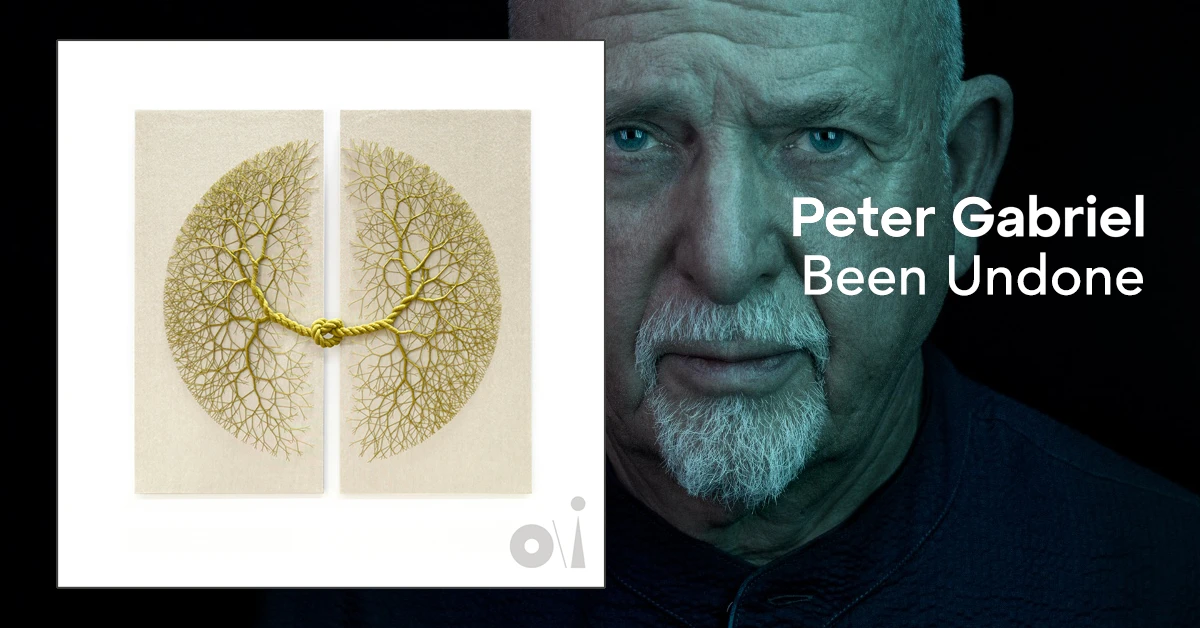
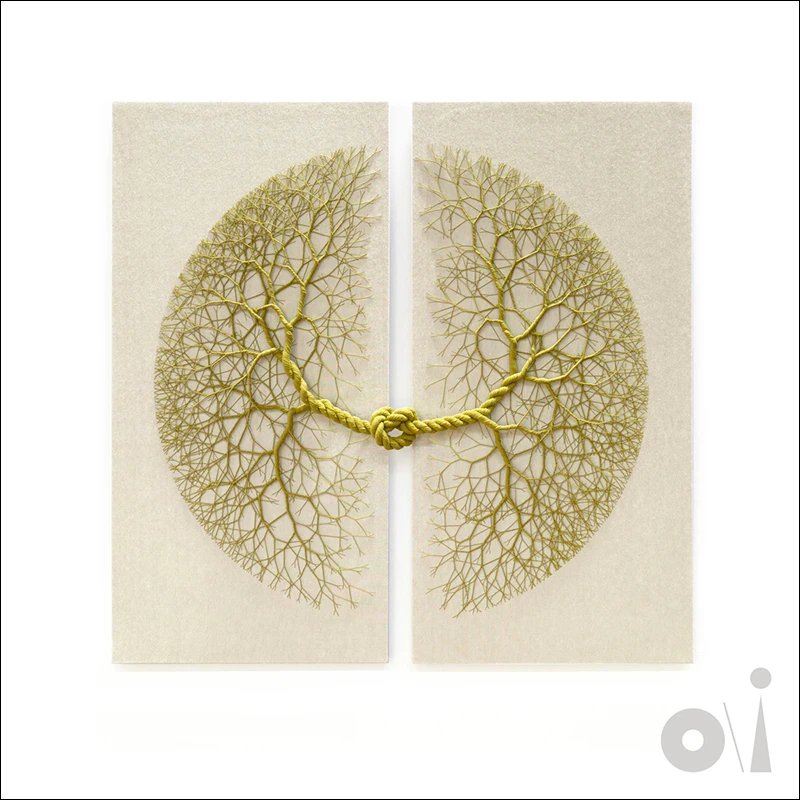
The first artwork for the album is by Brazilian artist Janaina Mello Landini (born 1975), dates from 2019, is called 'Ciclotrama 156 (palindrome)' (138 cm x 138 cm) and consists of handmade green cotton rope on linen.
Landini first studied architecture, then fine art, and her work also incorporates insights from physics and mathematics. Her artistic themes are time and diversity.
She often works with strings and ropes, which she weaves and knots into wall hangings, but also into space-filling webs. In many of them, one can recognise roots, branches and trees. Her website provides a comprehensive insight into her work.
Gabriel finds numerous connections to his song in the selected work: the theme of raveling and entanglement or disentanglement; he sees something like brain hemispheres in the depiction, perhaps the thread of life in general.
At the moment, one of Landini's existing objects has been selected for the song – but Gabriel is delighted to announce that another work, created especially for the track, is to follow.
More about the album artwork and the artists behind in our separate article.
Dark-Side Mix – 3rd January 2026
Words and Music by Peter Gabriel
Published by Real World Music Ltd / Sony Music Publishing
Produced by Peter Gabriel
Mixed by Tchad Blake
Mastered by Matt Colton at Metropolis Studios
Engineering by Faye Dolle, Katie, May, Dom Shaw, Richard Chappell, Ben Findlay
Assistant engineering by Xav Sinden, Charles Hughes, Maisy Preece
Recorded at Real World Studios, Bath and The Beehive, London
Manu Katché – drums
Tony Levin – bass
David Rhodes – electric guitar
Richard Evans – electric guitar, acoustic guitar, mandolin
Faye Dolle – rhythm programming, additional synths, percussion
Charles Hughes – percussion
Ged Lynch – percussion
Peter Gabriel – piano, synths, rhythm programming, vocals, backing vocals
Length 7:39
Available on Streaming services and Bandcamp.
It has been announced that the two mixes will differ more significantly from each other than was the case with i/o. Well, the Dark Side Mix comes across as calm. In a way, it is gentle. Gabriel noted that Tchad Blake likes it when things have time to develop. The length of this first mix certainly confirms this. And also the further structure bears witness to this.
Music
The basis is formed by a harmonium-like accompaniment, into which other sounds are increasingly woven. There is also a gently fluttering rhythm section. Later, powerful, accentuating drums come in, but remain pleasantly integrated into the overall fabric. During the bridge section Arabic-style percussion is mixed in.
The verse melody is simple without being boring. The interludes then are rather quirky and unpredictable, but they remain short. The piece does not have a classic verse-chorus structure.
Been Undone works through its gradual development, building slowly throughout its entire length. It increasingly gains swing and a subtle groove, but remains restrained overall. The lyrics tell of misfortune, but the music is rather conciliatory. Only once does the brutality break in briefly and powerfully, not denying reality – but the indestructible optimism immediately takes over again.
Personnel
Similar to i/o, the album begins with a track featuring a fairly compact line-up. Essentially, this is Gabriel's core band, as they can now rightly be called.
It is noteworthy that Richard Evans is involved. With the release of the demo version later in the month, it becomes clear that his contribution must have been recorded recently, whereas Ged Lynch's contribution was recorded before the band sessions. It has been confirmed that Lynch was at Real World Studios in 2015, which suggests that a lot of time was spent working on the track.
Bright-Side Mix – 18 January 2026
Words and Music by Peter Gabriel
Published by Real World Music Ltd / Sony Music Publishing
Produced by Peter Gabriel
Mixed by Mark 'Spike' Stent
Mastered by Matt Colton at Metropolis Studios
Engineering by Faye Dolle, Katie May, Dom Shaw, Richard Chappell, Ben Findlay
Assistant engineering by Xav Sinden, Charles Hughes, Maisy Preece
Recorded at Real World Studios, Bath and The Beehive, London
Manu Katché – drums
Tony Levin – bass
David Rhodes – electric guitar
Richard Evans – electric guitar, acoustic guitar, mandolin
Faye Dolle – rhythm programming, additional synths, percussion
Charles Hughes – percussion
Ged Lynch – percussion
Peter Gabriel – piano, synths, rhythm programming, vocals, backing vocals
Length 6:48
Available on streaming services and on Bandcamp.
As it turns out with the release: The Bright-Side Mix isn't as incredibly different as some had expected, or perhaps even hoped. It's actually just another final mix, not a standalone song production. Once again, the focus here is clearly on creating interplay, whereas the Dark Side Mix has always highlighted certain elements and focused on them. In this respect, the two mixes of Been Undone are a real lesson.
Music
The Bright-Side Mix is about 50 seconds shorter, which is due to two cuts. The first comes right at the beginning: the horn-like opening sound is missing. The song begins directly with the harmonium.
There are also changes in what follows: the guitar comes in from the third verse, and from the fifth verse there is bass and subtle percussion (which generally doesn't come across as hard as in the Dark Side Mix). Basically, it gives the impression of listening to a band. This is also because the vocals are more prominent than the accompaniment, which seem more like a background. The guitar is also more in focus, the percussion is less present, and some of the irritating sample sounds floating through the room are missing.
In general, the structure is not as edgy, not as heavy in its accents, not as effect-oriented. The Bright-Side Mix remains more consistent in its rhythm and accompaniment.
This can be seen, for example, when it comes to "Like a wire on a spool": the piano is less dark than in the Dark-Side Mix, and the rhythm continues to bounce. The change is also less noticeable in the "But how can you smile" interlude. Essentially, only the guitar and drums are toned down slightly.
However, the passage starting with "By a squeak from a chair" is different: only the keyboard and flute lines remain to accompany the vocals, with light percussion responding during the pauses. It's a back-and-forth interplay. This is not so obvious in the Dark Side Mix.
The second cut comes towards the end: the dark intrusion of industrial violence is missing. The subsequent repetition of the "How can you smile" passage has also been omitted. The song goes directly into the final section, which is not as urgently dense. The crescendo is more moderate.
In conclusion, it can be said that the Bright-Side Mix attempts to guide the listener more and not irritate them so much. The aim is less to create a layered structure and more to create a continuous unity. The absence of the industrial interruption is consistent with this. However, the uniformity also makes the length of the song more noticeable, even though the Bright-Side Mix is shorter.
Full Moon Version – 26 January 2026
Words and Music by Peter Gabriel
Published by Real World Music Ltd / Sony Music Publishing
Engineering by Faye Dolle, Dom Shaw, Richard Chappell, Ben Findlay
Produced by Peter Gabriel
Recorded at Real World Studios, Bath and The Beehive, London
Faye Dolle – rhythm programming
Ged Lynch – percussion
Tony Levin – bass
David Rhodes – electric guitar
Peter Gabriel – rhythm programming, percussion, synths, piano, vocals
Length 7:34
On the day of the waxing crescent moon, an alternative version of Been Undone has been released on Bandcamp. As it was the case with i/o, these extra tracks are exclusively for subscribers. According to the accompanying information, this version, with the somewhat unusual title Full Moon Version, dates from October 2025 and is what the band was sent in preparation for the actual recordings later that month. It goes on to say that it contains some elements from recording sessions in October 1996.
But what is the title all about? The version wasn't simply called 'Demo'. Nor was it called 'Pre Band', as it was in the i/o days. Last year, the term 'Bandcamp Version' was used for a "rebalanced and edited" version. Is that what this is? But if so, it's not clear where the edits have been made.
Music
This is a classic demo version with only rudimentary instrumentation. The drums and bass are programmed and sound like it. The rest of the accompaniment consists almost exclusively of harmonium and flute sounds. There is hardly anything else. The vocals also seem quite strained at times. Some of the percussion elements, which gradually join in, can be heard in the final version, but basically everything sounds provisional and unfinished. It is simply a demonstration of the intended song idea. Nothing more.
However, the structure of the song is already complete. This includes the initial horn, the interruption after the middle section (both still using very primitive sounds here) and the repetition of the "How can you smile…" interlude. The structure therefore corresponds exactly to the Dark-Side Mix, which somewhat reinforces the impression that the Bright-Side Mix is just a cut version of it.
The lyrics, on the other hand, are almost finalised. Only the middle section "Then it starts…" still consists of incomprehensible Gabrielese – or, at times, nothing at all. Since this section has a different colour in sound and vocals, it is quite possible that it is the aforementioned section from 1996.
Personnel
The contributions of the musicians mentioned in the credits are not easy to identify. Ged Lynch is probably not very prominent in his work. Occasionally, quiet shakers can be heard or muffled drumming that could come from him. Tony Levin is also said to play. However, as the bass lines are very rudimentary, it is difficult to judge what actually comes from him and what is programmed. David Rhodes on guitar is not really discernible. It is conceivable that both appear in the 1996 section, but not very prominently then.
Background info about the song on petergabriel.com
Webseite of Janaina Mello Landini
Discuss this track in this thread in our forum.
Author: Thomas Schrage