

- Article
- Read in 30 minutes
Peter Gabriel – o\i – The Artwork
Peter Gabriel has once again paired each track on the album with a work of art. Let's take a closer look at them and the artists behind them.
Once again, Peter Gabriel has accompanied each track on his new album with a work of art. This follows the same principle as on i/o. Once again, suitable artists and works of art were sought out worldwide – though the works were not always created specifically for the song.
Gabriel feels a strong connection to the visual arts – whether paintings, sculptures, or photographs. He loves it when there is an exchange, a dialogue between his music and other forms of expression. He has long been inspired by interdisciplinarity. In the case of album artwork, he has also liked to draw on material from the field of science.
Here we present the 12 artworks for o\i, the artists, and some background information.
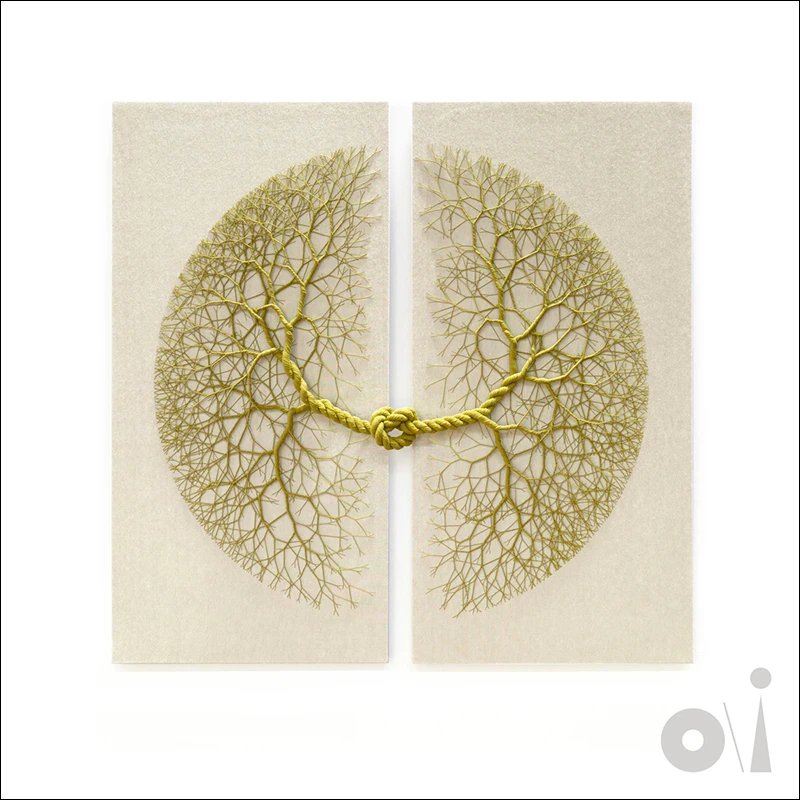
1 – Janaina Mello Landini: "Ciclotrama 156 (palindrome)" for Been Undone
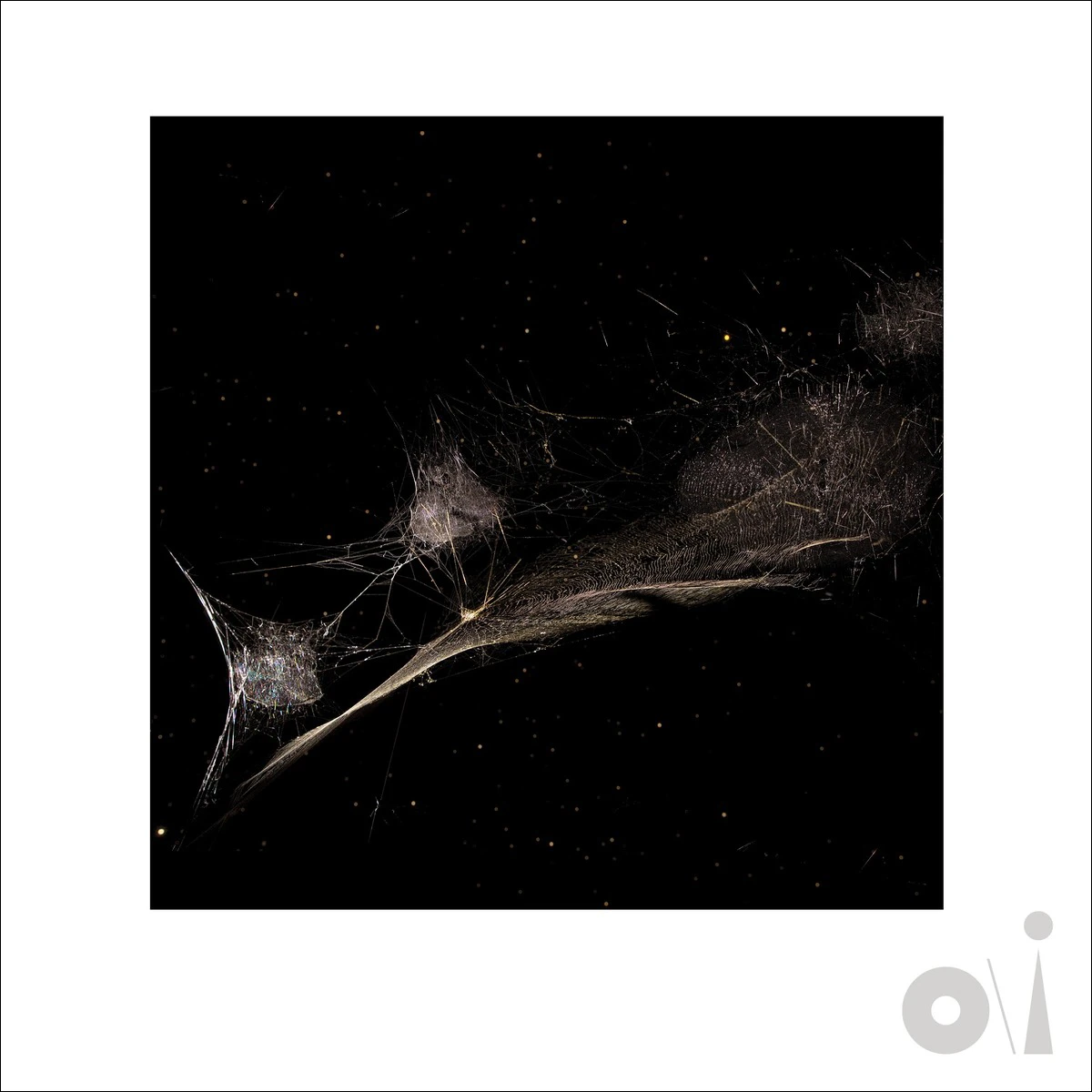
2 – Tomás Saraceno "Cosmic Spider/Web" for Put The Bucket Down
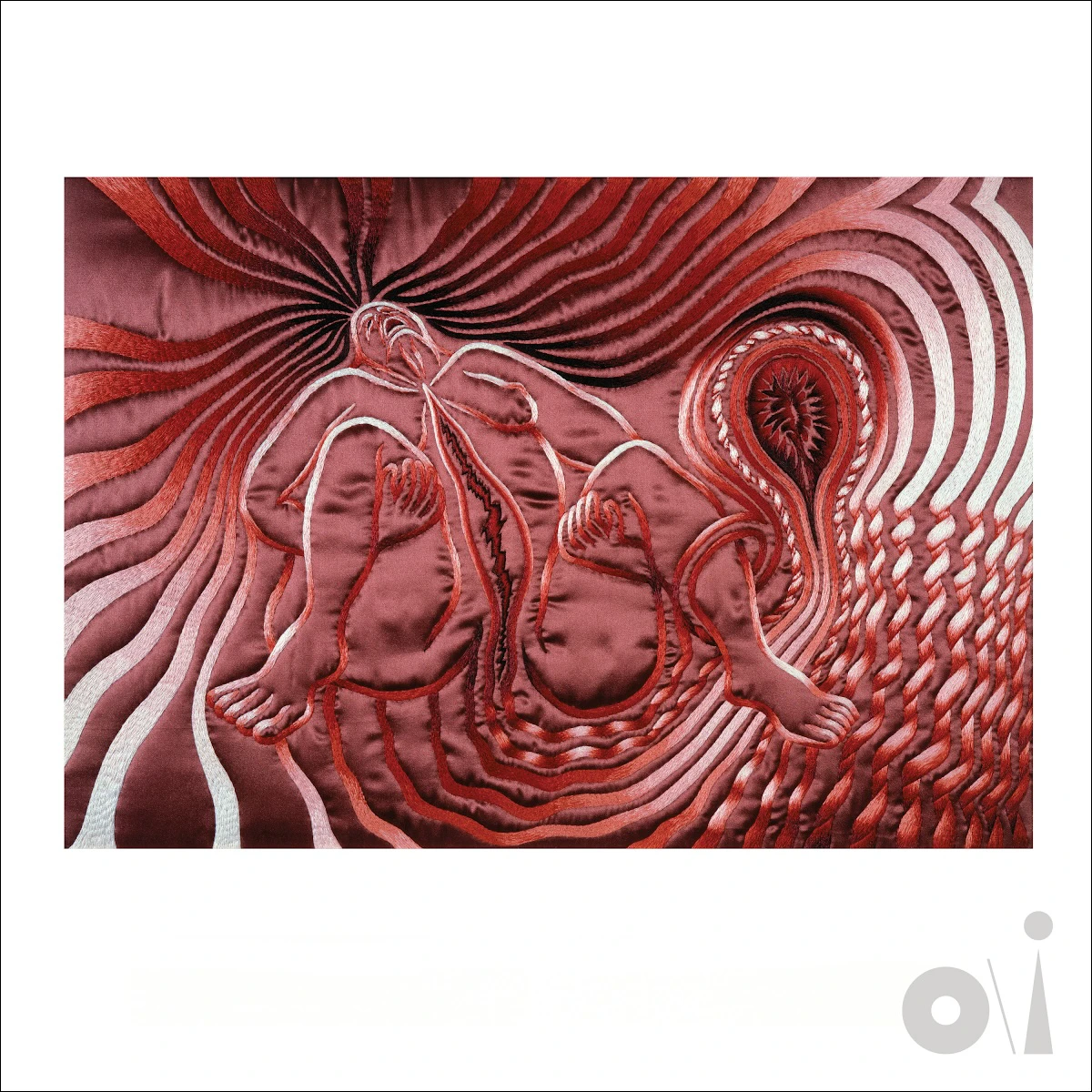
3 – Judy Chicago "Birth Tear/Tear" for What Lies Ahead
4 – Tatsuo Miyajima "Warp Time with Warp Self No. 2" for Till Your Mind Is Shining
5 – Shirin Neshat "Faith" for Won't Stand Down
6 – Francis Alÿs "Cuentos Patrióticos" for A Hard Lesson
7 – Berndnaut Smilde "Nimbus de Toekomst 1" for I Belong To The Sky
8 – David Altmejd "Pieces" for One By One
9 – Tishan Hsu "Closed Circuit II" for Looking For The Happy
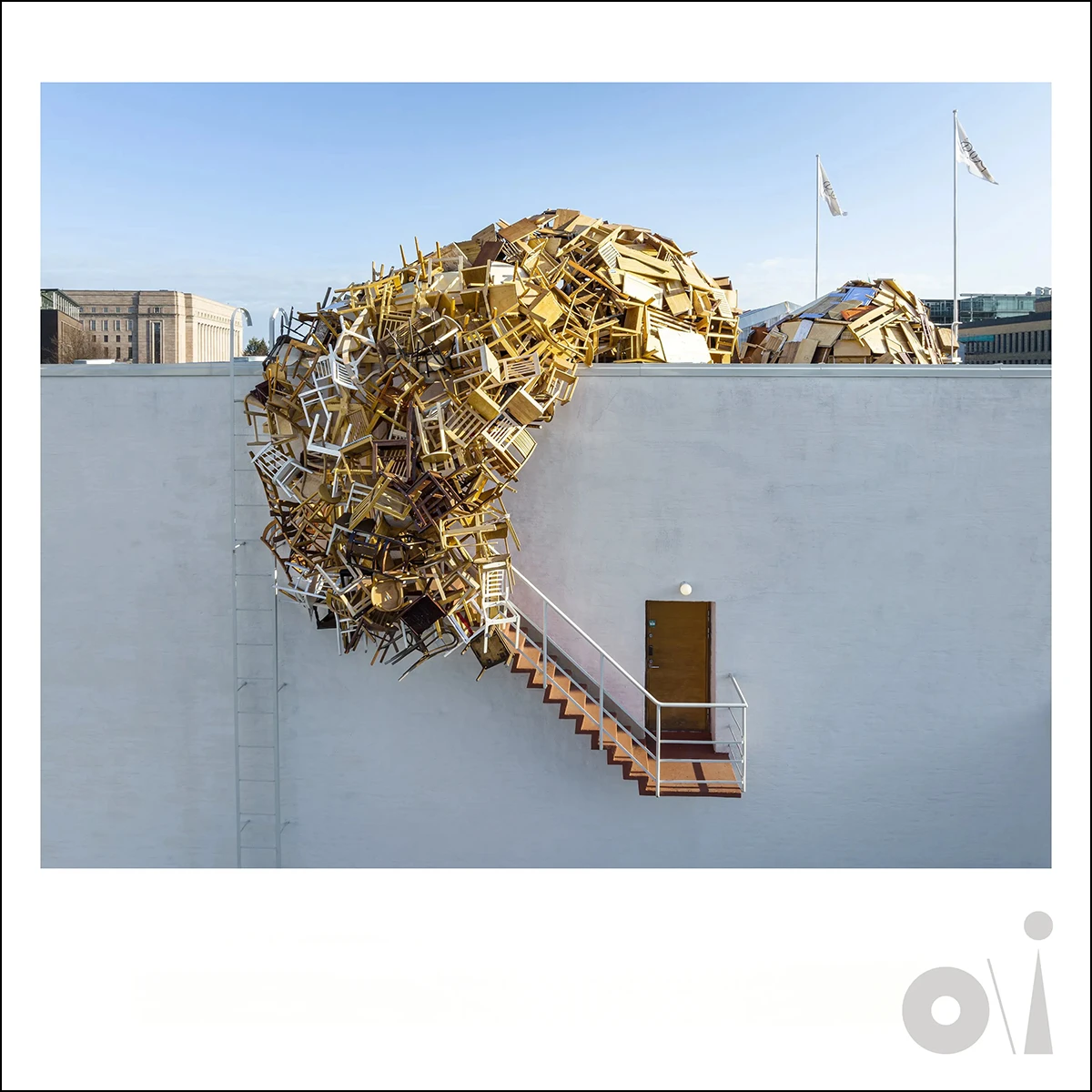
10 – Tadashi Kawamata "The Nest" for Face The Wall
…
overview of the o\i article series
Release #1 from January 3rd, 2026: Been Undone
The Track
Been Undone is a rather quiet song that enumerates a bitter, long list what has ruined or destroyed in life. However, Gabriel also says that he actually sees these negatives in a positive light. Because you also learn from difficult and painful moments in life – often the most.
And so the song continues with an optimistic "just listen and feel." And at the end, even "and I feel it in you, you feel it in me." So the sombre conclusion is that you can feel something after all – in others, in yourself.
The Artist
Janaina Mello Landini (born in Brazil in 1975) initially studied architecture, then fine arts; her work also incorporates insights from physics and mathematics.
She initially worked as an architect for ten years, then designed stage sets and costumes for theater productions and films between 2003 and 2006. In 2013, she moved to São Paulo to devote herself exclusively to her art. She still lives and works there today.
In 2010, Landini began experimenting with space, using threads, nails, and knots, twisting and tension. She now works almost exclusively with strings and ropes, which she weaves and knots into wall hangings and expansive webs. Many of them resemble roots, branches, and trees. They are also reminiscent of lichen growth or the structures of blood vessels.
Basically, thick ropes are divided into individual strands, which are then split again into smaller strands, and so on, down to the basic individual fibres. Landini arranges these increasingly branching structures into patterns with a wide variety of outlines. And depending on the situation, one can also see the process in reverse, with the thinnest fibres connecting with each other, continuing further and further until they form thick strands.
Her work is characterized by skilled technique, often taking months or even years to complete. She frequently draws on the Fibonacci sequence and other patterns found in nature, contrasting the rigid logic of artificial structures with the wisdom of organic forms. She seeks to explore themes such as connectedness and interdependence, time, and diversity.
Landini's objects have been exhibited in Brazil, France, the Netherlands, the United States, and the United Arab Emirates. Her works were on display at the Palais de Tokyo in Paris in 2016, at the Château de Chaumont-sur-Loire in 2019, and at the 13th Mercosul Biennial in 2022.
Her website provides a comprehensive insight into her work.
The Artwork
The first artwork for the album is called Ciclotrama 156 (palindrome), measures 138cm x 138cm, was created in 2019 and consists of handmade green cotton rope on linen.
Two separate fabric panels spread out in semicircular, highly branched structures. Both extend toward each other, and there is a knot at the connecting center. In a sense, it is the center of everything.
The title Ciclotrama combines the word "cycle" with the latin word "trama" (meaning "chain" or "weaving"). The additional designation palindrome refers to the mirrored arrangement, which allows the work to be "read" forwards and backwards.
At the moment, Landini's existing piece has been selected for Been Undone. But Gabriel is delighted to announce that another work, created especially for the track, is to follow.
The Connection
Gabriel finds several connections to his song in the depiction: the theme of knots and entanglement or disentanglement, the thread that either does us up or undoes us, perhaps also the thread of life in general. He also recognizes something like brain hemispheres. This fits in with his current theme of the brain project, to which he adds the song Been Undone.
He probably also likes the exciting connection between technical precision (he also sees fractals here) and natural, organic structures.
Fun fact: Gabriel pronounced the name of the upcoming album also as "Oi". This is a greeting in Brazilian Portuguese, similar to 'Hi'.
Release #2 from February 1st, 2026: Put The Bucket Down
The Track
Gabriel says that the bucket in Put The Bucket Down is full of the crap that goes around our head all the time. To find your way forward, you have to put it down.
Gabriel also says that he is fascinated by the idea that it might be possible to read and write human thoughts. However, he also sees the dangers of invading privacy or transplanting foreign ideas. And that the whole process is likely to cause enormous confusion. The song is about this confusion. The person singing is uncertain because she does not know exactly what she is experiencing. Whether her thoughts belong to her or to someone else.
The Artist
Once again, the creator of an o\i artwork comes from South America. Tomás Saraceno was born in Argentina in 1973 and studied art and architecture in Buenos Aires and Frankfurt. In Italy, he took part in a course taught by Olafur Eliasson (who also contributed a work of art to i/o), among others. In 2009, he also participated in NASA's International Space Studies Programme.
Saraceno's themes are fundamental natural structures and their status in the technological world. With his nature-laboratory aesthetic, he is quite close to the work of Olafur Eliasson. He has already explored emission-free flying, built floating greenhouses out of helium balloons, laid ropes through rooms that produced ambient vibration echoes when touched, and constructed landscape objects with a technological-aesthetic appearance that stand in nature and interact with it, for example by serving as habitats for birds and insects.
And he keeps coming back to spiders. He even has his own website about them, which includes a mobile app for interacting with the vibrational senses of spiders. Saraceno has repeatedly used these animals to create objects that trace cosmic structures – or has meticulously recorded spider populations in exhibition buildings (and not removed spider webs during the exhibition period).
Gabriel says he first encountered Saraceno through the Aerocene project, an interdisciplinary community of artists that seeks to highlight new forms of ecological sensitivity and raise awareness of the atmosphere and the environment.
Saraceno has lived in Berlin since 2001.
His website provides a comprehensive insight into his work.
The Artwork
The work provided by Saraceno is called Cosmic Spider/Web and is not actually the artwork itself, but a photograph of it. It shows a partial view of an installation that Saraceno created with the help of spiders, which had woven webs along metal elements throughout an entire room.
This installation was called Weaving The Cosmos and was on display in 2019 at the Milan Planetarium. The spider webs floated under the dome of the planetarium and looked like galaxy systems. Thanks to a sound system, visitors could also hear the vibrations of the spiders in the web. Saraceno was inspired by the similarities that scientists have found between the thread-like structure of the cosmic network and the intricate web of spider webs. Details and some photos of the installation can be found here.
For those who are interested: involved were five specimens of the genus Cyrtophora citricola, a single Nephila senegalensis and six Holocnemus pluchei.
The Connection
Saraceno listened to Gabriel's song and then found this image fitting and selected it. Gabriel, in turn, found the shapes of the spider webs fascinating and beautiful. He sees a connection between them and other shapes in nature, as well as to perceptions that the brain is capable of. That's why the image suits him too.
So perhaps what is represented here is less the content of the song about the confusion caused by thought transmission and more the idea of brain networking as a whole. Its cosmic size, its fascination, its light and shadow.
Also remarkable in this context is that there is a species of spider named after Peter Gabriel: Umidia gabrieli, a species of trapdoor spider from Baja California described in 2021. The tour book for the i/o Tour notes that this species of spider has some similarities with Gabriel: for example, it has little hair – at least on its legs…
Release #3 from March 3rd, 2026: What Lies Ahead
The Track
The third o\i song, What Lies Ahead, takes a rather detached look at all inventors, all visionaries who look creatively to the future and tirelessly try to shape it. This has a spiritual aspect because it involves creation, but it also has a laborious, exhausting side.
Gabriel says that, through his father, an electrical engineer and inventor, he witnessed how frustrating it can be to have good ideas but not be able to bring them to fruition. Nevertheless, he concludes the song with the sentence: "What lies ahead is forming in your hands."
The Artist
In 1939 Judith Sylvia Cohen was born in Chicago and adopted later in the 1970s the pseudonym Judy Chicago. She had already made a name for herself as a pioneer of feminist art and art education, becoming highly influential in the process. She graduated from the University of California, Los Angeles, with a degree in painting and sculpture, then went on to teach herself at Fresno State College, the California Institute of the Arts and several other institutions.
One of her significant works is the installation The Dinner Party (1974-79), displaying 39 elaborately arranged place settings on a triangular banquet table and celebrating well-known women from mythology and history. From 1985 to 1993, she worked on her Holocaust Project: From Darkness into Light, which combines sixteen large-format works in various media (tapestries, stained glass, metalwork, woodwork, photography, painting and sewing). They are intended to examine the genocide of the Jews, but also themes such as victimhood, oppression, injustice and human cruelty.
In 1972, Chicago co-organised one of the first feminist art exhibitions, Womanhouse. The focus was on women's housework as a parody of social stereotypes. The aim was to highlight female experiences and actively promote female art.
Chicago's central theme is the absence or even erasure of women in Western cultural history and the need to oppose this. She has been exhibited internationally (currently at the Joods Museum, Amsterdam) and has received numerous awards.
Judy Chicagos Website provides many insights into her decades of extensive work.
The Artwork
Chicago created her Birth Project between 1980 and 1985. Paintings and needlework explore different aspects of the birth process, its magnificence and its violence. Around 150 different women participated in the creation of the individual objects. The work for What Lies Ahead is part of this project and is called Birth Tear/Tear (1982, embroidery on silk, 52 x 70 cm). The design is by Chicago, the execution by Jane Gaddie Thompson.
Intricate ornaments in dark red reveal, only at second glance, the depiction of a woman with a wide open vulva. A birth is shown, the agonising and painful aspect – with the woman's face contorted in an enormous scream. The title Birth Tear/Tear is choosen carefully. The embroiderer Thompson, however, is delighted that the umbilical cord in the image is "round and gently twisted, full of magic and life".
Finally, it should be mentioned in a subordinate clause that the illustration is the first in the series of artworks for i/o\i in landscape format. This makes the graphic appearance stand out somewhat.
The Connection
Gabriel makes it clear that no man will ever have an understanding what it really means to give birth to a child. That is why Birth Tear/Tear and What Lies Ahead are completely different in terms of the dimension of suffering and pain that is portrayed. It is also about a completely different way of bringing something into life. Nevertheless, there is actually a strange connection between the image and the song. Gabriel: "Giving birth to an idea has many (less painful) parallels."
Release #4 from April 2nd, 2026: Till Your Mind Is Shining
The Track
Gabriel says that Till Your Mind Is Shining is about "opening up the mind" and "going into it". It's about the possibility of using modern technology to complete several years' worth of learning in a shorter time, and thereby – as Gabriel hopes – making decisions in a more responsible and compassionate way. The lyrics are actually a series of light-hearted descriptions of a rapid flow of data or thoughts.
And so, taken as a whole, the track radiates a certain enthusiasm and cheerfulness; it comes across as a bit eccentric at times, yet remains consistently laid-back – and is, for all these reasons, also somewhat unsettling.
The Artist
The Japanese sculptor and installation artist Tatsuo Miyajima was born in 1957 and studied painting at the Tokyo National University of Fine Arts and Music, from which he graduated in 1986.
Soon afterwards, he began experimenting with performance art before moving on to light-based installations. His work centres on time and its passing. Digital displays almost always form the centrepiece, alternately showing the numbers 1 to 9, but never zero, which for Miyajima represents stagnation and death.
He explains that he draws inspiration from Buddhism. For him, the ticking numbers are associated with inevitability, universality and mortality. "I am making installations which experiment with different systems of time. There is no absolute length of time, only a personal rhythm." Three concepts are of central importance to his work: "Keep Changing", "Connected with everything" and "Continue forever".
Miyajima has since used his number sequences in numerous objects, projected them onto house walls or painted them as images. Gabriel also notes: "He first came to prominence in 1988 when he was invited to the Venice Biennale, in the young artist's section, where his works using digital numerals attracted international attention. Since 1996, he has also been promoting the Kaki Tree Project, an art project that promotes peace and the importance of life through the planting of saplings taken from a kaki tree in Nagasaki which miraculously survived the atomic bomb."
Many impressions of Miyajima's work and his conceptual ideas can be found on his website.
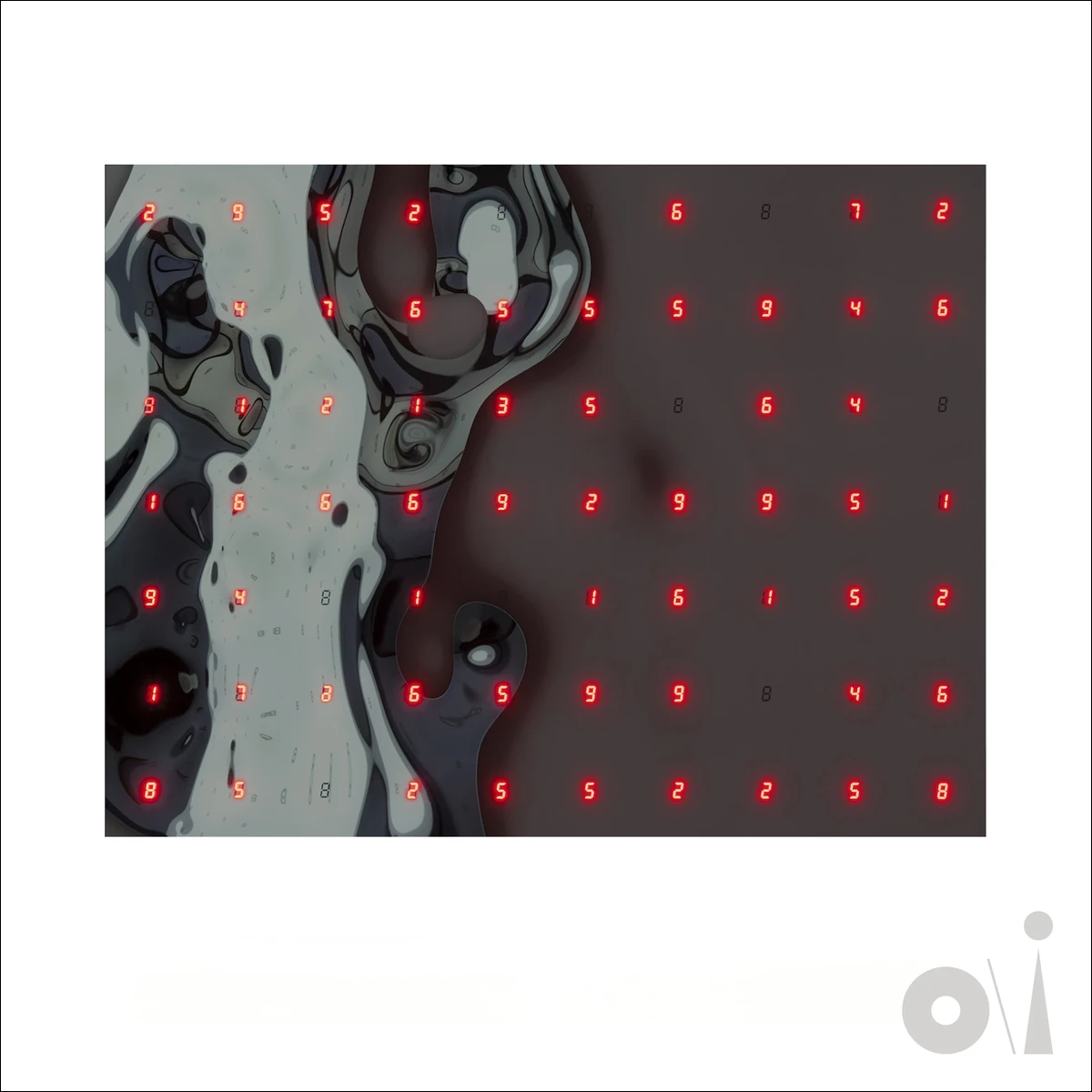
The Artwork
The artwork for the song features a photograph of a constantly changing wall-mounted object. It was created in 2010 and is titled Warp Time with Warp Self No. 2 (LED, IC, electrical cable, mirror glass, steel, 105 x 150 x 15.5 cm). What can be seen is a reflective surface that is not entirely flat, and therefore distorts the surroundings, and does so not always in the same way (depending on where and how one stands). Placed on this surface are 70 light-emitting diodes, on which the numbers 1 to 9 appear in irregular order. Each photograph of the object therefore shows only a snapshot in time. An alternative view can, for example, be viewed on a gallery's website here.
The designation "No. 2" also indicates that this concept exists in various versions (at least nine). They differ in size and layout.
The Connection
Gabriel likes the mix of cold and structure, as well as soft and self-reflective, in the chosen artwork. "I love that it feels quite futuristic in one sense, with numbers and data and yet you've got this 'warp self' in the background." He is likely referring to the reflection in the surface, in which the viewer always sees themselves slightly distorted. For him, this creates "an interaction between humans and the mechanical AI world."
For him, both the artwork and the song say something about "where the shining mind should lead you and what that is there to counter".
The opportunity to pair the track with Warp Time with Warp Self No. 2 definitely felt just right to him.
Release #5 from May 1st, 2026: Won't Stand Down
The Track
The lyrics of Won't Stand Down are an encouraging call to action and evoke a sense of unity. At its core, it is about not standing still, but working together towards a tangibly better future. The lyrics say that even when every brutal act horrifies us and the cries are buried, the spirit calls out within us and we cannot hide. And then in the chorus: We won't back down until something better comes along.
Gabriel says: "It's really a song to encourage some sort of activism."
The Artist
Shirin Neshat was born in Qazvin, Iran, in 1957 (Gabriel reckons she would probably say Persia). She grew up there in a wealthy, Western-oriented environment and, as a young woman, was even allowed to attend college. She moved to the USA in 1979 to study art. She earned two degrees from the University of California, Berkeley, in Fine Art and Performing Arts.
She married and lived in New York, moving in the local art scene, but produced no art herself because she did not believe she could contribute anything of significance.
After eleven years, Neshat returned to the Islamic Republic of Iran in 1990 and was shocked by the ideologically dominated conditions there. This led her to resume her artistic activities from 1993 onwards. She quickly gained recognition through the photo series Women of Allah (1993–1997). In it, a woman (herself) is repeatedly shown wearing the floor-length traditional garment, the chador – and in some cases also carrying a weapon. Neshat wrote calligraphic texts on the photographs, specifically over the hands, feet and face, which may remain uncovered under Islamic law. In doing so, she gave women a voice, so to speak.
In 1996, this photo series also gave rise to her first video, Anchorage. From then on, she devoted herself increasingly to film and video art, and from 2009 she also directed feature films. The most recent of these was Women Without Men, which can currently be viewed in Mediathek of the german public TV Station ZDF.
Her art focuses on the contrasts between Islam and the West, femininity and masculinity, public and private life, and bridging the gaps between them. She sees her work as a cry for humanity.
Neshat now lives in New York City again, and occasionally in Berlin.
The Artwork
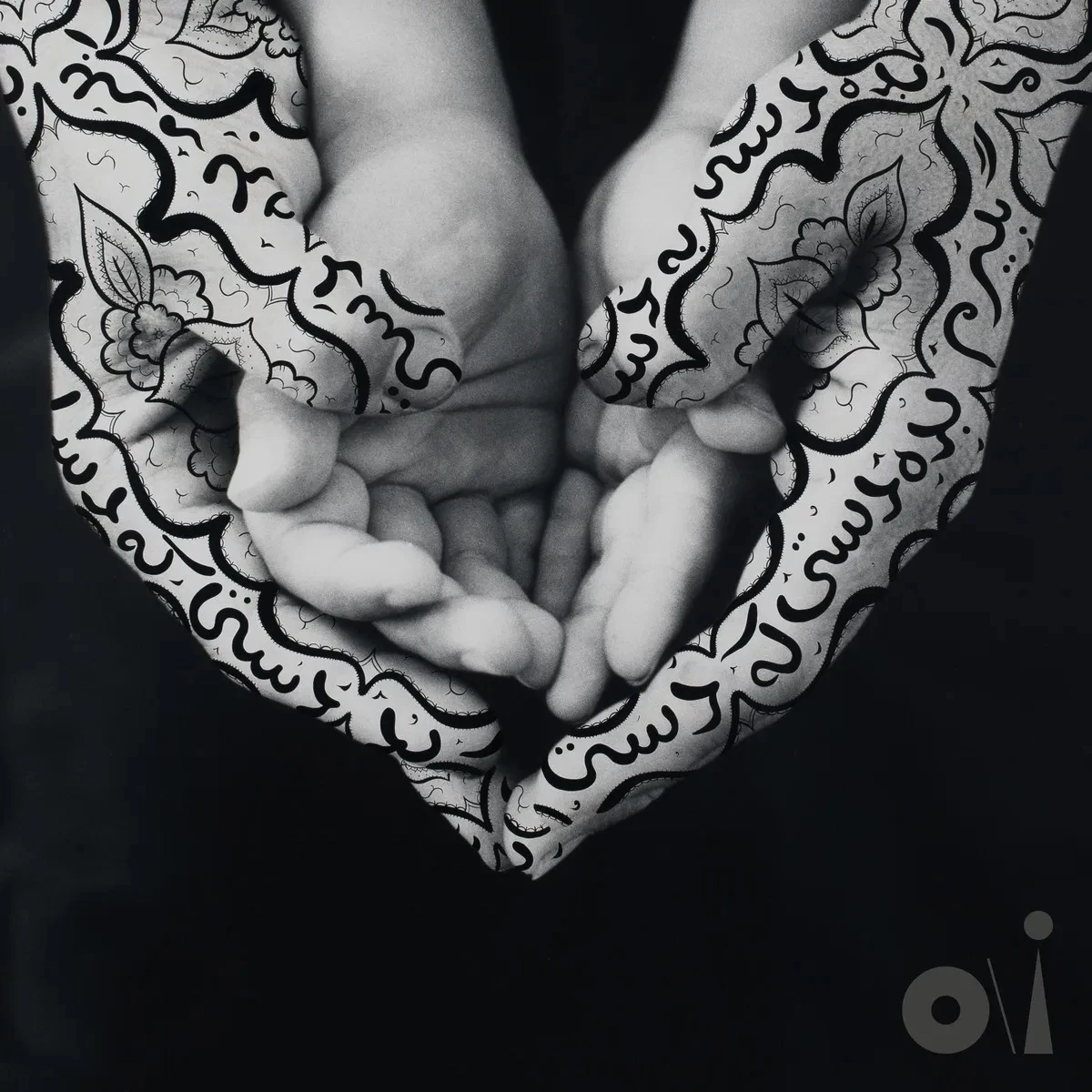
For the first time in the i/o\i Reigen series, a photograph has been included with the track. However, it has been enhanced and is therefore more than just a photograph. It shows a child's hands, which are in turn held by a woman's hands – protecting, supporting, guiding. Both pairs of hands form the customary gesture of Islamic prayer.
The work is titled Faith, dates from 1996, measures approximately 30 x 40 cm and was produced in a series of ten. The individual editions differ in the pattern of the calligraphy painted in ink on the woman's hands and, apparently, also in the inscription in Farsi. The version shown here reads: "Give me a hand so I can be held."
Faith forms a pair with a variation on the motif called Bonding. In the other photograph, the hands are clasped more tightly together, creating a markedly different impression. Both motifs can be viewed here for example.
The Connection
Gabriel says it was difficult to find something for the song that represents the theme of activism without simply resorting to a "slogan". The artwork should also convey warmth and humanity. For him, the image they have now found represents to protect a positive future for our kids
Gabriel was also asked whether the song refers to the current situation in Iran. Given the choice of artist, this is not surprising. However, the lyrics were written much earlier. Nevertheless, the connection works and seems fitting. Gabriel believes that the events in Iran illustrate precisely the state in which humanity is not realised.
Release #6 from May 31st, 2026: A Hard Lesson
The Track
A Hard Lesson is about finding a place in life. One is constantly searching for familiar ground, having to explain where one stands – finding it hard to discern. One is pulled out of the world, which, moreover, never stays the same. It is a hard lesson to learn.
Combined with the music, a difficult, rocky path is depicted. A picture of struggles and life's battles.
The Artist
Francis Alÿs was born in Antwerp, Belgium, in 1959. He studied architecture, first in Tournai and then in Venice until 1986. In 1987, he travelled to Mexico as an engineer to work on a Belgian government aid project following the 1985 Mexico City earthquake. He settled permanently in Mexico and began working as an artist.
He does not like to create large-scale sculptures or installations; his focus is on photography and film, as well as painting. He also creates performance works, which frequently take 'paseos' (walks) as their starting point, during which he engages with public space, social tensions and geopolitics through various actions.
For his first performance, The Collector (1991), he pulled a small magnetic toy dog on wheels through Mexico City, which collected all the metallic debris lying on the streets. Paradox of Praxis 1 (Sometimes Making Something Leads to Nothing) was a seemingly pointless endeavour in which Alÿs pushed a large block of ice through the streets for nine hours until it had completely melted. In the photo series Sleepers, begun in 1997, he captures people lying motionless in Mexico City, where it is unclear whether they are dead or asleep.
For decades, he has also been documenting children's games from a wide variety of regions around the world. Some are very simple, such as skipping or snowball fights, whilst others involve rules that only gradually become apparent. Alÿs captures them in films, photographs and paintings, showcasing the children's enthusiasm and concentration, whilst also touching on power structures and the realities of life, opportunities and inequalities.
An exhibition on this subject was not held until 2025 at the im Museum Ludwig, Cologne, Gemany.
Further projects and works can be found on Francis Alÿs's website.
The Artwork
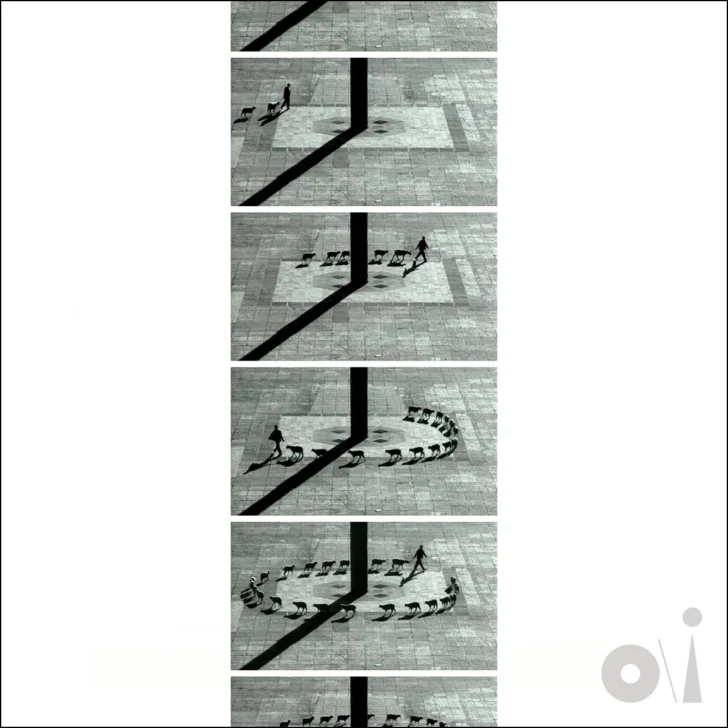
On display are stills from a film. Four are arranged one below the other, with a further cropped one above and below each of them. They depict different scenes from the short film Cuentos Patrióticos (Patriotic Stories).
The film captures a performance on the Zócalo, the main square in Mexico City. A man runs in a circle around the central flagpole, pulling a sheep behind him. He is soon joined by a second sheep, which runs alongside them. Then a third, and more and more. Stubbornly, they all trot one after the other, always in a circle. At some point, the man no longer leads the formation but runs behind it himself. Yet even then, all the sheep remain on their course. Eventually, they gradually leave the circle one by one, until only one remains, trotting ahead of the man – until finally these two leave the frame, too.
The film dates from 1997, is just under 26 minutes long and was created in collaboration with the artist Rafael Ortega.
When viewing the movie, the image of a stupid sheep mindlessly following the herd, even when it makes no sense, naturally springs to mind. And this can then be applied to people: mindless followers. However, Alÿs is referring even more specifically to a historical event that took place in the Zócalo. The square was originally laid out by the Spanish conquistadors as a symbol of their victory over the Aztecs and has repeatedly been the scene of various demonstrations of power. In 1968, at the height of political student unrest, thousands of civil servants were ordered to demonstrate in the square in support of the government. They resisted, however, by gathering in the square but turning their backs on the government stage and bleating like sheep.
The film can be found on YouTube here.
The Connection
Gabriel saw one of the stills from the film and he not only felt it depicted a townsquare, but also saw a general association with 'place' and 'living space'. Furthermore, the central pole and the long shadows remind him of a sundial, which is why 'time' also features. These are themes in his song.
He admits that this is quite associative and not necessarily rational, but for him it still feels right.
A sharp contrast—which is perhaps precisely what makes it effective—is formed by the numbing tranquillity of the monotonous circling in the film and still images, in contrast to the sometimes harsh atmosphere of the music.
Release #7 from June 30th, 2026: I Belong To The Sky
The Track
It's about dreaming and making dreams come true. I Belong To The Sky conveys a positive message. According to Gabriel, the world is more malleable than one might think. Powerful visions increase the chance that things will actually come to pass.
Two states are evident in the song: the verses describe a relaxed sense of letting go, of letting one's thoughts wander. The chorus then moves on to putting those ideas into action. One sets out into the world so that one's thoughts can materialise.
The Artist
Berndnaut Smilde was born in Groningen in 1978. He completed his artistic training at the Frank Mohr Institute at Hanze University of Groningen, a centre for study and research in the field of art and new media. In 2005, he completed his Master's degree in Fine Art there. He now lives and works in Amsterdam.
Smilde's work encompasses installations, sculptures and photography. He explores the themes of light, space and atmosphere. One of his best-known works is the sculpture series Conditioner – eerie tangles of industrial hoses and pipes that emit an antiseptic scent. He began another project in 2015. In Breaking Light, rainbow colours generated by bespoke prisms are projected onto buildings, temporarily imbuing them with a natural phenomenon.
His idea for the art exhibition Welcome to the Neighbourhood 2009 – to trick Google Street View – is rather quirky. In the 1840s, residents of the Irish village of Askeaton emigrated and founded a new town in the USA also called Askeaton. Street View soon became available there in the new millennium, but the original village in Ireland remained excluded. Smilde erected a replica of the façade of a barn from the American town by the roadside there, intended to be captured should the Street View camera van pass by one day. Which happened in 2012. The same building could then be seen in both places, linking them together.
These and other projects can be found on Smilde's Website.
The Artwork
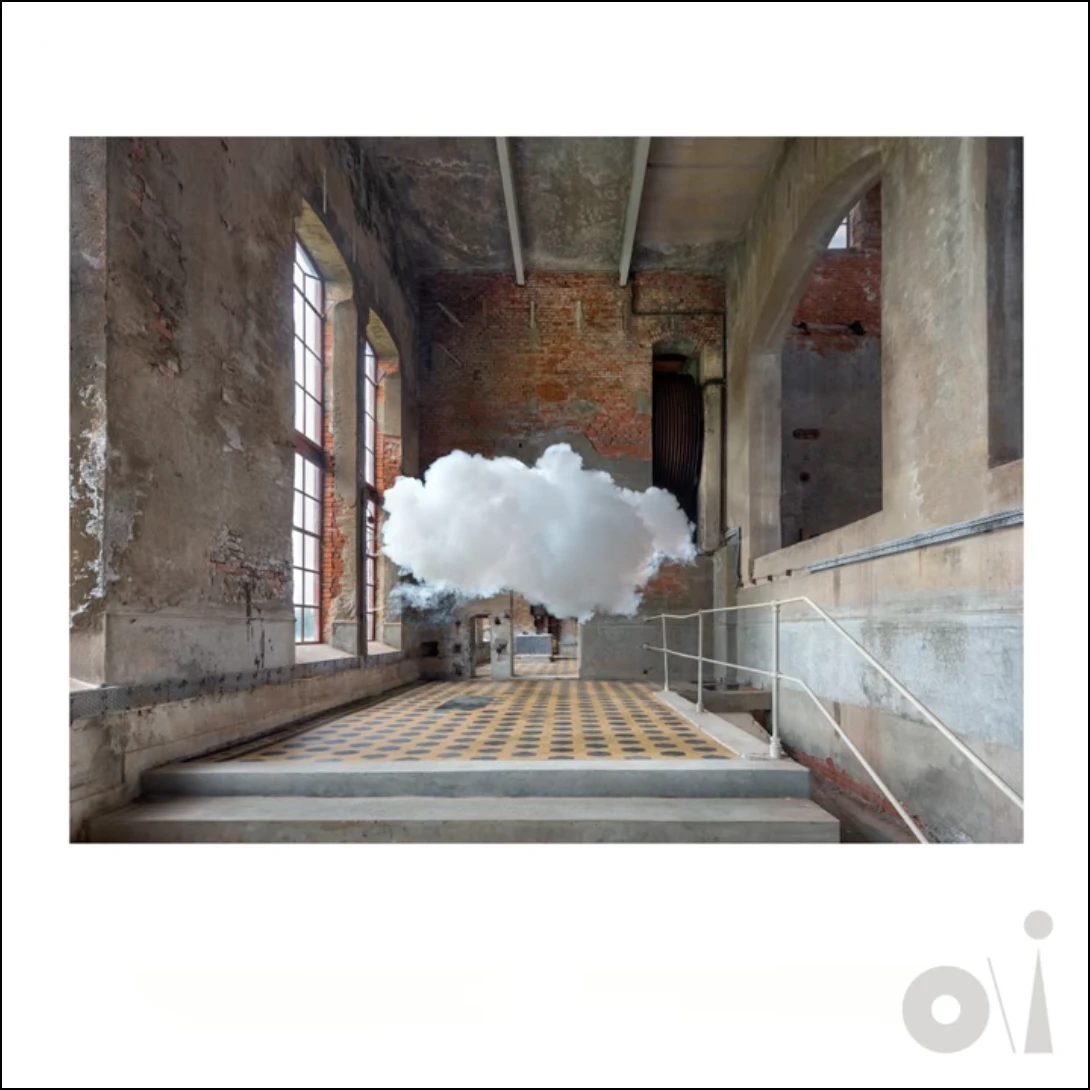
The title is Nimbus de Toekomst 1 (Nimbus of the Future 1) and depicts a cloud formation hovering in the midst of an older building. The image dates from 2019 and was produced as part of a series of six pieces, each measuring 125 × 169 cm (photograph: Cassander Eeftinck Schattenkerk).
It forms part of a series of similar images called Nimbus, which began in 2012 and is still growing. Smilde creates the clouds himself by first setting up a fine curtain of water vapour in large rooms, at which a fog machine is directed. At the curtain, the fog combines with the water droplets, causing it to be pressed down towards the floor, which creates the distinctive cloud shape. They are then captured on camera by professional photographers with whom Smilde collaborates.
What interests him is the ephemeral nature of the process. Ultimately, the cloud exists only as a photograph documenting something that has long since dissipated. He also says: "I see them as temporary sculptures of almost nothing – the edge of materiality. It looks like you can dive into them or grab them, but they just fall apart. There's a duality there that I really like, where you're trying to achieve this ideal thing that then just collapses moments later. There's a duality there that I really like, where you're trying to achieve this ideal thing that then just collapses moments later."
The Nimbus series, with its surrealist images devoid of people, has now grown to be enormous in scope and is hugely successful. Not only has it been featured in numerous exhibitions – in 2013, Smilde also used such images to design a special edition of a fashion magazine. Karl Lagerfeld, Dolce & Gabbana and Donatella Versace were also involved.
The Connection
Gabriel likes the Nimbus series because it brings the sky indoors. He sees a mix between the interior and the exterior and the transition between them. That's what his song is about, too. He also likes the fact that Smilde says his clouds are connected to dreams.
And finally: of the many images in the photo series, Nimbus de Toekomst 1 is Gabriel's favourite.
Release #8 from July 29th 2026: One By One
The Track
Mozo, the protagonist of the song One By One has, in a sense, been torn apart. Everything in his life has fallen apart and his heart is broken. The song begins by looking at his state from the outside, then he himself describes how he braces up to painstakingly 'put himself back together' – piece by piece, one by one.
It's about 'not giving up', about the will to regain strength, and the long final section also speaks of finding love again.
The Artist
David Altmejd is a sculptor born in Montréal in 1974, who initially studied at the Université du Québec à Montréal and went on to complete a Master of Fine Arts at Columbia University in New York City in 2001. Altmejd now lives and works in Los Angeles.
His works are often surreal and explore themes such as decay and transformation. He is best known for his busts, which are frequently based on human anatomy but are always distorted through the duplication of individual segments or by blending them with parts of animals or inanimate objects. In doing so, he blurs the boundaries between figurative and abstract representation, between the internal and the external, and between the beautiful and the grotesque.
More recently, he has repeatedly depicted animals themselves – particularly rabbits – and then reworked them in his own distinctive way. These include obscure sculptures of animals as musicians – with a swan's guitar, for example. Gabriel first became aware of him in 2022 through the artwork 9x9x9.
In addition, Altmejd has designed entire rooms for exhibitions and created large-scale installations that blur the line between the organic and the constructed.
David's first foray into the world of music is rather atypical of his work: in 2016, he designed the cover for Yeasayer's album Amen & Goodbye, which features a collection of comparatively ordinary figures.
David Altmejd's website can be found here. Among other things, videos on the site offer insights into how his works are created.
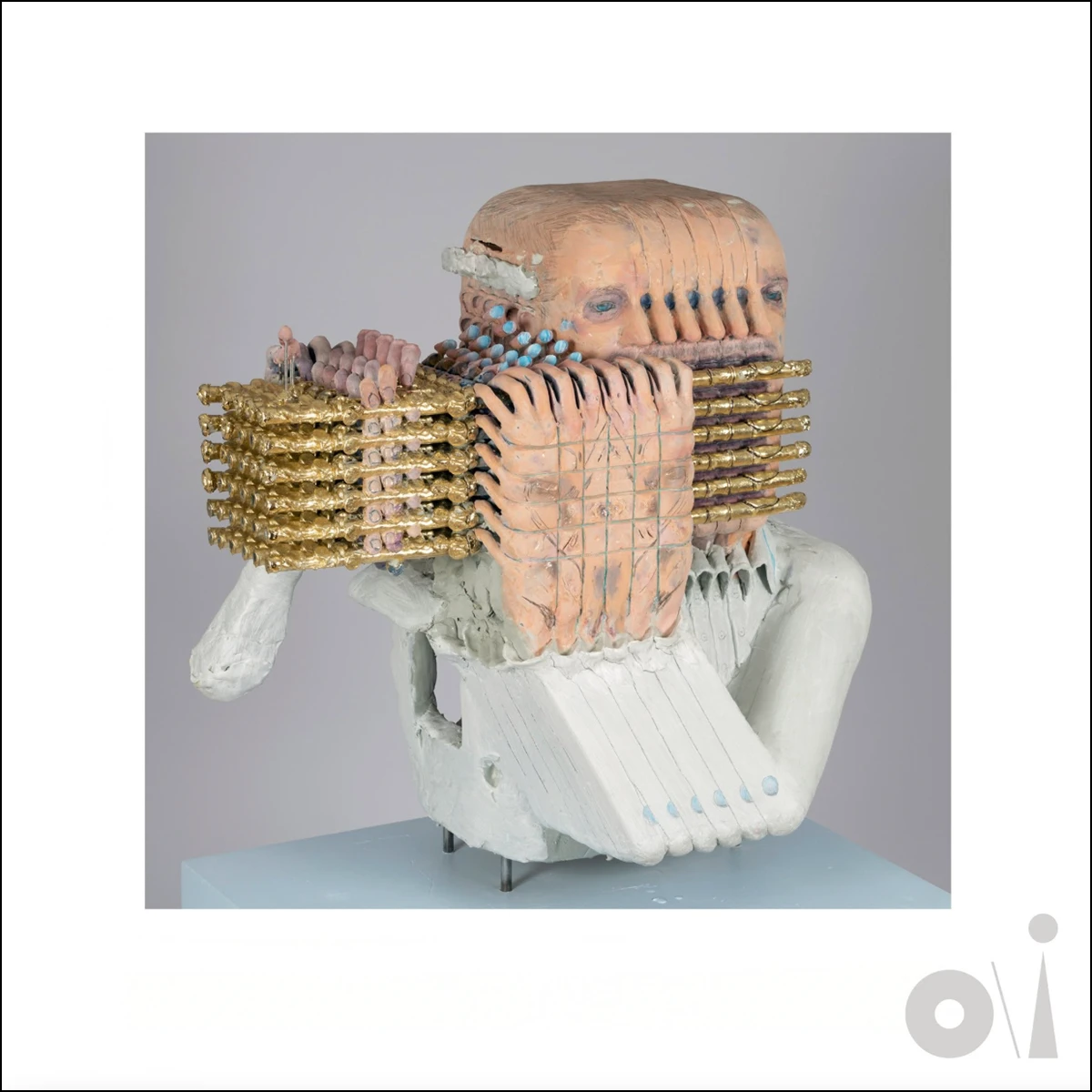
The Artwork
This artwork, entitled Pieces, is a bust of a person playing the flute. The sculpture is divided horizontally and vertically into segments that are repeated and arranged in a row. The figure is still clearly recognisable, but has been istorted in a distinctive, square-like manner. The artwork has an effect that is both human and technical at the same time.
Pieces was created especially for the song, and in Gabriel's introductory video you can also see a few moments from its creation.
The Connection
It is obvious – and Gabriel mentions this too – that Altmejd reassembles things in his works. The result is something that goes "beyond where our heads normally are – finding this other substance there."
David Altmejd adds: "One by One evokes a kind of spiritual evolution by piecing together the broken parts of oneself. This resonates deeply with me because I understand my sculptures as being made the same way. They start by forming themselves in matter, then they are destroyed, and finally reassembled in a way that makes them transcend materiality."
Gabriel also mentioned the Japanese art of kintsugi, in which broken ceramics are mended and the cracks highlighted with gold paint. The resulting piece is considered to be of greater value than the original.
Gabriel feels his song about rebuilding is well represented by this.
Release #9 from August 28th 2026: Looking For The Happy
The Track
On the one hand, the verses of Looking For The Happy reflect on the complexity of the world, pondering challenges and confusing, technological changes.
However, the bulk of the piece is taken up by the joyful search – "looking for the happy". "The circus" is cut away; satisfying moments are described; dancing shoes are put on; and simple pleasures are savoured, such as sitting under the old oak tree with a cup of tea.
The Artist
Tishan Hsu was born in 1951 in Boston, Massachusetts. He spent his early years in Zurich (Switzerland), before growing up in Ohio, Wisconsin, Virginia and New York. He studied environmental design and architecture at the Massachusetts Institute of Technology, as well as film at the Carpenter Centre for the Visual Arts at Harvard University. After graduating in 1979, he moved to New York. His first exhibitions took place from 1985 onwards. In the spring of 1988, Hsu moved to Cologne (Germany) for two years. Since 1990, Hsu has been living and working in New York again.
In the early 1980s, he had a part-time job as a word processor and thus came into contact with computers much earlier than the general public. He began to sense how this technology could be both restrictive and liberating, and consequently created abstract works that reflected this inner conflict – works that were largely underappreciated at the time.
In the 1984 painting The Cross Product of Madame X, one can already make out a smartphone screen. His installation Interface Remix (2001) depicts organic-looking structures – skin, muscle tissue – which are complemented, in a rather jarring way, by technological elements. The sculpture Virtual Flow (1990–2018) features a monitor screen framed by tiles and a glass display case containing what looks like organs and tissue. Everything is connected by cables, raising the question: what emits energy and what absorbs it?
Hsu predicted that technology would become increasingly integrated into our everyday lives. "In a way, I had to create a different body in the world," he says. "Maybe I was just projecting all of this onto new technology: we'll have a different body."
His works can be seen in major public collections such as the Metropolitan Museum of Art (New York), the Centre Pompidou (Paris), the Tate Modern (London) and the Museum für Moderne Kunst (Frankfurt am Main).
Hsu does not appear to have his own website, but he does have an Instagram account. Further examples of his work can also be found at the Lisson Gallery.
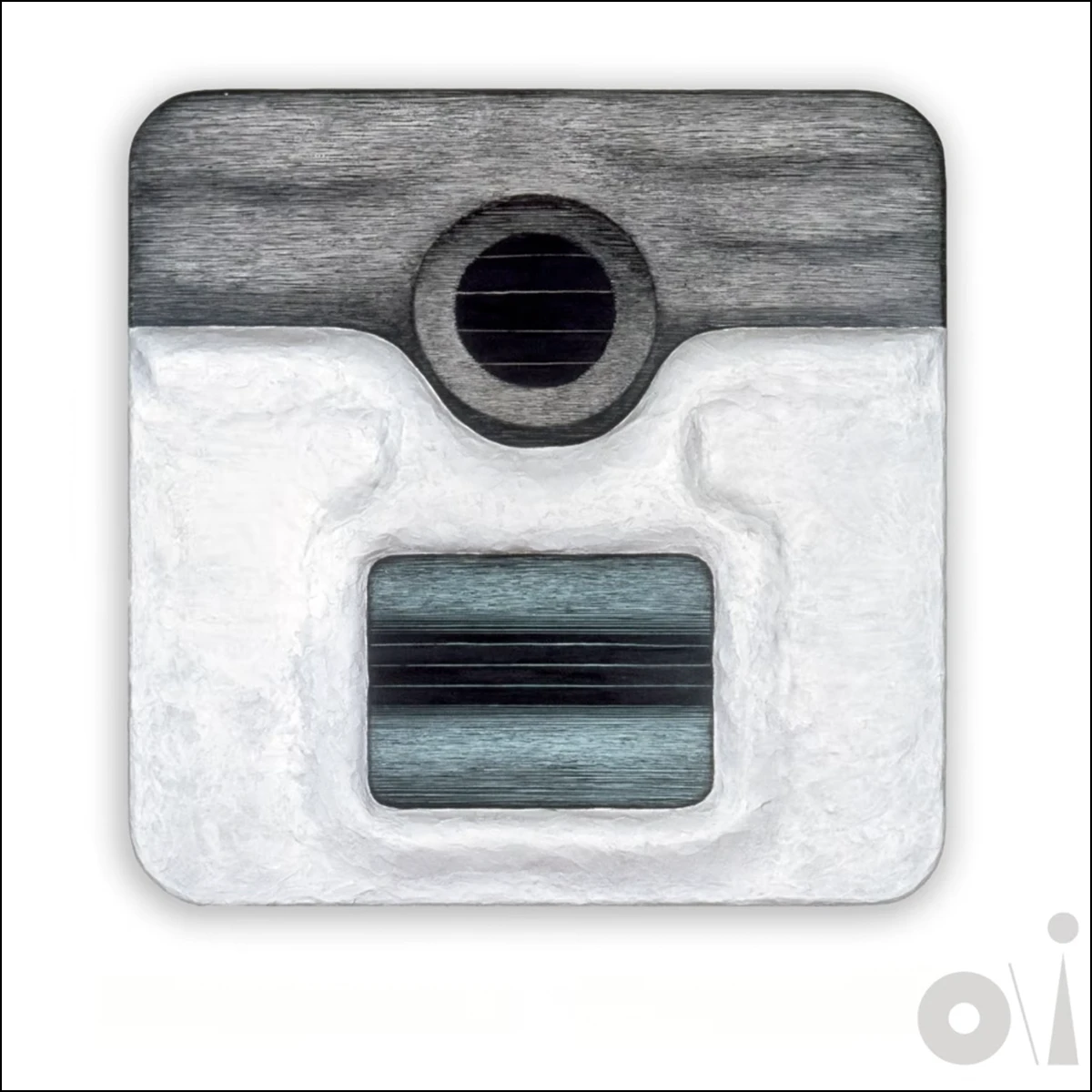
The Artwork
Closed Circuit II is a painting featuring raised sections, rounded corners and predominantly rendered in two different shades of grey. The surface of the darker section has the appearance of brushed metal, though this is merely painted. A circular and a rectangular element in the piece vaguely suggest the appearance of a camera front, though they may also bring to mind a highly abstracted face. The artwork is made from acrylic, alkyd resin, polystyrene and vinyl cement on wood (dimensions: 150 × 150 × 10.2 cm).
It is striking that it dates from 1986 and, forty years ago, its aesthetic anticipated the design of smart devices. The motif is also said to have foreshadowed the original Instagram logo.
Closed Circuit II is part of a travelling retrospective exhibition called Liquid Circuit (see here). All the shown works are older pieces that were ahead of their time and convey a sense of inner alienation caused by the technology embedded in our everyday lives.
The Connection
Gabriel says: "Often when we see these images for the songs, we're reacting spontaneously to something that feels right and then we dig down and discover that there are similar themes being explored visually and musically. (…) In the way that the song was trying to explore consciousness, technology and nature I think Tishan does that in some of his own work."
The artwork therefore relates less to the "happy" aspect of the song and more to the source of that search.
And Gabriel too: "Although the work is about tech it's interesting that the work itself is not really technology-based – it is very traditional painting and sculptural techniques that he's employing."
Release #10 from September 26th 2026: Face The Wall
The Track
Gabriel isn't very explicit – neither in the introductory video nor in the lyrics – but it's safe to assume that Face The Wall is about the serious illness his wife Meabh had to overcome a few years ago. Full of reverence and admiration, the song speaks of great force in persevering – in what appears to be a gentle piano ballad.
Yet behind the kindness, the song is actually about death. It's about having strength and giving strength, about staying grounded, about not giving up. It's about having to "face the wall". And about someone who showed true greatness in the process.
The Artist
Tadashi Kawamata was born in 1953 in northern Japan – in Mikasa, Hokkaidō – where he grew up in a rural setting close to nature, an experience that continues to influence him to this day. He initially studied painting at the Tokyo University of the Arts, but after a few years realised that he was far more interested in object art. In 1979, he began creating installations, which continue to characterise his work to this day.
He almost always uses wood for his works, often leaving it untreated. His work frequently involves interacting with existing architecture; he takes over corners and façades that would otherwise go unnoticed. He unsettles or astonishes, partly through his play with materials and scale, and invites us to engage with the question: What fits into the picture, and what does not? What is considered valuable, and why?
Kawamata adds: "I choose simplicity. To make something with little, but with precision – that does not mean scarcity, but mindfulness."
Alongside these large-scale installations, Kawamata also creates structures on a more modest scale. His Field Works are constructions made of cardboard and plywood, designed to fall apart over time. They bear a strong resemblance to the shelters of homeless people and are intended to draw attention to something that would otherwise go unnoticed. Kawamata has left his Field Works in cities such as Tokyo, Chicago, New York and Montreal. In 1992, he also exhibited at Documenta 9.
For the work Over Flow at MAAT in Lisbon (2018), rubbish was collected from various Portuguese beaches and carefully sorted. This resulted in an indoor installation made of colourful rubbish – fishing lines, pieces of plastic, bottles, electrical components – which hung above the visitors' heads and was intended to raise questions about global ecology and tourism.
You can get a glimpse of the work on his website.
The Artwork
The selected image shows the temporary installation The Nest at the Amos Rex Museum in Helsinki from 2022. The building itself is called Lasipalatsi (Glass Palace), and on the relevant Wikipedia page there is a a photograph that also shows the installation.
The work consists of hundreds of discarded chairs and other wooden objects, forming what look like waves that spill over the edges of the roof in several places. The selected photograph shows one of these waves tipping over a high building wall. A staircase, a door and a ladder are also featured. Ways out?
All the materials used in the installation were collected in collaboration with the Helsinki Reuse Centre and reused after the exhibition.
The Connection
Gabriel thought The Nest was just right for the song. He sees the huge, massive wall, which to him is a bit like death. "And these sort of messy human chairs are falling over the wall and somehow they spill over the top. It's a sort of 'David and Goliath' moment for me that these chairs can get up and over. It's funny but it's also hopeful and against unbelievable odds."
So it seems that, for him, this image represents the struggle that must be endured. An act of defiance.
Author: Thomas Schrage