

- Article
- Read in 10 minutes
Song 06: "A Hard Lesson" (31st May 2026)
The track for the second full moon in May isn't quite as smooth as its two predecessors. Instead, Gabriel once again showcases his mastery of the abysmal.
Bright-Side Mix
Dark-Side Mix
RE Industrial Mix
overview of the o\i article series
The track for the second full moon in May is once again much more powerful. It also has a darker feel to it.
It has its origins in the late 80s / early 90s and is the track that took the longest to create on o\i. The original musical inspiration came from Gabriel's stay in Senegal, where he heard interwoven triple and quadruple rhythms. He tried to create something of this kind himself. The initial ideas apparently sounded very much like blues rock, which is hard to imagine given the final result with its rather industrial-sounding feel.
Over time, the song underwent many changes, even disappearing into the archives, but has now been brought out again and finally completed.
Theme-wise, it's about finding one's place in life. Gabriel also says, however, that the song mainly should be enjoyed.
Lyrics
The song describes, in quite clear terms, the struggle of finding one's place in life: you constantly have to explain where you stand. You search for familiar ground – which is not easy to discern. In fact it's a hard lesson to learn.
The chorus says that you search for the love you know from your dreams, but that leads far away from where you come from, pulling you out from a world that never, never, never stays the same.
The lyrics may not convey any incredibly new ideas, but combined with the music, they paint a rather striking picture of hardship and life's difficult struggles.
Artwork
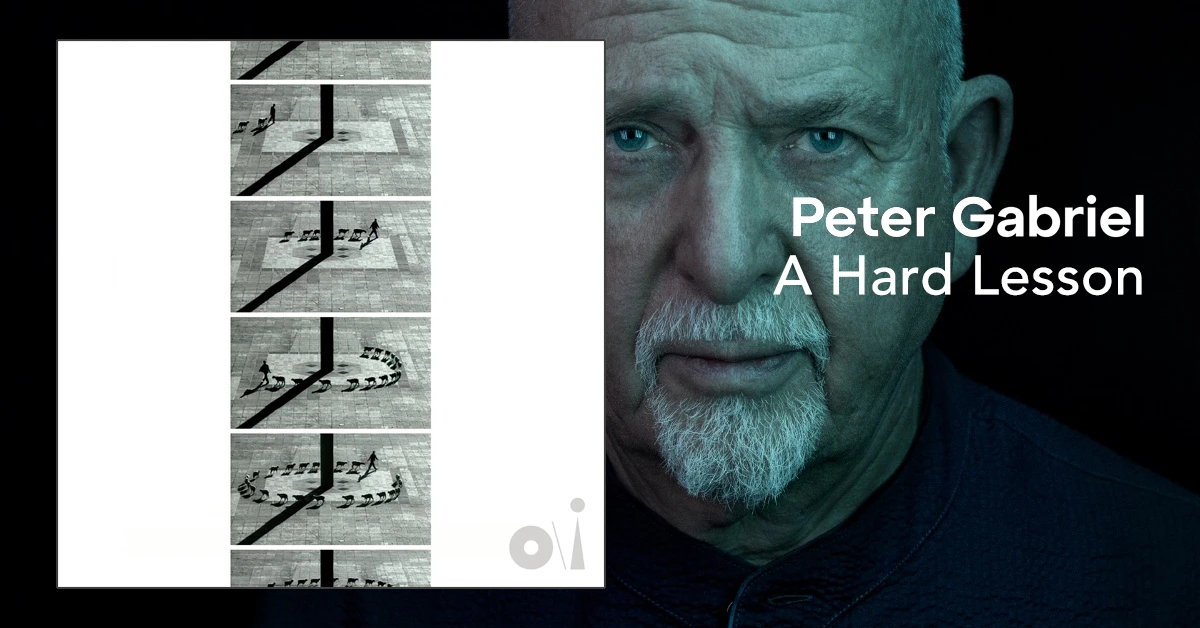
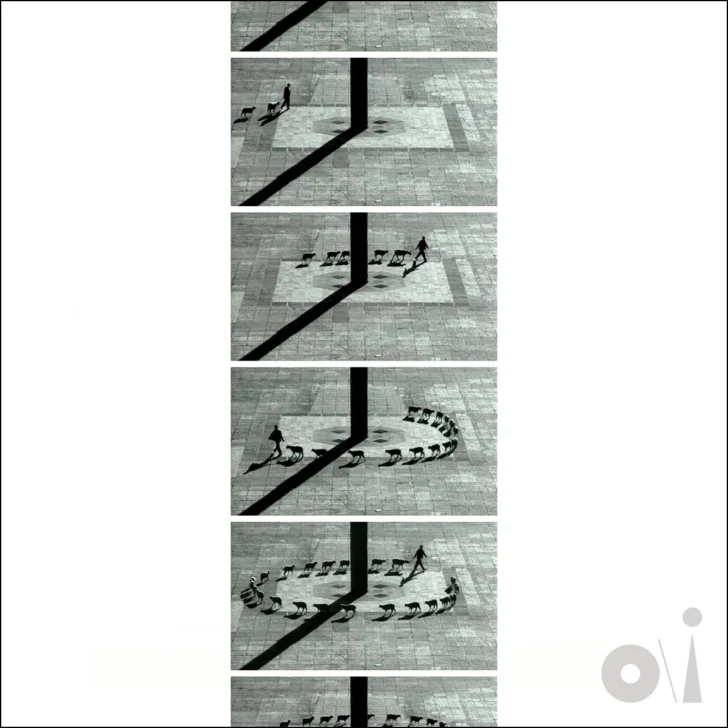
The artwork this time consists of stills from a short film by Francis Alÿs entitled Cuentos Patrióticos (Patriotic Stories). It documents a performance from 1997 on the Zócalo, the main square in Mexico City. The footage shows a man walking in a circle around the central flagpole, initially followed by a single sheep, then a second, and then more and more. They stubbornly trot in a circle, one behind the other, even when the man is no longer leading the formation and is now running behind them himself. One can read a great deal into this sequence, especially as there are also some symbolic undertones.
The track-image uses four stills from the film, arranged one below the other, with a further one appearing cropped at the top and bottom.
Gabriel saw one of these stills and felt that it said something about "place". Moreover, the central pole and the long shadows remind him of a sundial, which is why "time" is also featured. He admits that this is quite associative and not necessarily rational, but for him it's nevertheless fitting.
Francis Alÿs was born in Antwerp, Belgium, in 1959, but moved to Mexico in 1987, where he still lives today. He originally studied architecture, but now works as a photographer, painter, performance and video artist. His presentation works are frequently based on "paseos" (walks), during which he engages with public space, social tensions and geopolitics through various actions. He has also been documenting children's games for decades.
You can find out more about the o\i artworks and the artists behind them in our separate article.
Bright-Side Mix – 31st May 2026
Words and Music by Peter Gabriel
Produced by Peter Gabriel and Mike Elizondo
Mixed by Mark 'Spike' Stent
Engineering by Katie May, Dom Shaw, Faye Dolle, Richard Evans, Richard Chappell
Additional engineering by Erica Block, Alex Wilders
Assistant engineering by Charles Hughes, Xav Sinden, Maisy Preece
Pre-production engineering by Richard Chappell, Richard Evans, Charles Hughes
Original Industrial Arrangement: Richard Evans
Mastered by Matt Colton at Metropolis Studios
Recorded at Real World Studios, Bath and The Beehive, London & Phantom Studios, Gallatin, TN
Drums – Abe Rounds with Manu Katché
Rhythm Programming – Peter Gabriel, Mike Elizondo
Percussion – Abe Rounds, Peter Gabriel, Charles Hughes, Faye Dolle
Bass – Mike Elizondo with Tony Levin
Synth Bass – Richard Evans
Electric Guitar – David Rhodes, Tony Berg
12-string Acoustic Guitar – Richard Evans
Banjo – Richard Evans
Mandolin – Richard Evans
Synths – Peter Gabriel, Richard Evans
Backing vocals – Peter Gabriel
Vocals – Peter Gabriel
Length 6:42
Anyone expecting an African flavour from the song, based on Gabriel's description of its origins, will be disappointed. Nor are there any real traces of blues to be found. Gabriel now describes the whole thing as a "quirky, strange, long track".
He does, however, skilfully achieve his aim of conveying a certain mood.
Music
An instrumental intro runs for 40 seconds, trembling nervously and rumbling, until a heavy drone cuts in as the underlying accompaniment. A guitar counters this with high-pitched chords, creating a tense response, which is replaced by the vocals in the verses.
This intensity is maintained throughout the song, underpinned by ticking percussion, various interjected sounds and keyboard runs. There is practically no vocal melody, and the lyrics are delivered gruffly. A heavy, rugged path is laid out here.
But in the chorus, this recedes, giving way to piano and guitar, which provide a lighter, more folky backdrop. Here, too, there is a harmonic progression and a clearly discernible vocal line.
The third and fourth verses vary in their accompaniment, which is occasionally paused briefly, but the overall structure remains essentially intact.
Until, at 4:08, an interlude begins that unexpectedly offers emptiness, featuring only soft guitar and piano. Gabriel sings three lines about walking on thin ice in a vulnerable voice – before the song returns to its usual brute force. This continues right up to the end, with the "talking, talking…" accompanied by further eccentric sounds and vocals. One gets the slight feeling that a nightmare is then coming to an abrupt end.
Personnel
As the song had been maturing for over 30 years, Gabriel reckoned the list of credits would be incredibly long – a wide variety of musicians had contributed to it time and again. Yet the list for the final track isn't actually that long.
Firstly, it's worth noting that there is another producer alongside Gabriel. It is Mike Elizondo, who was already mentioned in connection with the two previous tracks. He played a significant role in sifting through and streamlining the extensive material. Abe Rounds, who was introduced by Elizondo, also features here once again.
It is interesting to note that Elizondo is generally listed for bass, whilst Rounds is for drums. Levin and Katché are each credited on their respective instruments only for additional contributions.* This is an indication of just how much the song was further developed after the band sessions.
Richard Evans is listed several times, and Gabriel also mentions him specifically in his introductory video. Apparently, he produced an early version that leaned more towards industrial, before Gabriel decided that the chorus should have a more organic sound, which Evans then achieved using acoustic instruments.
* That was the original wording. The phrasing has since been changed. See below under the Dark-Side Mix.
Dark-Side Mix – 15th June 2026
Words and Music by Peter Gabriel
Produced by Peter Gabriel and Mike Elizondo
Mixed by Tchad Blake
Engineering by Katie May, Faye Dolle, Dom Shaw, Richard Evans, Richard Chappell
Additional engineering by Erica Block, Alex Wilders
Assistant engineering by Charles Hughes, Xav Sinden, Maisy Preece
Pre-production engineering by Richard Chappell, Richard Evans, Charles Hughes
Original Industrial Arrangement: Richard Evans
Mastered by Matt Colton at Metropolis Studios
Recorded at Real World Studios, Bath and The Beehive, London & Phantom Studios, Gallatin, TN
Drums – Abe Rounds with Manu Katché
Rhythm Programming – Peter Gabriel, Mike Elizondo
Percussion – Abe Rounds, Peter Gabriel, Charles Hughes, Faye Dolle
Bass – Mike Elizondo with Tony Levin
Synth Bass – Richard Evans
Electric Guitar – David Rhodes, Tony Berg
12-string Acoustic Guitar – Richard Evans
Banjo – Richard Evans
Mandolin – Richard Evans
Synths – Peter Gabriel, Richard Evans
Backing vocals – Peter Gabriel
Vocals – Peter Gabriel
Length 6:42
With the release of the Dark-Side Mix of A Hard Lesson, we now have two versions which, once again, exemplify the styles of the two mixers in a textbook manner. And even though the overall structure has remained the same, the details at least show once more that both use different material.
Music
Differences become apparent right from the intro. Whilst both mixes are based on the same nervously pulsating bass, it is emphasised much more prominently in the Dark-Side Mix. Both also share the restless piano, but the clattering percussion doesn't kick in until quite late. The overall effect is darker and more static right from the start.
In the main section, the deep, rumbling riff is slightly sharper in the equalisation, which makes it sound even harder and more powerful than in the Bright-Side Mix. Although the guitar's response comes from just as far to the left in the stereo panorama, it is positioned further forward, which makes it seem further out. Above all, however, the Dark-Side Mix lacks the many small clicking and pulsating interludes. A few others have been added, but it is clear here too that the Dark-Side Mix is, on the whole, less playful.
The chorus here does not recede as noticeably as in the Bright-Side Mix; it keeps the oscillating accompaniment more active, even adding further elements, and consequently comes across as more restless, almost hyper. The Bright-Side Mix opts for more restraint here.
The most noticeable difference is in the subdued middle section. In the Bright-Side Mix, this section features only a restrained guitar and light keyboard parts; in the Dark-Side Mix, a piano is layered over this (it's unique to this version), almost completely drowning out the guitar. The vocals are not dreamily reverberant either, but remain prominent at the forefront. Furthermore, the wind noises kick in earlier and become louder. Overall, there is a much greater sense of unease here too.
In conclusion, one could say that the Dark-Side Mix presents the theme of 'people in dire straits' with a stark, raw intensity; it feels more rootless and dispenses with all musical niceties. It also dispenses with most of the embellishments. Whereas the Bright-Side Mix still strives to be smooth, this mix shows no such consideration.
Personnel
Although the credits are exactly the same as on the Bright-Side Mix, it is interesting to note that there have been a few changes to the wording since its release, which now appear on Bandcamp for both versions.
Firstly, Richard Evans is once again highlighted for what is described as the "Original Industrial Arrangement". It also now reads "Drums: Abe Rounds with Manu Katché", and similarly "Bass: Mike Elizondo with Tony Levin". In the original version, it was read "Drums: Abe Rounds; Additional drums: Manu Katché" – with the bass credited in the same way. Apparently, it was felt that the new way of crediting better reflects the musicians' contributions and does not push the core band into the background.
Gabriel himself is no longer specifically mentioned for "Synth strings", which may be down to modesty or the relative insignificance of this musical element (perhaps it has even been omitted entirely from the mixes, though this isn't necessarily verifiable given the sonic storm).
RE Industrial Mix – 29th June 2026
Written by Peter Gabriel
Mixed by Richard Evans
Rebuilt by Charles Hughes
Published by Real World Music Ltd / Sony Music Publishing
Manu Katché – drums
Tony Levin – bass
David Rhodes – guitar
Richard Evan – synths
Peter Gabriel – synths
Length 5:09
Since Richard Evans' preparatory work for A Hard Lesson had been prominently highlighted in the credits after the fact (see above), it was no surprise that this "Original Industrial Arrangement" – of all things – was released as a Bandcamp bonus version. Although the 'RE' in this mix's title refers to Evans, it also evokes the meaning of 're' as in 'back', because for the RE Industrial Mix, studio engineer Charles Hughes apparently reassembled the original version so that the band would have a backing track to play along to during the 2025 recordings. Which, incidentally, is also the reason why the whole thing is an instrumental track without vocals.
Music
At first, sounds reminiscent of atmospheric radio static can be heard, over which the intro familiar from the final version then layers. But the overall sound seems a bit thin. The central guitar riff also is less harsh and stays more in the background. The "industrial" element is primarily evident in the arrangement of the rhythm track. This general restraint makes it clear that this version was intended for the band to play over. The RE Industrial Mix isn't very distinctive in itself and isn't nearly as brutal as the final result. It has a more swaying quality rather than a wild one.
Nevertheless, it's quite well-crafted, features a whole series of decorative details, and undergoes a slight evolution over its course. And even though the vocals – which would provide orientation – are missing, the structure largely corresponds to the final version; only the second verse section is shorter, and the receding middle section is absent. It's also interesting to note that the chorus doesn't calms down, but continues to follow the groove.
And overall, it becomes quite clear from which era recording and original mix originate, as this version could just as easily have fit on Up.
Personnel
Only Gabriel's core band is featured here – and in a very old recording from 1996. What's peculiar is that during the 2025 studio sessions, the band essentially played along with itself. However, this may have been a technique used repeatedly, which explains why individual musicians are often represented in the final versions with a wide variety of contributions.
The only additions here are synthesizers, for which Richard Evans is credited – just like Gabriel himself. It's impossible to say exactly which parts are attributed to whom. However, Evans likely contributed the industrial appearance.
–
Author: Thomas Schrage
Links
Introductory video for A Hard Lesson:
Song background on petergabriel.com
The Webseite of Francis Alÿs.
The movie Cuentos Patrióticos of Francis Alÿs on Youtube.
Digging in the Dirt with Sheryl Crow, produced by Mike Elizondo on Youtube.
Join the discussion about the song here in the forum.