

- Article
- Read in 9 minutes
Song 04: "Till Your Mind Is Shining" (2nd April 2026)
The fourth track on o\i is – just like on i/o – a cheerful, fairly short number. It's laid-back, even a bit unsettling – and not really trivial.
overview of the o\i article series
This song, too, explores the themes of perception and brain function. It is becoming increasingly clear that this is evidently the central theme of the entire album.
Specifically, Gabriel says the song is about 'opening the mind' and immersing oneself in it. The brain remains a largely unexplored territory. With future possibilities, people will increasingly work on their minds, much as they have long worked on their bodies. With AI support, it will be possible to complete several years' worth of learning in a shorter time. Which – Gabriel hopes – will lead to a better understanding of oneself and to making decisions in a more responsible and compassionate manner.
Also interesting: Gabriel says, "To my ears it's the closest I get to a pop song on this record."
Lyrics
The lyrics are essentially a series of light-hearted descriptions of a rapid stream of data or thoughts. The blurred distinction is intentional. Metaphors relating to the sea, water and flowing are also used consistently. And for the sake of musicality, entire lines are sometimes repeated.
The chorus sums up the enthusiasm inherent in it all: "You look, you learn, you see it – illumination – you look, you learn, you listen – till your mind is shining".
Art
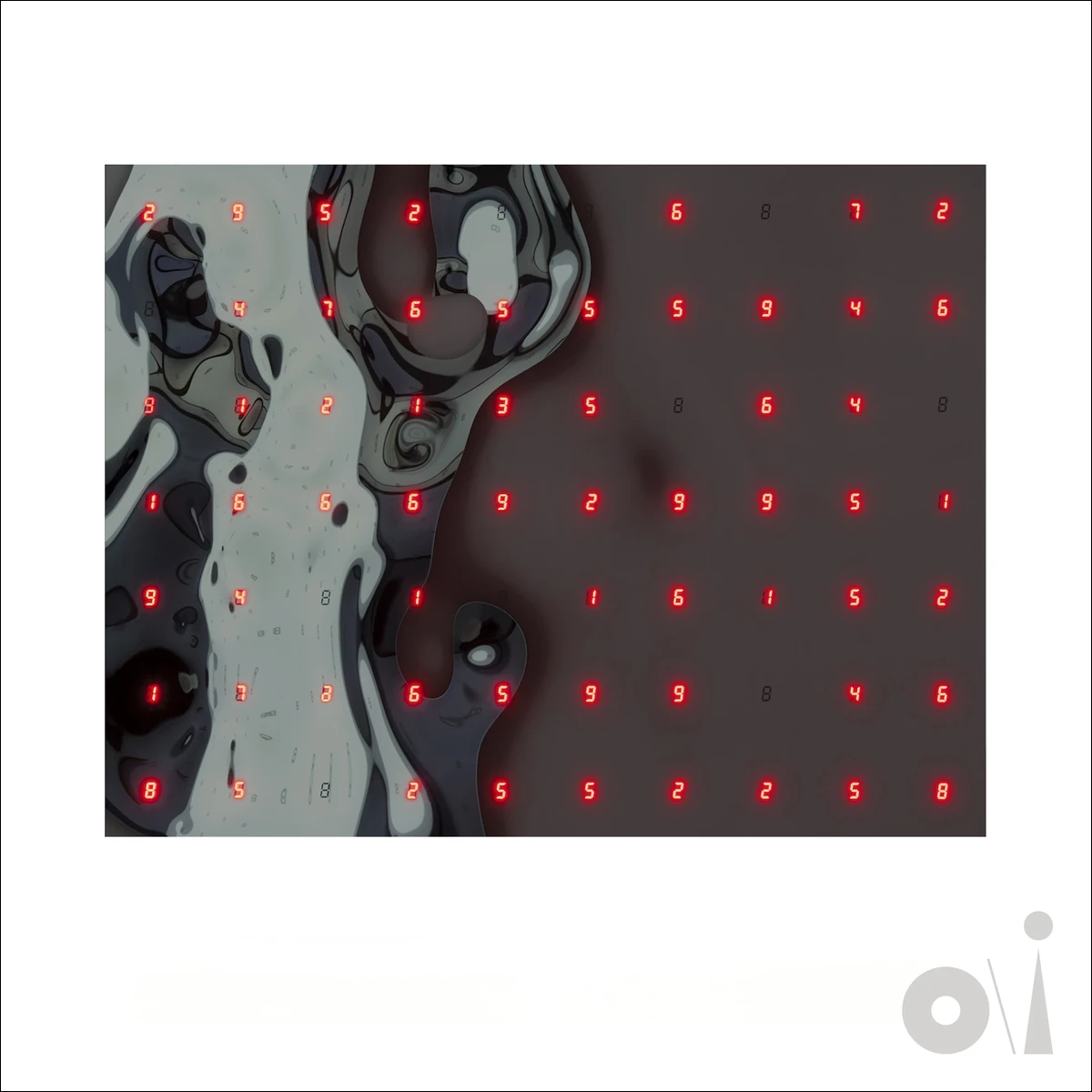
The visual motif of the song consists of a photograph of the artwork Warp Time with Warp Self No. 2 (LED, IC, electric wire, mirror glass, steel, 105 x 150 x 15.5 cm). In fact, it shows only a snapshot of this object, as it is constantly changing. This applies not only to the numbers displayed on the LEDs, but also to their background, which consists of reflective glass that is not perfectly flat. It distorts the surroundings and therefore always looks different depending on where you stand.
The object was created by Tatsuo Miyajima, a Japanese sculptor and installation artist. Born in 1957, he studied painting in Tokyo, graduating with a Master's degree in 1986. Soon afterwards, he began experimenting with performance art before moving on to light-based installations. He frequently works with numbers that appear on LEDs or are sometimes projected onto entire high-rise buildings.
For him, the focus is primarily on the function and significance of time and transience. The LEDs in his works count cyclically from 1 to 9, but never display the number zero, which for Miyajima represents stagnation and death. Buddhist perspectives on inevitability, universality and mortality play a role in these concepts.
You can get a good sense of Miyajima's work on his website.
What appeals to Gabriel about the chosen artwork is the blend of coldness and structure, as well as softness and self-reflection. He sees an interaction (not just through the reflective background) between humans and mechanics. Choosing Warp Time with Warp Self No. 2 felt like the right decision to him.
You can find out more about the o\i artworks and the artists behind them in our separate article.
Dark-Side Mix – 2nd April 2026
Words and Music by Peter Gabriel
Engineering by Oli Jacobs, Katie May, Faye Dolle, Dom Shaw
Assistant engineering by Charles Hughes
Pre-production engineering by Richard Chappell
Produced by Peter Gabriel
Mixed by Tchad Blake
Mastered by Matt Colton at Metropolis Studios
Recorded at Real World Studios, Bath and The Beehive, London
Drums – Manu Katché, Oli Jacobs
Rhythm Programming – Peter Gabriel, Oli Jacobs, Mike Elizondo, Faye Dolle, Richard Chappell
Bass – Tony Levin
Electric Guitar – David Rhodes
Acoustic Guitar – Katie May
12-String Acoustic – Richard Evans
Mandolin – Richard Evans
Piano – Peter Gabriel
Synth – Peter Gabriel
Additional Synth – Katie May
Backing vocals – Peter Gabriel, David Rhodes
Vocals – Peter Gabriel
Length 5:09
[Radio Edit 3:53 – Intro to verse cut in half, first verse and chorus omitted – and, surprisingly, 1% faster]
Available on Bandcamp
As with i/o, the fourth track on the album is a cheery, playful number. Gabriel also says that this track took him back to his schooldays, when he was still trying to write pop songs in the style of soul and R&B. Such references can certainly be detected, at least in the (strikingly short) chorus.
Music
The song kicks off immediately with a lively, soaring chorus, before easing back. The verses are underpinned by a diverse array of electronic elements. Levin's bass flashes in and out throughout. The vocal melody is almost impossible to predict. It meanders tentatively and playfully.
The high-pitched scream then forms an unusual transition to the chorus. The track switches to a more structured band accompaniment. In particular, a piano comes in, lifting the song into a cheerful mood and lending it a peculiar retro charm. The whole thing skips along casually, with the vocal melody remaining intricate yet sounding thoroughly smooth.
For the second verse, the track returns to the electro sound. The same applies to the instrumental interlude, which – brief as it is – layers its elements together with great precision.
The whole song, with its quirky playfulness, comes across as happy, at times almost exuberant, as well as somewhat eccentric, laid-back and not particularly catchy. And that is precisely why it is also unsettling. Interestingly, it feels shorter than it actually is at 5 minutes.
Incidentally: No, this is not an easy pop song.
Personnel
Till Your Mind Is Shining places a strong emphasis on rhythm programming, which was largely handled by almost the whole Real World studio team and appears to have been developed over a long period of time. Also involved was Mike Elizondo, a successful music producer in the rap scene. Gabriel already was in contact in 2024, when Digging in the Dirt was released as a cover version produced by Elizondo featuring Sheryl Crow, on which Gabriel also sings.
Additionally it is worth noting that, alongside Manu Katché, Oli Jacobs plays drums. As Jacobs was head engineer at Real World only during the first recording phase of i/o, so his involvement here suggests that recordings for the song took place as early as 2021. Jacobs stated on social media that the grooves were provided by Manu, whilst he contributed the drum fill, presumably in the instrumental section. This demonstrates how Gabriel likes to work in minute detail.
Bright-Side Mix – 17th April 2026
Words and Music by Peter Gabriel
Engineering by Oli Jacobs, Katie May, Faye Dolle, Dom Shaw
Assistant engineering by Charles Hughes
Pre-production engineering by Richard Chappell
Produced by Peter Gabriel
Mixed by Mark 'Spike' Stent
Mastered by Matt Colton at Metropolis Studios
Recorded at Real World Studios, Bath and The Beehive, London
Drums – Manu Katché, Oli Jacobs
Rhythm Programming – Peter Gabriel, Oli Jacobs, Mike Elizondo, Faye Dolle, Richard Chappell
Bass – Tony Levin
Electric Guitar – David Rhodes
Acoustic Guitar – Katie May
12-String Acoustic – Richard Evans
Mandolin – Richard Evans
Piano – Peter Gabriel
Synth – Peter Gabriel
Additional Synth – Katie May
Backing vocals – Peter Gabriel, David Rhodes
Vocals – Peter Gabriel
Length 5:07
Contrary to what Gabriel announced at the start of the year, the differences between the two mixes of Till Your Mind Is Shining aren't that significant after all. Musically speaking, the core elements are essentially the same throughout. However, the differences that do exist are ultimately what give the tracks a different overall feel.
Music
Right from the opening chorus, it is noticeable that the snare drum – which in the Dark-Side Mix still comes across as a hard, dark hit – has been processed differently here and reduced to a dry, hissing sound. It is not clear whether this is really down solely to filtering and equalisation, or whether an additional recording has been mixed in with the Dark-Side Mix after all.
In the verses, a shaker (presumably electronic) comes to the fore, creating a stronger groove. In contrast, other elements are significantly toned down, such as the bass. What has, however, been clearly emphasised are all the rhythm-defining electronic elements, which have also been positioned far to the sides in the stereo image. Overall, this results in greater flow, but also a more synthetic sound and little sense of a live band.
The shrill scream sounds barely different in the two versions, but in the Bright-Side Mix it is less harsh in the equalisation, which makes it seem slightly more natural.
The short interlude, meanwhile, is noticeably less sharply produced compared to the Dark-Side Mix. It doesn't aim to stand out at all, but rather serves as a brief excursion into other realms. The electronics that pile up in the other mix have given way here to handmade drumming (though sonically it is still clearly processed), and the result is not quite as exuberant.
The closing section of the track also unfolds less dynamically. Here, too, there are fewer additional background elements (which is rather unusual for the Bright-Side Mix). However, this does reinforce the fact that the overall dynamics remain much more consistent throughout the entire song.
On the whole, the Bright-Side Mix feels more shimmering, but also less forceful.
Bandcamp Version – 1st May 2026
Words and Music by Peter Gabriel
Engineering by Oli Jacobs, Katie May
Assistant engineering by Faye Dolle, Dom Shaw
Pre-production engineering by Richard Chappell
Produced by Peter Gabriel
Recorded at Real World Studios, Bath and The Beehive, London
Drums – Manu Katché
Rhythm Programming – Peter Gabriel, Oli Jacobs, Richard Chappell
Bass – Tony Levin
Guitar – David Rhodes
Piano – Peter Gabriel
Synth – Peter Gabriel
Vocals – Peter Gabriel
Länge 5:13
To coincide with the first full moon in May, Gabriel is also releasing the bonus version of Till Your Mind Is Shining for subscribers, which didn't come out in April.
It's called Bandcamp Version, which again suggests that it has been pieced together specifically for this release. And indeed, it is stated that it is primarily based on the band recording from 17 December 2021, though the bass loop and parts of the rhythm programming date from 2019.
Music
The overall structure is essentially the same as in the final versions, but there are significant differences in the details. For instance, the song doesn't start straight away with the chorus, but with four bars of bass loop and rhythm programming. These have a driving, energetic feel and form the constantly recurring foundation of this version. As a result, the opening is quite different. The first verse follows immediately afterwards, so there is no positive mood at the start of the track. It only sets in with the chorus, which is then repeated by the way.
The instrumental interlude, meanwhile, is firstly half as long again, and secondly still clearly unfinished. One senses that the intention was to insert some sort of electro flourish here, but what can be heard is more consistent.
In the final section, the accompaniment is reduced to e-piano and a few thrown-in sound fragments. As a result, this doesn't feel at all like the final climax for the ending. It is only in the second half, when the band kicks in again, that things come to life once more.
Despite all these limitations, however, this Bandcamp Version has surprising drive and a character all of its own.
Finally, it should be noted that this version is slightly slower – meaning there is yet another edit of TYMIS with a different beat.
Personnel
The rhythm programming isn't quite as polished yet, and later additions by Faye Dolle and, in particular, Mike Elizondo are still missing. As a result, everything feels more static and flat. Furthermore, contributions from Katie May and Richard Evans are absent, leaving the arrangement feeling less full. This isn't necessarily a bad thing, and it certainly has its own charm here.
Oli Jacobs is also not yet present with his much-discussed drum fills. This is probably due, at least in part, to the fact that the instrumental interlude does not feature here at all. However, the recording cannot have been made much later than the time of this session, as Jacobs embarked on his own career the following spring and was no longer involved in the i/o Sessions.
–
Author: Thomas Schrage
Links
Introductory video for Till Your Mind Is Shining:
Song background on petergabriel.com
Website by Tatsuo Miyajima
Digging in the Dirt featuring Sheryl Crow, produced by Mike Elizondo on YouTube
Join the discussion about the song here in the forum.