

- Article
- Read in 8 minutes
Song 09: Looking For The Happy (28th August 2026)
Following the longest track in July, Gabriel releases the second-longest in August – a track that comes across as cheerful and light-hearted.
overview of the o\i article series
For the fifth time in a row – and the seventh time overall – the Bright-Side Mix of an o\i song is being released first. Apparently, this was changed at the last minute, as the introductory video for the song features the Dark-Side Mix. This mix was also briefly (and presumably by mistake) available on YouTube.
Gabriel says of the track that it has always been easier for him to write sad songs. So he wanted to challenge himself and unleash some joy. So the foundation of Looking For The Happy is a Latin-style groove – some might also find it Afro-inspired – which comes across as cheerful and almost laid-back.
Gabriel also adds: "Trying to get a handle on where you fit in life, that's part of what I write about a lot. Also getting comfortable with two contradictory ideas simultaneously has been part of growing old – like being a part of everything and a part of nothing. (…) If you can find what in today, in the now, is making you happy and what you're grateful for, I think it's a much better ride – a better vehicle to travel in. And as I get older, I'm trying to do a little less bitching."
Lyrics
The title Looking For The Happy is of course a bit unusual, because strictly speaking it doesn't work grammatically in English ("happy" isn't a noun, what's expected here). Taken more freely, however, it can be understood (like in "looking for the rich") as "searching for the happy ones" or also as "for happiness".
The verses reflect on the complexity of the world – how fierce intelligence challenges what makes us us. This contemplative mood is swept aside by the pre-chorus, "the circus" is cut away, so that by the time the chorus comes around, the focus is solely on "looking for the happy".
The second verse goes on to note that the 'I' has tried to offer a sense of trust – with "rhythm and the verse for better and for worse" – whoever it is who's speaking right there…
However, the bulk of the song is taken up by this joyful search for happiness. It describes moments of contentment; after "burning through the deepest blues", the dancing shoes are put on; simple pleasures are savoured, such as sitting under the old oak tree with a cup of tea. Finally, there is dancing in the riverbed until falling into the water and love spreads everywhere.
Art
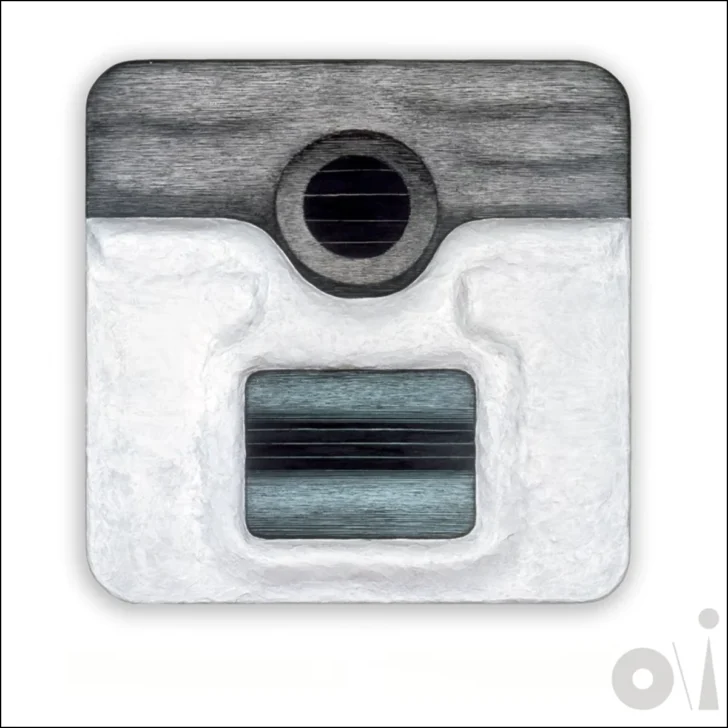
This artwork is entitled Closed Circuit II and is a relief mural (1986, 150 × 150 × 10.2 cm). It has rounded corners and is predominantly rendered in two different shades of grey, with the surface of the darker one having a brushed-metal look. A circular and a rectangular element in the image vaguely suggest the appearance of a camera front (the motif is also said to have anticipated the original Instagram logo), but they may also bring to mind a highly abstracted face.
Tishan Hsu (born in 1951 in Boston, Massachusetts) lives and works in New York. In his work, he often explores the relationship between the organic – such as human beings – and our information age. His central theme is, in essence, "the embodiment of technology".
Gabriel says: "In the way that the song was trying to explore consciousness, technology and nature I think Tishan does that in some of his own work."
Art by Hsu can be found in major public collections such as the Metropolitan Museum of Art (New York), the Centre Pompidou (Paris), the Tate Modern (London) and the Museum für Moderne Kunst (Frankfurt am Main).
Hsu does not appear to have an own website, but he does, of all things, have an Instagram account. Further examples of his work can also be found at the Lisson Gallery in example.
More about the o\i artworks and the artists behind them in our separate article.
Bright-Side Mix – 28th August 2026
Words and Music by Peter Gabriel
Published by Real World Music Ltd / Sony Music Publishing
Produced by Peter Gabriel
Mixed by Mark 'Spike' Stent
Brass Arrangement Peter Gabriel with improvisations by Josh Shpak
Engineering by Faye Dolle, Katie May, Dom Shaw
Assistant engineering by Charles Hughes, Xav Sinden, Maisy Preece
Additional engineering by Erica Block, Alex Wilders, Abe Rounds at Phantom Studios, Lucas D'Angelo at Studio Saint Louis
Pre-production engineering by Richard Chappell
Mastered by Matt Colton at Metropolis Studios
Recorded at Real World Studios, Bath and The Beehive, London, Phantom Studios, Gallatin, TN, Studio Saint Louis, Paris
Drums – Manu Katché
Additional breakdown hi-hat – Abe Rounds
Rhythm Programming – Peter Gabriel, Jack Mills, Katie May, Faye Dolle
Percussion – Abe Rounds, Peter Gabriel, Manu Katché
Bass – Tony Levin
Electric Guitar – David Rhodes
Acoustic Guitar – Katie May
Mandolin – Richard Evans
Additional Rideout Keys – Don E
Trumpet, Trombone, Flugel – Josh Shpak
Piano, Synths, Synth Brass, Vocals – Peter Gabriel
Length 8:34
At first, the piece's structure may seem somewhat obscured by its eight-and-a-half-minute duration. Yet it is organised in a thoroughly classical manner, comprising verses, a pre-chorus, a chorus and bridge sections. There are three such bridge sections, each of which is further divided into distinct parts; together with the intervening, quite freely varied choruses, these may well make the structure somewhat difficult to follow.
Music
A sparse intro – just an electric piano, with a bass line joining in on the second pass – initially sets a sombre mood. However, this is immediately dispelled as the actual song begins. A subtly swaying groove brings a sense of lightness, verging on the dreamy. Levin's gently undulating bass is clearly the focal point here. At the forefront, centre stage, is Gabriel's voice, which, despite a touch of reverb, still sounds quite soft.
A pre-chorus changes the basic chord progression for the first time, shifting the mood towards optimism. For the chorus, the drums kick in fully and an additional muffled drum provides a pulse. Above all the (synth) brass play a distinctive ascending motif. This forms the central element of the song, and the music returns to it time and again. The result is a bouncy, light-hearted feel with a swing, somewhere between Latin and Afro vibe.
The sequence of verse, pre-chorus and chorus is repeated. This second chorus, however, is already doubled and is also varied quite freely as the song progresses. In particular, the lyrics are occasionally arranged in unexpected ways.
Then comes a lively sequence of interludes, choruses and instrumental sections, occasionally interspersed with unexpected vocals, which culminate in an extended finale that cheerfully celebrates the joy of the moment – until everything finally fades out.
Spike's mix minimises the breaks between the individual segments as much as possible, thereby once again creating a rather continuous overall arc. Everything grooves and bounces, displays great cohesion and remains catchy.
Personnel
Alongside the usual core band – in which Levin's bass, in particular, plays a central role here – there are also a number of guest musicians, all of whom are well-known.
Firstly, there is Richard Evans, who can be heard playing the mandolin in the first interlude. Then there is Abe Rounds once again, credited with percussion and "Additional breakdown hi-hat". Special recognition goes to Josh Shpak, who not only plays all the brass instruments but has also enriched Gabriel's arrangement with improvisations. His work therefore plays a leading role in the impact of Looking For The Happy.
Finally, Don E is also listed; he accompanied Gabriel on the i/o Tour and has now been asked back to record something described as "Additional Rideout Keys".
Dark-Side Mix – 11th September 2026
Words and Music by Peter Gabriel
Published by Real World Music Ltd / Sony Music Publishing
Produced by Peter Gabriel
Brass Arrangement Peter Gabriel with improvisations by Josh Shpak
Mixed by Tchad Blake
Engineering by Faye Dolle, Katie May, Dom Shaw
Assistant engineering by Charles Hughes, Xav Sinden, Maisy Preece
Additional engineering by Erica Block, Alex Wilders, Abe Rounds at Phantom Studios, Lucas D'Angelo at Studio Saint Louis
Pre-production engineering by Richard Chappell
Mastered by Matt Colton at Metropolis Studios
Recorded at Real World Studios, Bath and The Beehive, London, Phantom Studios, Gallatin, TN, Studio Saint Louis, Paris
Drums – Manu Katché
Additional breakdown hi-hat – Abe Rounds
Rhythm Programming – Peter Gabriel, Jack Mills, Katie May, Faye Dolle
Percussion – Abe Rounds, Peter Gabriel, Manu Katché
Bass – Tony Levin
Electric Guitar – David Rhodes
Acoustic Guitar – Katie May
Mandolin – Richard Evans
Additional Rideout Keys – Don E
Trumpet, Trombone, Flugel – Josh Shpak
Piano, Synths, Synth Brass, Vocals – Peter Gabriel
Length: 8:46
Once again, Real World has surprised us with the release date. This time, it's set for 10 September, which is also the date of the new moon on one third of the Earth (in the evening or at night) – but not on the other two thirds…
Music
The Dark-Side Mix opens with a rather harsh, radical stereo effect: the keyboards on the right, followed shortly afterwards by the bass on the left. This is quite unpleasant on headphones, and whether there's any need for it is open to question.
Leaving this gimmick aside, the actual prelude reveals the truly fundamental differences between the two mixes: whilst the Bright-Side Mix comes across as rather soft, once again presenting a more cohesive soundscape in which only Levin's bass stands out clearly, the Dark-Side Mix refocuses on the details, placing particular emphasis on the percussion pattern that runs through almost the entire track. The bass remains in the background.
Because of this ongoing percussion pattern, the transition into the pre-chorus is a less pronounced change than in the Bright-Side Mix. And the electric piano, percussion and bass are given plenty of space here – they sound pure and comparatively stripped-back, with little softness.
In the chorus, the Dark-Side Mix really kicks off. Whilst the brass in the Bright-Side Mix is still rounded and lively, with a different arrangement, and Gabriel's voice is integrated in a pleasing way, in the Dark-Side Mix the drums once again come through hard, with the voice sitting harshly at the forefront. The synth brass really come across as such here; they sound flatter in the soundscape, almost crude, but all the more energetic for it. In the second chorus, Josh's real trumpet also repeatedly adds little flourishes on top (these are present in the Bright-Side Mix too, but here they are much more clearly emphasised).
Rhythm plays a key role in this track. Whilst the Bright-Side Mix derives its rhythm primarily from its muffled, pulsating bass drum, the Dark-Side Mix is characterised above all by a lively, swirling movement created by the continuous percussion pattern, its brighter equalisation and its different composition.
The entire closing section is significantly more energetic and invigorating thanks to this clattering rhythm. An exuberant invitation to dance. The Bright-Side Mix remains more refined here. The transitions into the interludes always represent quite a distinct change. Whereas the Bright-Side Mix tends to try to flow through, the Dark-Side Mix works with contrasts and restraint. Once again, Blake structures the song (or at least its second half) more clearly into individual segments.
Finally, there is the most obvious difference between the two versions: the Dark-Side Mix has no fade-out. Without losing any of its momentum, the arrangement gradually narrows down to the trumpets – which are already much more prominent – until only they remain, playing the final notes.
For a catchy pop song, Looking For The Happy remains too idiosyncratic – yet it can still carry away.
–
Author: Thomas Schrage
Links
Introductory video for Looking For The Happy:
Song-background info on petergabriel.com
The Instagram account of Tishan Hsu.
Join the discussion about the song here in the forum.