

- Article
- Read in 9 minutes
Song 08: "One By One" (29th July 2026)
As July draws to a close, Gabriel treats us to the longest track on o\i. And an old acquaintance reappears: the character Mozo, someone who has fallen from grace.
overview of the o\i article series
Two notable features stand out on the July track. Firstly, it is the longest track on o\i. Divided into various segments, it reflects an idea Gabriel expressed years ago: that he prefers to create music that undergo various transformations and take the listener on a journey. Good examples of this are certainly the "mini-operas" Mirrorball and My Body Is A Cage on Scratch My Back. In the new song, there is, above all, a marked change in the middle, which divides One By One into two halves (much like Live And Let Live on i/o).
The second distinctive feature is that the character "Mozo" reappears here after a long absence. He is an outcast who first appeared in On The Air, where he attempted to be a hero through his rebellious radio broadcasts. Gabriel wrote further songs about this figures's life and spread them across several albums. The original intention was to create a larger, cohesive whole from them, but the project was not continued after So.
And with regard to One By One, Gabriel admits that the main motivation was not to finally continue the story of Mozo, but rather that he needed a character for the concept behind the track, and Mozo was the obvious choice.
He adds, moreover, that this track is also part of his 'Brain' project.
Lyrics
Initially, the song tells us that Mozo is, in a sense, torn apart. That everything in his life is broken and his heart is shattered. On the surface, it seems as though everything is fine. Yet the clouds roll in, and in the chorus he bravely declares: "I'm putting it back together, this is my only self-defence".
In the second verse, the perspective shifts back to an outside view, and it is stated that even though Mozo had seemingly disappeared, his tale had to be told: "By the time the crowd had noticed him, there was nowhere else to roam."
The second part of the song then changes to a much freer form, akin to a long recital. Mozo still describes how things are falling apart for him – but he comes back, making himself whole, as getting together a jigsaw. Even though nothing remains "to feel this love", Mozo can still "make out your face". The flow of these many words describes the pain and, at the same time, the hope that remains amidst all the struggles. For this is the path Mozo is on: "Getting together. Holding your hand."
Art
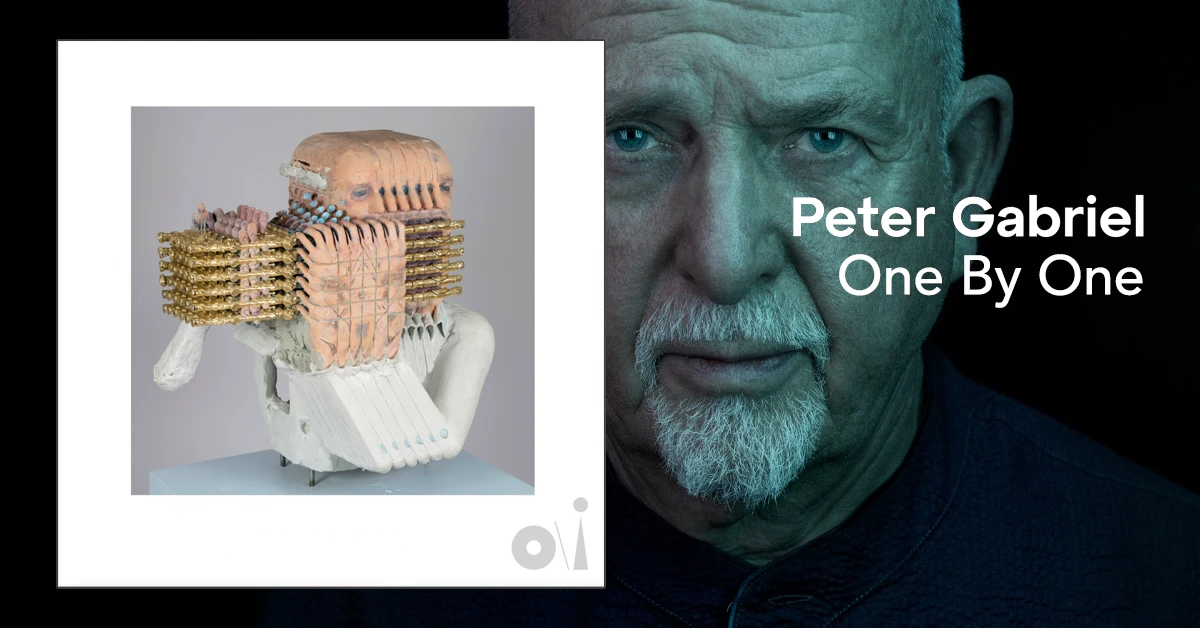
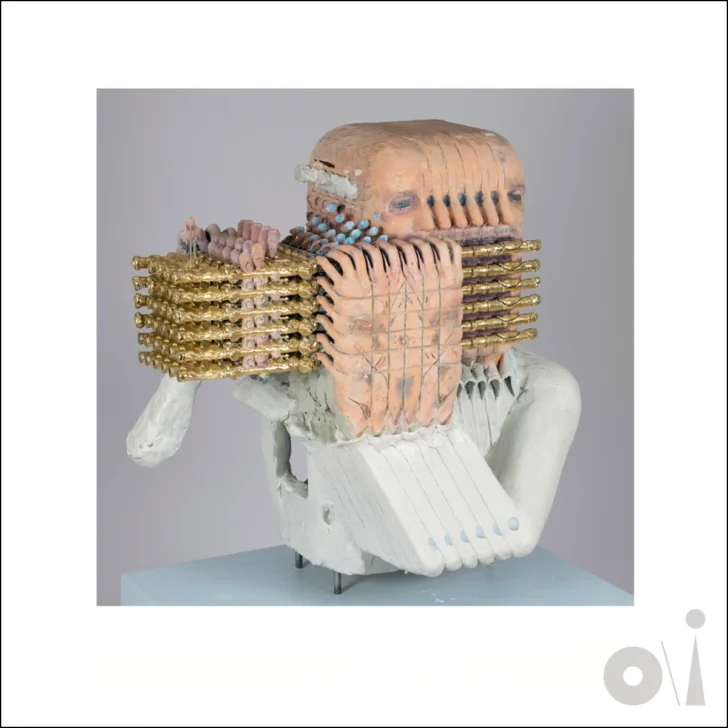
This artwork is by David Altmejd and is called Pieces. It was created especially for the song, and in Gabriel's introductory video you can also see a few moments from its creation.
It is a bust depicting a person playing the flute. The sculpture is divided horizontally and vertically into segments that are repeated and arranged in rows. This results in a strangely square appearance. The artwork has an effect that is both human and technical at the same time.
David Altmejd was born in Montréal in 1974, but now lives and works in Los Angeles. He studied at the Université du Québec à Montréal and graduated with a Master of Fine Arts from Columbia University in New York City in 2001.
With his idiosyncratic sculptures he blurs the boundaries between figurative and abstract representation, between the inner and the outer, the beautiful and the grotesque. Almost always he creates busts, using materials such as plaster, epoxy resin and glass eyes. They are often initially based on human anatomy, but are always distorted by the duplication of individual segments or by the incorporation of parts from animals or inanimate objects. The results are, at the very least, unusual – and, depending on the piece, disturbing – and raise questions about beauty and incompleteness, about acceptance and about change.
David's other foray into the world of music is somehow different: he designed the cover for Yeasayer's album Amen & Goodbye, which features a collection of comparatively ordinary figures.
David Altmejd's website can be found here here. Among other things, videos on the site offer further insights into how his works are created.
More about the o\i artworks and the artists behind them in our separate article.
Bright-Side Mix – 29th July 2026
Words and Music by Peter Gabriel
Produced by Peter Gabriel
Mixed by Mark 'Spike' Stent
Engineering: Faye Dolle, Katie May, Dom Shaw
Additional Engineering: Erica Block, Alex Wilders, Abe Rounds at Phantom Studios
Pre-Production Engineering: Richard Chappell
Assistant Engineering: Charles Hughes, Xav Sinden, Maisy Preece
Mastered by Matt Colton at Metropolis Studios
Recorded at Real World Studios, Bath and The Beehive, London, Phantom Studios, Gallatin, TN
Drums: Manu Katché
Rhythm Programming: Mike Elizondo, Charles Hughes, Peter Gabriel
Percussion: Abe Rounds
Bass: Tony Levin
Electric Guitar: David Rhodes
Acoustic Guitar: Katie May, David Rhodes
Flugel Horn, French Horn: Josh Shpak
Saxophone, Flute: Evan Smith
Synth Strings: Faye Dolle
Piano, Synths, Synth Brass, Rideout Bass, Vocals: Peter Gabriel
Length 9:37
Gabriel is aware that One By One is unusually long, and can well imagine that some listeners might find it a bit of a slog. But he believes that sometimes a track needs to be long enough for you to really immerse yourself in it – so that you can arrive at this new place and get a feel for the flow there.
Music
An instrumental intro runs throughout the first minute, beginning with hesitant piano notes. They quickly pick up pace and the sequence of notes is repeated and carried forward by keyboards. From those first, solitary sounds, a delicate, shimmering soundscape builds up. It is moving yet meditative – though Gabriel also describes it as ghostly and a psyche.
With the first verse, the band comes in subtly, accompanying a seemingly simple vocal line. Gabriel says that everyone has written music based on these harmonies before. Here, he accompanies the descriptions of Mozo's state rather reservedly, without grand gestures, almost impassively.
For the chorus, however, the perspective shifts to Mozo's, and in keeping with his resolve to heal himself, the accompaniment builds a very light rock-music drive, becoming gently energetic. Nevertheless, everything remains – not least due to the harmonies – subdued and melancholic.
The first half of One By One follows a conventional structure with two verse sections and two choruses. In between, the track repeatedly returns to the shimmering soundscape. Right in the middle, at around 4:45, this changes completely. A peaceful flute interlude marks the beginning of a new arc of tension. A different harmonic progression lends an almost sacred quality, whilst the bass conspicuously takes centre stage.
The lengthy final section accompanies the litany-like descriptions of shattering and courageous new attempts with the addition of various elements. The flute continues, joined later by other wind instruments, whilst Gabriel sings vocal flourishes in a fragile voice. These are intricate layers that continue to weave ever more deeply into one another.
What is remarkable here is that none of this builds to a major climax. The hoped-for release – or even redemption – fails to materialise. Musically, this section goes round in circles and finds no conclusion. Mozo has not yet completed his process of self-salvation.
Consequently, the track ends with a fade-out, something that has (almost) never happened before on o\i.
Personnel
Although the list of contributors isn't particularly long – as is actually the case with all of the o\i tracks – it's worth noting that many of the special guests from previous songs are featured here again. Once more, Mike Elizondo and Abe Rounds complete the rhythm section, which, however, doesn't stand out here. Evan Smith also features again – the saxophonist who played such a central role on I Belong To The Sky – though his contribution isn't particularly prominent either, nor is that of Josh Shpak on horns. It is interesting, however, that any emphasis was placed on a brass section at all.
Otherwise, the usual core band plays, supplemented by the familiar names from the studio line-up, who have once again made their own contributions.
Dark-Side Mix – 13th August 2026
Words and Music by Peter Gabriel
Produced by Peter Gabriel
Mixed by Tchad Blake
Engineering: Faye Dolle, Katie May, Dom Shaw
Additional Engineering: Erica Block, Alex Wilders, Abe Rounds at Phantom Studios
Pre-Production Engineering: Richard Chappell
Assistant Engineering: Charles Hughes, Xav Sinden, Maisy Preece
Mastered by Matt Colton at Metropolis Studios
Recorded at Real World Studios, Bath and The Beehive, London, Phantom Studios, Gallatin, TN
Drums: Manu Katché
Rhythm Programming: Mike Elizondo, Charles Hughes, Peter Gabriel
Percussion: Abe Rounds
Bass: Tony Levin
Electric Guitar: David Rhodes
Acoustic Guitar: Katie May, David Rhodes
Flugel, French Horn: Josh Shpak
Saxophone, Flute: Evan Smith
Synth Strings: Faye Dolle
Piano, Synths, Synth Brass, Rideout Bass, Vocals: Peter Gabriel
Length: 9:29
To everyone's great surprise, the Dark-Side Mix was not released on 12 August, but not until 13 August. For three-quarters of the planet, that was no longer the day of the new moon. It seems Real World did the maths in their own way…
The next unusual thing about the Dark-Side Mix is that it plays at a slightly faster tempo than the Bright-Side Mix. You can't hear this straight away, but if you try to align the two audio tracks perfectly on top of each other in audio editing software, it becomes obvious. As a result, it's even slightly higher in pitch, which you can actually hear when comparing the two side by side.
We've seen a similar change before in the radio edit of Till Your Mind Is Shining, which also plays slightly faster. What previously looked like yet another attempt to make a track suitable for broadcast has now been applied to one of the main mixes here, for no apparent reason. For the time being, it remains unclear whether the Dark-Side Mix has been sped up or the Bright-Side Mix has been slowed down.
Music
In some places, there are very distinct differences between the two versions. Right at the start of the intro, the Dark-Side Mix no longer features the gently breathy flutes; instead, deep wind instruments have been added. They create a markedly different atmosphere – rougher and more earthy.
The lead vocals have been given a slight reverb, which lends them a somewhat solemn quality. Once again, they aren't quite as prominent here. Otherwise, the verses no longer feature the bright ringing that runs unobtrusively throughout the Bright-Side Mix. The emphasis here is clearly on the core band – the accompaniment has been stripped back to almost nothing else. There are, however, a few occasional touches: in the second verse, for example, some interjections on the flute stand out unusually clearly.
The chorus then kicks off with a bang. Powerful guitars and driving drums create a raw rock feel.
During the interlude following the second chorus, the Dark-Side Mix initially fades out completely. It's almost as if a whole new song were beginning halfway through the track. The flute, then – unusually for Blake – is embedded amongst other sounds and barely discernible as such. Then, however, Levin's bass kicks in, and the way it's been processed almost serves as a textbook example for the two mixers: whilst Spike Stent integrates it softly, almost cotton-like, into the overall texture, Blake has crafted its sound in such a way that you can clearly hear every pluck of the strings and every change of fingering, almost giving you the feeling that you're standing right next to Levin.
The long final section, meanwhile, remains noticeably more sparse at first. As a result, some additional elements are not only more clearly audible, they are even emphasised, such as the gritty guitar chord at 6:32. The high-pitched, strained vocals on "There's nothing left to do…" are, by contrast, placed further back in the mix and thus seem somewhat less harsh.
The drums, which kick in as the final crescendo, are then once again positioned well to the fore and really stand out. Here the overall accompaniment becomes quite dense. The vocals remain in the background throughout, giving them a more ethereal, almost otherworldly quality. Overall, Blake tells Mozo's story in a more stoic manner, though at times he is also more impetuous.
The fade-out begins at 8:50 and therefore lasts for around 40 seconds. It is thus similar in structure to the Bright-Side Mix. The only thing worth noting is that its curve is slightly steeper, so it ends more quickly – and for the last four seconds, there is essentially nothing but silence.
–
Author: Thomas Schrage
Links
Introductory video for One By One:
Song-background info on petergabriel.com
The website of David Altmejd.
Join the discussion about the song here in the forum.