

- Article
- Read in 8 minutes
Song 07: "I Belong To The Sky" (30th June 2026)
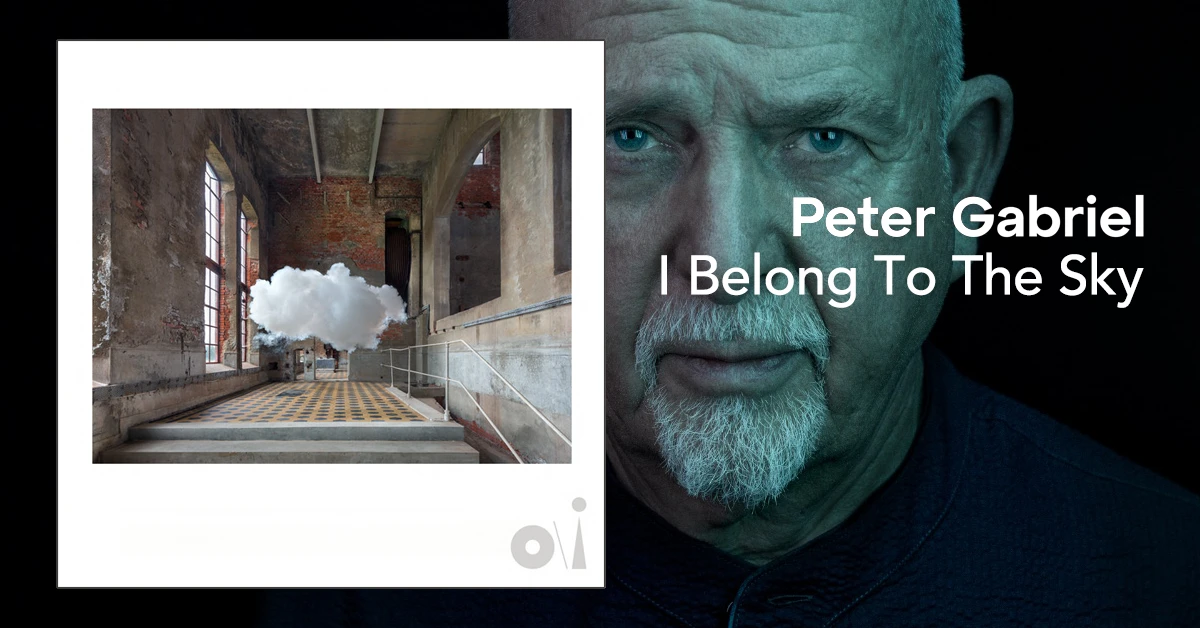
At the end of June, we get to hear the song "I Belong To The Sky," which was always one of Gabriel's favorites. It's an amazingly light and swinging number.
Bright-Side Mix
Dark-Side Mix
Bandcamp Version
overview of the o\i article series
Gabriel wraps up the month of June with a gently grooving up-tempo track. The song has always been one of his favorites, Gabriel says in his introductory video, and was already in the works for i/o, but he didn't manage to finish it in time.
Now it's finally come together, and once again on this album it's a look at the world with optimism.
Lyrics
Gabriel explains that the lyrics depict two states. The verses describe a relaxed, laid-back state – gazing up at the sky and letting one's thoughts wander. The chorus then shifts to the realization of those thoughts and dreams. One sets out into the world so that the dreams can materialize.
Thus, the song begins with the title line, "I belong to the sky", and describes how the sun paints a smile, how quiet it is when dreams leave their nest. Then, however, one sets out on the "street to life", and the mental image loads and loads until a picture finally is forming.
A positive message is conveyed here. The world, according to Gabriel, is more malleable than one might think. Strong pictures affect the chances of it to materialize.
Art
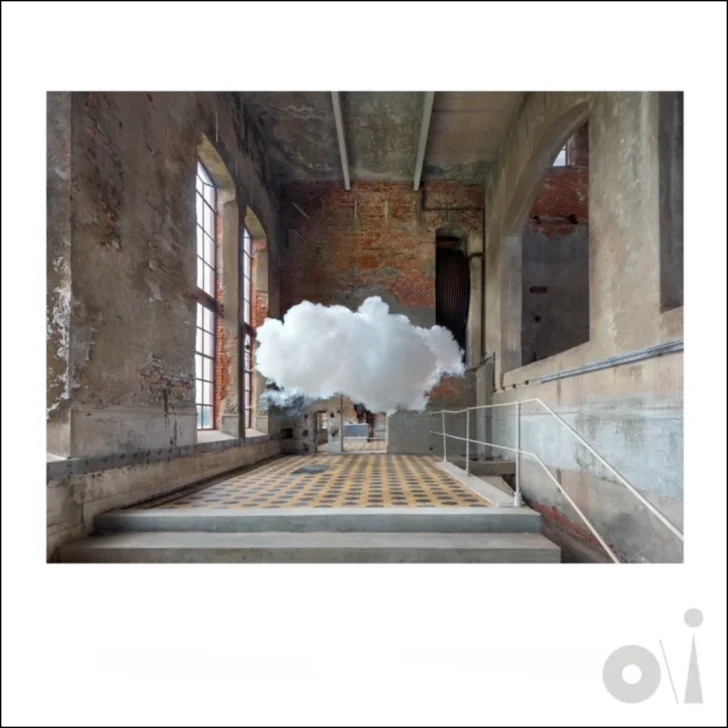
Once again, Gabriel has decided to accompany a song with a photograph. The title is Nimbus de Toekomst 1 (Nimbus of the Future 1) and depicts a cloud formation hovering in the midst of an old building. The image is from 2019 and was released as part of a series of six prints, each measuring 125 × 169 cm (Photograph: Cassander Eeftinck Schattenkerk).
The artist behind the work is the Dutch artist Berndnaut Smilde, born in 1978 in Groningen. He studied at the Frank Mohr Institute at Hanze University of Groningen, where he earned a Master's degree in Fine Arts in 2005. He lives and works in Amsterdam now.
The image is part of the Nimbus series, which depicts such clouds inside rooms. They are formed by a precise mixture of moisture, mist, and light. Smilde is interested in the ephemeral nature of these clouds – ultimately, the cloud exists only as a photograph that documents something that has since dissipated. Smilde also says: "I see them as temporary sculptures of almost nothing – the edge of materiality. It looks like you can dive into them or grab them, but they just fall apart."
Gabriel likes the blending of the interior and outside worlds, because the song is about the transitions from the inside to the outside.
Other well-known works by Smilde include the Conditioner series – sculptures made of industrial hoses and pipes that emit an antiseptic scent – and the Breaking Light project, in which rainbow colors generated by prisms are projected onto buildings. These and other works can be found on Smilde's website www.berndnaut.nl
Learn more about the o\i artworks and the artists behind them in our separate article.
Bright-Side Mix – 30th June 2026
Words and Music by Peter Gabriel
Produced by Peter Gabriel
Mixed by Mark 'Spike' Stent
Engineering by Oli Jacobs, Faye Dolle, Katie May, Dom Shaw
Assistant engineering by Charles Hughes
Pre-production engineering by Richard Chappell
Mastered by Matt Colton at Metropolis Studios
Recorded at Real World Studios, Bath and The Beehive, London
Drums – Manu Katché
Rhythm Programming – Peter Gabriel, Richard Chappell
Percussion – Evan Smith
Bass – Tony Levin
Electric Guitar – David Rhodes, Katie May
Acoustic Guitar – David Rhodes, Katie May
Piano – Peter Gabriel
Synths – Peter Gabriel
Additional Synths – Brian Eno, Faye Dolle, Evan Smith
Brass – Evan Smith
Backing vocals – Peter Gabriel, Melanie Gabriel, Faye Dolle
Vocals – Peter Gabriel
Length 7:23
Available on Bandcamp.
At first, the song seems disconcerting. It unfolds seemingly without structure – without a clear outline, without any particular build-up or climaxes. Yet there is a development – the techniques used are simply subtle.
Music
The instrumental intro, which lasts 1:12, opens with a harmonic motif that gains additional layers with each repetition – from pure piano to keyboards to organ. Then the focus shifts to rhythm. The plucked guitar riff stands out, as do the first brass parts we hear here.
For the verse, the accompaniment is reduced to a calmly pulsating, timpani-like backdrop. Gabriel says that this mystical-sounding element was one of the original inspirations for the song. The accompaniment for the second verse becomes more defined, and the horns return with an intricate passage. The chorus rolls in with a build-up, and on "the street to life", the guitar we already know from the intro reappears.
The structure repeats throughout the sequence, but the horns – especially the saxophones – take on a more prominent role. The guitar groove for the second chorus, starting at 3:53, continues from there until the end, interrupted only by the bridge ("we're watching the flame"), which comes across in a more subdued manner, featuring almost exclusively piano and a single saxophone part (with harmonies straight from the beginning of the intro). Then the song picks up momentum again.
Gabriel says he loves it when a band really takes off toward the end of a song. That's exactly what's happening now, and all the musicians involved are giving it their all throughout the long closing section, weaving an increasingly dense tapestry.
The track has a subtle groove and feels rather relaxed – yet is still full of energy. The individual sections aren't sharply distinguished from one another, but if you listen closely, you can clearly make out the structure. What's unusual for Gabriel is how jazzy the feel is – almost funky.
Personnell
In his introduction, Gabriel once again highlights his regular band, which is in top form here – especially in the gently soaring final section.
Brian Eno has also contributed once more, even if his role isn't particularly prominent. In contrast, studio engineer Faye Dolle seems to be taking on an increasing number of musical responsibilities – much like her colleague Katie May has been doing for some time.
The most notable contribution is certainly that of Evan Smith on the brass instruments – especially the saxophone. Even though he is occasionally complemented by synth saxophone, it is his instrument that brings the jazzy touch. Smith is known as a multi-instrumentalist who plays in both jazz and pop – having previously collaborated with Taylor Swift, P!nk, David Byrne, and Bon Iver, among others. (He should not be confused with Dr. Evan Smith from Seattle, who is also a saxophonist.)
Dark-Side Mix – 14th July 2026
Words and Music by Peter Gabriel
Produced by Peter Gabriel
Mixed by Tchad Blake
Engineering by Oli Jacobs, Faye Dolle, Katie May, Dom Shaw
Assistant engineering by Charles Hughes
Pre-production engineering by Richard Chappell
Mastered by Matt Colton at Metropolis Studios
Recorded at Real World Studios, Bath and The Beehive, London
Drums – Manu Katché
Rhythm Programming – Peter Gabriel, Richard Chappell
Percussion – Evan Smith
Bass – Tony Levin
Electric Guitar – David Rhodes, Katie May
Acoustic Guitar – David Rhodes, Katie May
Piano – Peter Gabriel
Synths – Peter Gabriel
Additional Synths – Brian Eno, Faye Dolle, Evan Smith
Brass – Evan Smith
Backing vocals – Peter Gabriel, Melanie Gabriel, Faye Dolle
Vocals – Peter Gabriel
Length 7:22
On the seventh track of o\i, the mixing principles shift once again. It's still the case that Tchad Blake has stripped the track down, but this time it's his mix that seems to have a more subdued effect. This is reminiscent of i/o.
Music
Right from the start of the long intro, it becomes clear that Blake has reduced a lot of elements. The percussive keyboards are more subdued (in the Bright-Side Mix, they effectively form the centrepiece), and the fast-picked guitar pattern is initially absent altogether, only to be added later with a very subtle presence. The snare hits are still hard, but here they also have a drier sound. There is less movement right from the outset.
In the verses, by contrast, the timpani-like drums are much more prominently highlighted; they have greater volume because of a heavier reverb, as well as a sense of stereo movement. They almost push everything else aside. As the track progresses, it keeps returning to them and they remain present throughout the entire song.
The horn section in the pre-chorus is initially led by a distinct synth saxophone, before real instruments are added to complement it. These passages remain less intricate, focusing instead on individual parts. The actual chorus then sounds quite similar in both mixes. The same applies to the middle section from "we're watching the flame" onwards – in the Dark-Side Mix, it simply gains more grandeur through increased reverb.
The closing section, however, differs between the two versions. Blake uses fewer elements, and the brass arrangement is not as complex. Individual details are much more audible here, but everything is less interwoven, giving it a less dynamic feel. Here, too, the brass section plays a less prominent role. As a result, the jazzy feel gets lost and the finale comes across as more stoic overall.
The very last sound is particularly emblematic of the two mixers' approaches: Blake literally fires it straight into the song, bringing it to an abrupt halt. Stent takes a gentler approach here.
Bandcamp Version – 31th July 2026
Words and Music by Peter Gabriel
Produced by Peter Gabriel
Engineering by Oli Jacobs, Faye Dolle, Katie May, Dom Shaw
Pre-production engineering by Richard Chappell
Recorded at Real World Studios, Bath and The Beehive, London
Drums: Manu Katché
Rhythm Programming: Peter Gabriel, Richard Chappell
Bass Guitar and Synth bass: Tony Levin
Electric and Acoustic Guitar: David Rhodes, Katie May
Piano and synths: Peter Gabriel
Additional Synths: Brian Eno
Saxophone: Evan Smith
Flute: Evan Smith
Synth Brass: Peter Gabriel
Vocals: Peter Gabriel
Length: 7:16
Once again, subscribers are getting a so-called Bandcamp Version as a bonus. According to the description, it's from September 2022, and the brass tracks with Evan Smith have just been recorded and added. As a result, what we hear is a sort of rough version of the final song. It's already very close to it, but it's not quite polished and finished yet.
Music
Right from the intro, it becomes clear that everything is essentially familiar, but the arrangement gives it a different emphasis. This applies both to the sonic treatment of the elements and to their exact placement. The most striking difference is certainly the different recording of the guitar riff. Whereas the final version features acoustic plucking, here an electric guitar with distortion can be heard. It gives the song a edgier feel. Gabriel also begins singing during the extended intro – the chorus lines about "this street to live."
Everything that follows then proceeds as usual at first, and the lyrics are already the final version. Only the chorus lacks the "bringing the dream into life" interjections, and the first one has also been shortened by one repetition.
The closing section, however, is significantly different. A provisional set of lyrics is sung, their placement is different – and the entire instrumental accompaniment is only provisional, lacking energy and density. The saxophone part, in particular, is noticeably in the background. In contrast, Gabriel's voice is brought strongly to the forefront and has been given a distinct reverb, creating a somewhat dreamlike impression.
The Bandcamp Version then ends decisively, and the final, added line "Bringing the dream into life" is omitted.
It's interesting that while this version essentially corresponds to the final one, it also makes it clear just how much impact Gabriel's meticulous fine-tuning still has.
–
Author: Thomas Schrage
Links
Introductory video for I Belong To The Sky:
Song-background info on petergabriel.com
Berndnaut Smilde's website.
Evan Smith's website.
Join the discussion about the song here in the forum.