
- Article
- Read in 18 minutes
Steve Hackett – Interview in Italy (2002)
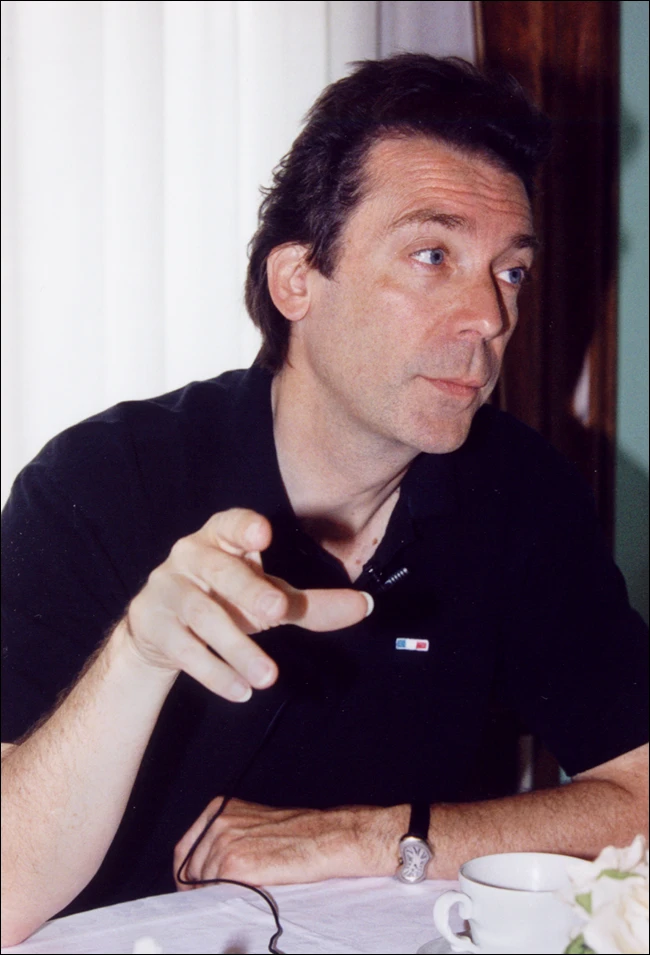
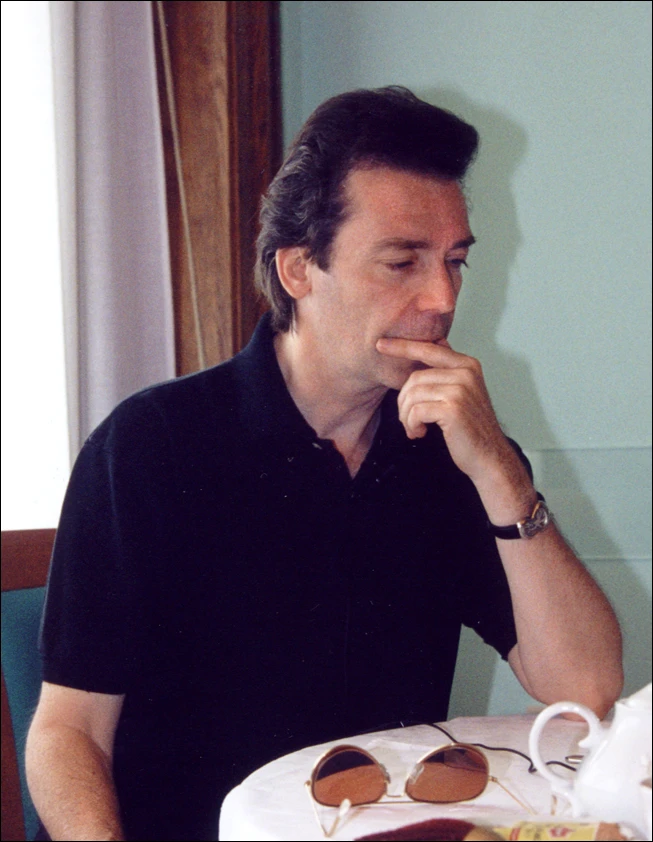
During the 2002 tour, we were able to do an in-depth interview with Steve Hackett in Italy.
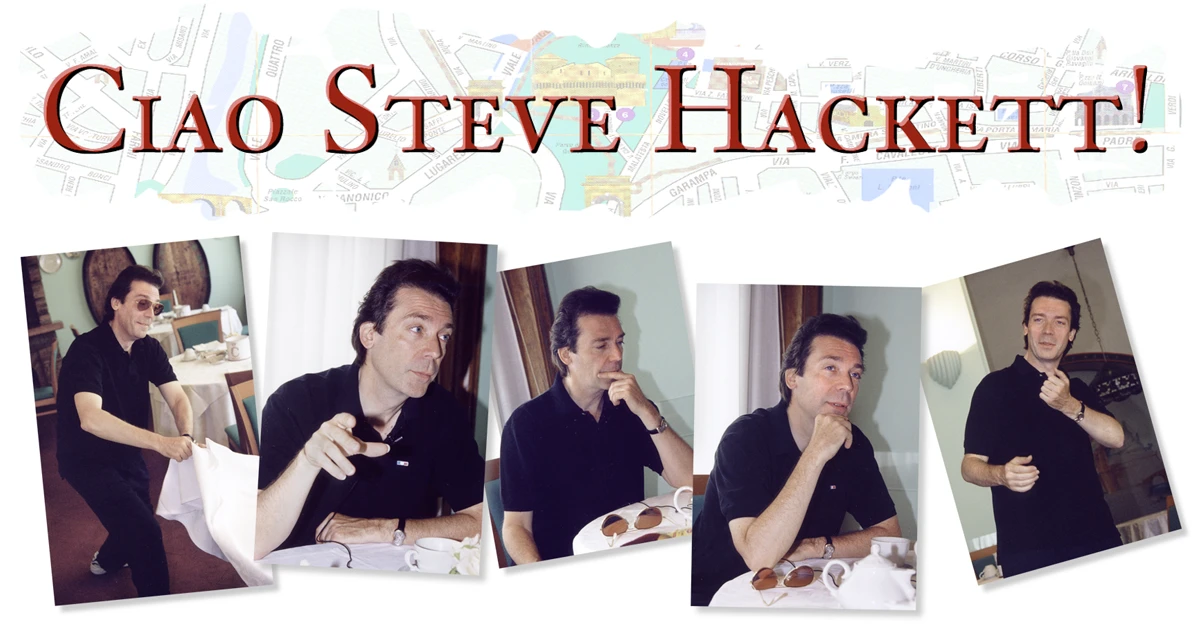
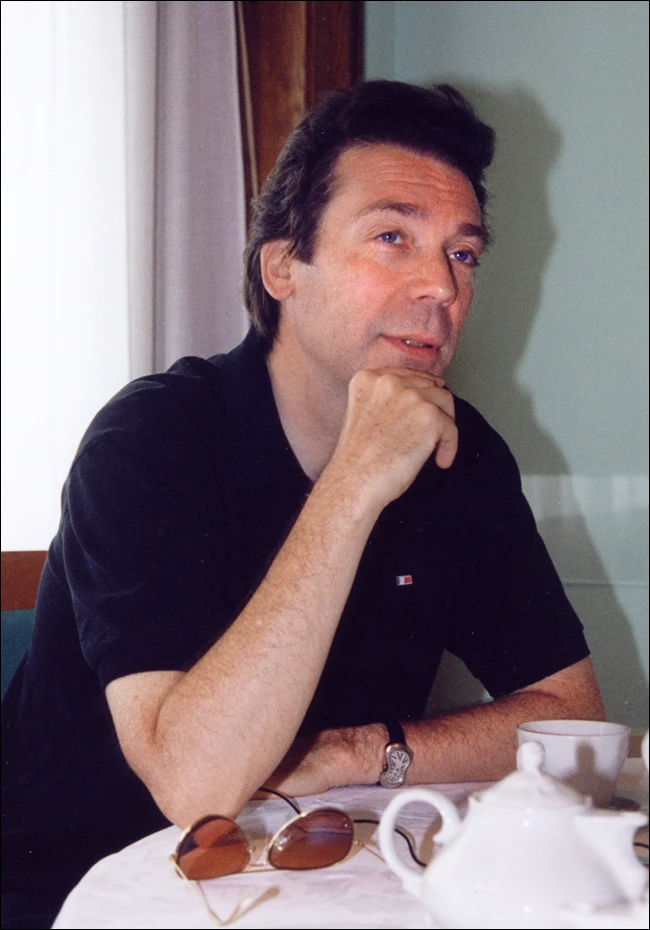
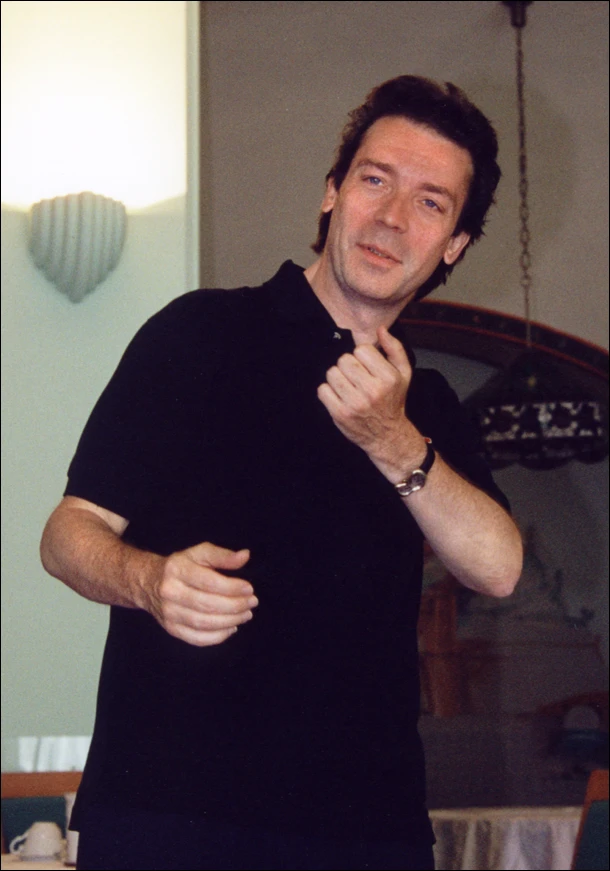
In 2002, Bernd Zindler and Helmut Janisch accompanied Steve Hackett and his band on their tour of Italy. As well as gaining a wealth of insights into life on tour, this also provided an opportunity for a new, in-depth interview with Steve.
it: You've been on tour with a full band again for a while now. How are you feeling?
Steve: Wonderful! It's a great band. I've said that about every group I've toured with so far. But I really mean what I say. They're brilliant musicians, and that makes everything a pleasure. I'm very happy and proud too. I no longer perform under a band name; everything runs under my own name. Nevertheless, it's very important that the right ingredients are in place.
Steve's new live-band
it: How did you end up choosing the musicians you eventually gathered around you for this tour?
Steve: I've been working with Roger King for a few years now. He mentioned that he'd love to be involved if I ever decided to play live again. I also saw a band called Manuka, whose singer is managed by Billy. I wanted to see Manuka live, so I went to one of their gigs. They were very good. I also watched the next band that evening. They were called Bombdropppers.
I noticed that the drummer was playing some very clever rhythms and mentioned this to Billy. He told me that the drummer was Gary O'Toole. Billy had spotted him for the show with Manuka. It was only then that I realised Gary had played in both bands. I'd had a poor seat and couldn't see much, so I hadn't noticed before. Billy told Gary that I was currently looking for a drummer. Shortly afterwards, Gary rang me, and he seemed interested in the job. That's how Gary came to be hired. Ian Mosley phoned me a while ago and told me he was currently working on an album with Ben Castle. Ben plays all sorts of wind instruments – including the saxophone and the flute.
Ben is the son of Roy Castle, a musician who is very well known in England. Roy is also known as a comedian and entertainer. Ian asked me if I'd like to play on the album in question. I agreed and played guitar on four tracks. The music consisted of improvised material that sounded arranged but left plenty of scope for short solos. I really enjoyed working with them. The recommendation for Phil Mulford came from Roger, who had worked with him. I saw him at a concert in London's West End and was blown away by his playing. Aron Friedman and Gary had also worked on projects with Phil before. So he was recommended to me from many quarters. Well, that's how I ended up putting my band together. I listened to other musicians as well, but ultimately decided on these four.
it: Was it your intention to put together a completely new band? On the Guitar Noir tour, you'd relied on musicians like Julian and Hugo, whom you'd worked with before.
Steve: Yes, I felt it was time to do something new. I'd written new music that's very difficult to play. I knew I needed musicians with a perfect sense of timing. It's hard, for instance, to keep counting correctly during quiet passages. This band is of a very professional standard. I don't think I've ever heard a more professional group than the one I'm with now.
Steve and Italy – a special connection
it: This is already your third tour of Italy in recent years. Are there any reasons why you don't tour other countries anymore?
Steve: I suppose I have the same problem as Mozart. You simply need a promoter's interest. It's just that the Italians have shown me the most attention recently. As soon as other organisers get in touch and express an interest, we'll be happy to play elsewhere too – precisely because I have such a great band. It's a bit of a shame that only the Italians get to see us.
There are factors I can't influence. I've spent a lot of time in the studio over the past few years, so people forget that there's also a live aspect to things. I'm fifty now, and you have to accept the fact that you're no longer the sex god you were at twenty. At that age, you simply don't have youth on your side anymore.
it: …but you've got so many other options these days!
Steve: I know exactly why I write the things I write, or why I record the things I record. I don't work on my projects to create the world's best-selling music. When you make music you love, you're paid in a currency other than money. We all love having lots of money to buy nice clothes or travel to great holiday destinations. But on the other hand, money has very limited possibilities. Let me put it another way: just as you want to keep a knife sharp, I also want to sharpen my awareness and never forget the possibilities that music and its various forms can offer.
it: Will you change the setlist during the tour, or will the next concerts feature the same set as in Vigevano?
Steve: At tomorrow's concert in Catania, we'll have to shorten our setlist as our performance is part of a guitar festival. So it'll only be a forty-minute show for us. That's a fact we can't change and is beyond our control. But it's typical of Italy. Here, you simply never know what's going to happen. In principle, though, we always want to play the same songs. If there are lots of calls for encores, we might have to rethink it. We could then either play some improvised material, or I could perform some pieces on the acoustic guitar. The show lasts about one and a half to one and three-quarter hours. I think that's plenty of music for the senses.
it: Is there a reason for this very successful mix of material from your solo albums, unreleased tracks and Genesis songs?
Steve: These are the tracks I still feel passionate about, or which have a curious, rare value – like 'Hairless Heart', for example, which I'm sure none of us has played live for over twenty years. I thought to myself, let's just dust this lovely little track off and breathe new life into it. It's also nice to have an element of surprise at a concert, and everyone will recognise 'Hairless Heart' straight away thanks to the keyboard intro.
New Songs
There is also some new material I've written that I wanted to perform live. These songs haven't been professionally recorded yet; only demo versions exist. Mechanical Bride, for example, was conceived with the idea of performing it live. This track represents a style of music that is rarely heard these days. I don't think it's an old-fashioned style – it's far from that. However, the fact is that very few bands nowadays play with such a high level of precision.
it: After the concert in Vigevano, we spoke to some fans. Many of them wondered why you interacted so little with the audience. Is there a reason why you didn't speak to the audience, as you usually do?
Steve: I wanted the music to flow in one go without any interruptions. When touring abroad – especially in non-English-speaking countries – I find it difficult to communicate with the audience in the local language. I've done this for many years. Often, though, it ends up being a rather amusing spectacle. Tomorrow in Catania, however, I will speak to the audience, as we're playing a shorter concert there. So I'll introduce the tracks – even if my Italian is limited to just one or two sentences.
it: Why do you play the acoustic guitar parts in the songs on an electric guitar?
Steve: Well, I wanted to give the whole thing a jazzy feel. On 'Walking Away From Rainbows', Ben plays the saxophone. I'm trying out a new arrangement where Ben delivers a wonderful soprano saxophone improvisation as the piece progresses. Compared to the original, this takes it further and turns it into a piece full of flexible thinking. The band has really created a great version of this track.
When I listen to Ben, I'm reminded of some jazz standards from the past. I'd love to write music where you don't even realise you're listening to jazz. It's actually our aim to introduce this genre to fans who supposedly don't like jazz. Perhaps we'll also manage to get people who didn't like classical music in the past interested in it through the Erik Satie track we've included in the programme.
it: The set also includes three unreleased songs. What can you tell us about them?
Steve: All three pieces sound very different. We wanted to demonstrate that a band is capable of playing a wide spectrum of diverse material. This can be material that is very angry or intense, and then takes a philosophical turn the next moment.
A new rock album is afoot
it: These tracks are new, aren't they? Do you intend to release them on a rock album?
Steve: Yes, they're tracks for a new rock album. We'll be recording the concerts, and there's a possibility we might release this material. But that also depends on how the music comes across. As you're no doubt aware, there's a huge bootleg market in Italy. We're well aware that material from these gigs will appear as bootlegs. So it stands to reason that we'd consider releasing an official live album – even if it were intended solely for fans and wouldn't be sold in record shops.
Ironically, this would mean that some tracks would be released live first – even before a studio recording is in the can. I very much hope to realise these planned studio recordings with these lads once the excitement of the tour has settled down. But I'd also like to make it clear once again that I'm very happy to be on tour again. I've really missed it for a very long time. I mean that quite honestly!
It's a special feeling to experience a concert. Everything is on a knife-edge. Will the show get out of hand? Will it rain or will the sun shine? Or will the audience walk out or stay in their seats? Will I play the notes correctly? Or will I kick my right leg out? Will I lose my trousers? Oops, I'm not even wearing a bra today! Will my toupee be blown away by the wind again? Those are the thoughts going through my head [laughter]!
it: Did you write these three songs yourself, or are they collaborations?
Steve: Actually, I can't really answer that question until the tracks are fully written for the new album. I wrote most of them, but I'll let you know for sure once the album's out. There's somehow no simple answer to this simple question. I know, for example, that the band and I would start jamming if the tour went on a bit longer. I'm actually convinced that some great material would come out of it. Many old Genesis songs were created through jamming. You listen to what you've played over and over again, filter out the good bits and chuck the rubbish [Steve pronounces this word in German; author's note] away.
Jamming, by the way, is a wonderful way to develop songs. The hardest part of writing is finding that spark to kick-start the composing process. Sometimes it's a verse or two of lyrics, or a couple of notes, that everything is based on. You need the framework on which everything else is built. Once you've started, the rest is relatively easy. It's like building a house, which I haven't actually done in my life, mind you. You have to know what sort of building you want to construct. The right spark is crucial here too! Lots of ideas just popped into my head.
The riff for Darktown, for example, popped into my head one day as I was crossing the road. I had to rush home to record it. No one was allowed to speak to me until I'd managed to preserve it somehow. It was as if someone had written that sequence for me. It's very important to capture ideas that come to you in this way immediately. If you think the idea will come back to you at some point, you've already lost, because that won't happen – the idea will be gone. This is an important lesson to learn.
Steve's plans after the tour
it: What are your plans after the tour?
Steve: I'm going to record the new tracks in the studio with this band. Of course, that also depends on whether all the musicians are available. We're also having a new studio built at the moment. Right now, I'm sort of stuck between two studios.
I hope the money keeps coming in and the build can be finished soon. I want to get the recordings done while everything is still fresh in their minds and they can still remember all the notes well. They're a killer band – they're brilliant! They've made the impossible possible. I used to be told that my music was too complicated. But complexity is just one of many colours in music. Who would tell Bach that his music is too complicated? Hey Bach, your compositions contain too many notes!
it: So we can look forward to a rock album?
Steve: That's a very interesting question! My band – or rather, the band – is nominally a rock band. But it's a jazz band, just as much as it's a rock band or a classical ensemble. Every member is highly professional. I'm perhaps the least professional of us all when it comes to technical ability. Everyone is shaped by many influences, so this team could make albums of all sorts without you realising, when listening to the music, that it's the same musicians. But I don't want to get ahead of myself.
Whenever I take too optimistic a view of the future, something goes wrong. One thing I can say, though: I'm very happy at the moment, as I sense a strong band spirit. I've had an idea for a long time, and this is what I imagine: one day it's Steve's band, the next it's Gary's band, and the day after that it's Ben's band. The individual days are used completely flexibly, resulting in a different overall impression each time. I can also imagine that songs could work in this way. I could have thought of this with Genesis too. This is just an idea, so why don't we make the composer of this piece happy and play what he has in mind.
If an idea comes from two people, you just do what those two want – at that moment, they are the masters of that particular idea. But although there was a democracy in Genesis back then, we never reached a level of trust that would have made such collaboration possible. Similarly, it's nonsense to assume that solo albums break a band apart.
Cooperation projects with Jim Diamond and Ian Mosley
it: Billy mentioned that the planned album with Jim Diamond isn't going ahead after all. What's the situation with that?
Steve: We've got lots of great songs. Who knows what will happen with them in the future? The project is on hold for the moment. I hope something will come of it. Maybe one or two tracks will appear on my album or his. There's a problem with partnerships. One person can't have the answers to all the questions. Jim felt it was more my album than his. I, on the other hand, thought at one point that it was more his album than mine. Nevertheless, we've already put together some very beautiful music and great material. These are cover versions of well-known tracks. This might not please all the fans.
it: Have you only made the selection so far, or are there finished recordings as well?
Steve: We've actually recorded quite a lot of material already!
it: What can you tell us about this project by Ian Mosley?
Steve: It's an album that Ian Mosley and Ben Castle are making together. You can hear various drums and woodwind instruments on it – that's all I know. Three guitarists are featured on it so far: Steve Rothery, John Etheridge and myself. So there's already quite a line-up of guest musicians and it sounds very good. The foundation, I think, is jazz – but somehow different. I had a really great day spent there in the studio.
it: How do you feel about working with Ian again after so many years?
Steve: Great! He has a brilliant sense of humour. They'd already recorded the tracks, so I just played over the existing material.
it: Are there any plans to perform material from the Erik Satie album live with your brother in any form?
Steve: As you may know, John has neck problems. So he's not interested in going on tour. We've done a few TV appearances. In Hungary, for example, we played material from the Satie album live. We're currently playing one of the Satie tracks in our set.
it: What's the latest on that old idea of offering your fans unreleased live and studio material?
Steve: Well, the planned live album I mentioned earlier will include unreleased tracks. There's also an album called *Feedback*, which was recorded in the mid-eighties. We might release this as Feedback 86. However, it's primarily intended for the fans and won't be available in record shops. This album was never really finished, as it were. When I listen to Feedback today, I think it contains some interesting material. Some pieces have already appeared on my re-released albums. These tracks include The Gulf and Stadiums Of The Damned. The fact is that this old material has been plundered somewhat – including Cassandra, which can be heard on the American pressing of Guitar Noir– although it is a different version. For many, Feedback will be of more sentimental than musical value. It is not the work of a genius, nor is it an outstanding, groundbreaking musical production. It is simply a collection of ideas that came about many years ago.
it: Are you still in contact with EMI or Virgin to secure the rights to the remaining back catalogue?
Steve: It used to be easier to get rights back. These days, the policy has changed. Hardly any record company gives the rights back, as songs from fifty years ago could suddenly become hits. That's why nobody's interested in losing the golden goose – nobody knows whether something successful might not come of it.
it: That's a shame! It would be great to re-release the back catalogue – perhaps in remastered form!
Steve: I could re-record that material. We'll have to see what's possible first! We need to check the legal basis for such re-recordings. That's going to be a very interesting legal process.
State of play: The Genesis Reunion
it: In Vigevano, you made a clear statement regarding the possibility of a tour with Genesis. You made it clear that you would be willing to take part in such a project, provided that the current Genesis members – Tony and Mike – were to approach you.
Steve: I'd like to say that I wouldn't be the biggest source of uncertainty for such a reunion and, if applicable, a joint album. It seems very important to me that significant safeguards would need to be put in place before we invest a lot of time and energy in such a venture. We must avoid ending up with the same kind of messy collaboration as we had with the re-recordings of Carpet Crawlers.
I make no secret of the fact that I'm very disappointed with the final version of the track. I contributed a great deal of guitar work that wasn't included in the final mix. In my view, that sort of thing shouldn't happen. So I'd need to retain control over the quality, and I'm not sure anything will come of it under these circumstances. I'm not prepared to go into the studio and leave the material I've contributed in the hands of a pop producer. That's why I'm leaving my guitar case in the corner for now. It doesn't really look as though the lads have the right mindset for a good band album, does it? I think it could be very difficult to become a player in a team again once you've experienced the joys of independence.
it: So it's up to Tony and Mike whether there'll be a tour or not?
Steve: They hold the keys to the kingdom – you could say that. So it's not up to me. But I don't think it's the most important thing for everyone involved at the moment. Of course, I've taken note that it's important for the fans. I've always tried to inspire people to move away from the past and get on board with the strong, magnificent future. But I understand the syndrome. I suppose I'd be more likely to buy the next Beatles album, if they were to reunite, than the last George Harrison album. But Genesis are different from the Beatles. Every individual member of the band committed themselves to a very serious and enduring musical endeavour. Armando Gallo once said that whoever left Genesis took their muse with them.
it: Maybe we could get together just to jam, and then see if anything comes of it. The idea would be not to take the whole thing too seriously.
Steve: Yes, that sounds good. But I don't think something like that is possible with Genesis. You work with the underlying aim of creating something that can compete with the 'Top of the Pops' hits. I tend more towards the jazz approach, which allows for free thinking. As soon as you start planning the whole thing down to the last detail, the story takes a back seat, and that story is exactly what the fans want to hear. Other things, like modern sounds, would probably come to the fore. So you can see that there's a huge gulf between me and the hitmakers.
it: Your goals and intentions seem fundamentally different from those of Tony and Mike. Whilst you emphasise making music that satisfies you, the two of them place great importance on success. They are obviously very disappointed by the failure of Calling All Stations!
Steve: It wouldn't bother me if an album didn't sell well. If I were proud of the record, I wouldn't care about the rest. As I said before: music rewards you with things other than money. But if your philosophy is to believe that your music is only as good as your last hit, then you simply have to give up if a record doesn't sell well. Personally, I simply have different expectations of music.
I can tell you about an interesting experience: I received an email from my old history teacher. He's Hungarian, and I hadn't heard from him for thirty-five years. I wanted to get in touch with him as I knew he now works at a broadcasting station. He wrote that he'd really liked the Satie album. It was precisely this teacher who never gave me good marks when I was at school [laughter]! So I've finally – after so many years – received a good review from him. That's what I call a reward! It's the music that counts – not the sales figures!
We would like to thank Steve for spending so much time to do this interview with us. These were some great hours! Thank you!
Interview: Helmut Janisch and Bernd Zindler
Photos: Helmut Janisch
This interview was re-translated from the German publication
More photos: