

- Article
- Read in 5 minutes
Song 10: Face The Wall (26th September 2026)
The tenth track for o\i is about death and how to face it. Yet the track comes across as surprisingly cheerful – and there are reasons for that.
overview of the o\i article series
In the tenth track, Gabriel sings of nothing less than death and dying. Anyone expecting sombre tragedy is likely to be surprised. Gabriel isn't being particularly clear – neither in the introductory video nor in the lyrics – but one can assume that the track concerns his wife Meabh's serious illness.
Filled with reverence and admiration, the song speaks of great strength in persevering. Of remaining in the world. Following This Is Home, this would be Gabriel's second, unusual love song to his wife – one with even greater emotional significance.
Lyrics
The first two verses describe a scene at dusk. The gaze is fixed on the red sun; footsteps can be heard on the shingles; stars punch holes in the night. On the cliff, one walks to the edge that no one wants to reach and looks down at what is unfolding.
The chorus addresses a counterpart who is full of strength, who remains steadfast even when everything is falling apart, who always finds their way back into the world and "faces the wall". The line stating that 'I see you coming through' is then strongly emphasised.
The second verse sounds a little more sombre. Even if it is perhaps the others who feel that the light has faded – the water seems to be crashing down upon you and you cling to every word.
Yet the chorus holds fast to the idea that there is a heart that cannot be shaken – and that it is seen to be coming through.
Art
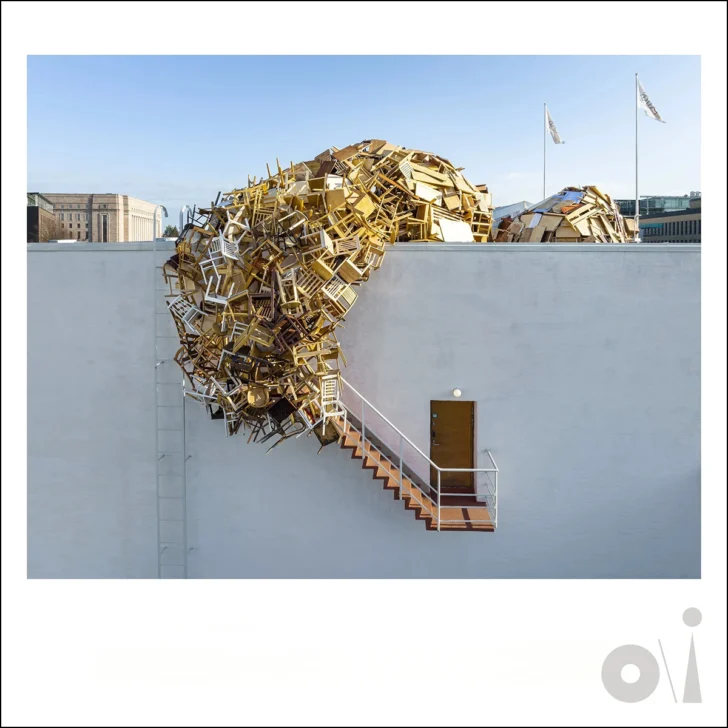
This time, the song is once again accompanied by a photograph of an installation. It is called The Nest and was on display at the Amos Rex Museum in Helsinki in 2022. Hundreds of discarded chairs and other wooden objects formed something like waves that spilled over the edges of the roof in several places. The selected photograph shows one of these waves against a high building wall.
The artist behind it is Tadashi Kawamata (born in 1953 in Mikasa, Hokkaidō), a Japanese sculptor who lives in Tokyo and Paris. He began creating installations in 1979, using primarily wood as his material to create large-scale structures in public spaces. Kawamata enjoys playing with architecture and disorientation, with construction and demolition, and occasionally questions social housing conditions when he erects huts for the homeless.
You can see some of it on his website.
Gabriel thought The Nest was just right for the song. He sees the big, solid wall, which to him is a bit like death. "And these sort of messy human chairs are falling over the wall and somehow they spill over the top. It's a sort of 'David and Goliath' moment for me that these chairs can get up and over. It's funny but it's also hopeful and against unbelievable odds."
More about the o\i artworks and the artists behind them in our separate article.
Dark-Side Mix – 26th September 2026
Words and Music by Peter Gabriel
Produced by Peter Gabriel
Mix by Tchad Blake
Orchestral arrangement by John Metcalfe with Peter Gabriel
Engineering by Oli Jacobs, Katie May, Faye Dolle, Dom Shaw
Assistant engineering by Charles Hughes
Pre-production engineering by Richard Chappell
Mastered by Matt Colton at Metropolis Studios
Recorded at Real World Studios, Bath and The Beehive, London, British Grove, London
Drums: Manu Katché
Percussion: Peter Gabriel, Charles Hughes, Faye Dolle
Bass: Tony Levin
Electric Guitar: David Rhodes
Piano: Tom Cawley
Rhythm Programming, Synths, Vocals: Peter Gabriel
Brass and Strings: New Blood Orchestra
Flute: Eliza Marshall
Violin: Everton Nelson, Richard George, Natalia Bonner, Cathy Thompson, Debbie Widdup, Odile Ollagnon, Ian Humphries, Louisa Fuller, Martin Burgess, Clare Hayes, Charles Mutter, Marianne Haynes
Viola: Bruce White, Rachel Roberts, Fiona Bonds, Peter Lale
Cello: Ian Burdge, Caroline Dale, Tony Woollard, Chris Worsey, William Schofield, Chris Allan
Double bass: Chris Laurence, Lucy Shaw, Stacey Watton
French Horn: David Pyatt, Richard Bissill
Trumpet: Andrew Crowley
Tenor Trombone / Euphonium: Andy Wood
Tenor Trombone: Tracy Holloway
Bass Trombone: Richard Henry
Tuba: David Powell
Length 4:47
The song, which is surprisingly short for o\i, comes across as very compact, with no room for excesses or extravagance. And, in its overall structure, it is also somewhat deceitful.
Music
A muffled tapping and electronic shuffling open the song. A piano joins in calmly. The rest of the accompaniment also remains rather restrained, serving the song well without any harsh edges. The song progresses with a gently swingling rhythm, increasingly enriched by warm musical throw-ins – as well as by the orchestra, which, however, remains discreetly in the background.
The chorus, too, has a simple feel, carried mainly by the piano. Yet it does not unfold as straightforwardly as one might expect. By the time the high voices come in during the second half (no female voices, all Gabriel), it takes on an otherworldly quality. And Gabriel's falsetto delivery of "I see you coming through" lays over it in an almost ethereal manner.
The second run-through of verse and chorus follows a similar pattern, building slightly with further contributions from the orchestra. Musically, however, everything remains free of any dramatic depths or driving intensity. Nor are there any major interludes, solos or the like – the narrative remains very compact.
The song culminates in the final "I see you coming through" and then fades out surprisingly quickly.
On the surface, Face The Wall appears to be a simple, pleasant piano ballad. You could call it friendly, perhaps dreamy, possibly even shallow. But if you let the lyrics sink in, it's a disconcerting piece of music that presents its bitter theme in a way that completely contradicts it. Quite unlike, for example, So Much on i/o, where the music and lyrics align perfectly.
Personnel
It's essentially just the core band playing. The additional percussion and programming are provided by Gabriel, along with the usual studio crew.
Gabriel also highlights Tom Cawley's contribution on the piano. He is delighted to have this accomplished musician and his skill on the track. It lends the piece a subtlety that Gabriel himself is probably unable to achieve.
Face The Wall is also one of the few o\i tracks to feature an orchestra. However, it doesn't stand out as particularly striking. Generally speaking, the orchestral parts on the album are very restrained compared to i/o. Whilst they played a central role in the musical fabric there, this time they come across as rather understated.
But the inclusion of an orchestra at all is evidence that the song was already in the works as early as 2022.
Bright-Side Mix – 10th Oktober 2026
–
Author: Thomas Schrage
Links
Introductory video for Face The Wall:
Song-background info on petergabriel.com
The website of Tadashi Kawamata.
Join the discussion about the song here in the forum.