

- Article
- Read in 6 minutes
Song 11: Who Are We Talking To? (26th October 2026)
What's special about the eleventh track is not only that its musical themes are already familiar – it was also mixed by Mike Elizondo.
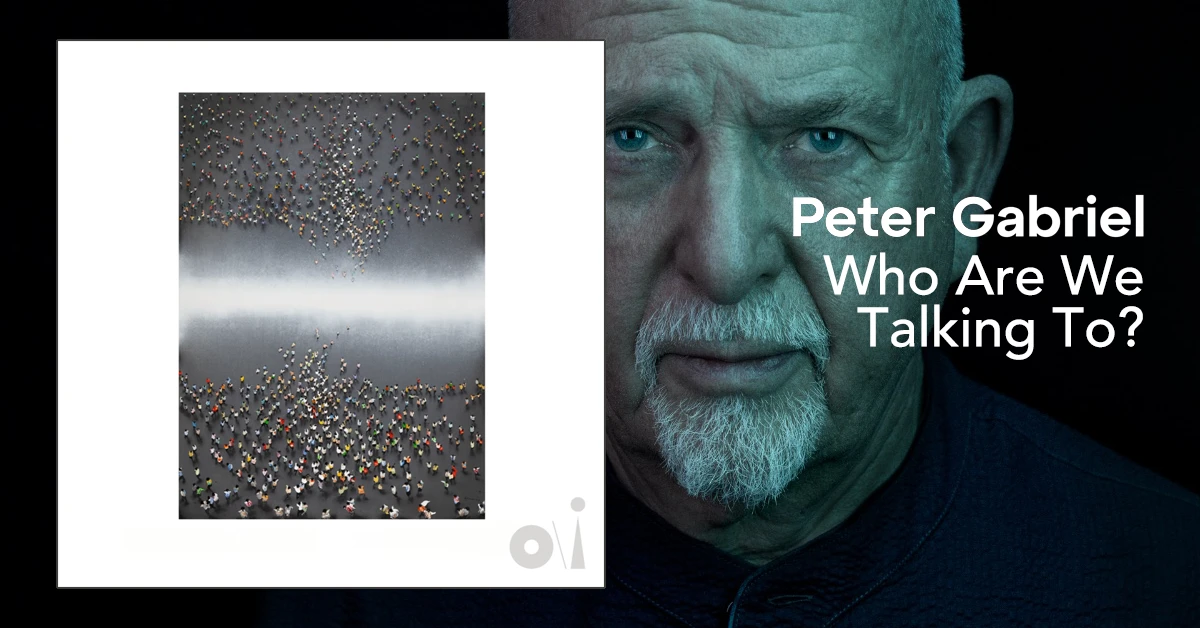
overview of the o\i article series
Song number eleven already has a bit of a history behind it.
In 2015, Gabriel contributed the theme tune to the internet radio station Radio Everyone, from which various jingles were derived. You can listen to the main theme here on SoundCloud.
Radio Everyone was a project by Global Goals, a United Nations initiative. It focused on promoting goals such as sustainable environmental management and the eradication of extreme poverty. Numerous celebrities supported the individual programmes. The whole thing was conceived as a pop-up station and only ran for a short time in 2015. However, you can still listen to all the episodes on Mixcloud.
It was noteworthy that Gabriel's theme tune was quite elaborately produced and once again featured a collaboration with the Soweto Gospel Choir from South Africa. Later, photos from Gabriel's studio revealed that work was also underway on a song version at the same time. It was a serious contender for i/o. And the song had apparently already been rehearsed for the 2016 tour with Sting, but had never been played at a gig.
So now Gabriel is finally releasing the track, and many ideas familiar from the jingles can be found in it. And in terms of content, the radio station's aim still aligns with the theme of the current song.
According to Gabriel, it is intended to support a particular kind of activism. He says that we must see ourselves as global citizens. Only when everyone works together on solutions will change come about for global problems. We humans are vulnerable – to things like climate change, artificial intelligence or pandemics – and the only way to counter this is to avoid dividing people into 'them and us'. People may well think him, as Gabriel says of himself, naïve or childish.
Lyrics
The two phrases that are constantly repeated are 'Who are we talking to?' and 'No one is worthless'. In between, questions are posed: How does it feel when nobody likes you? Where can you stand when you don't belong anywhere? Who makes the rules when everyone is at odds with one another?
Then the questions shift, taking on an empowering tone: Who can take the helm when all fear is cast aside? Who stands at the door when the whole world turns? Who holds the power?
The answer to this is thrown in time and again: "Everyone".
Given the significance attached to the content, and within the context of an album that is often very verbose, the track has surprisingly compact and rather structured lyrics.
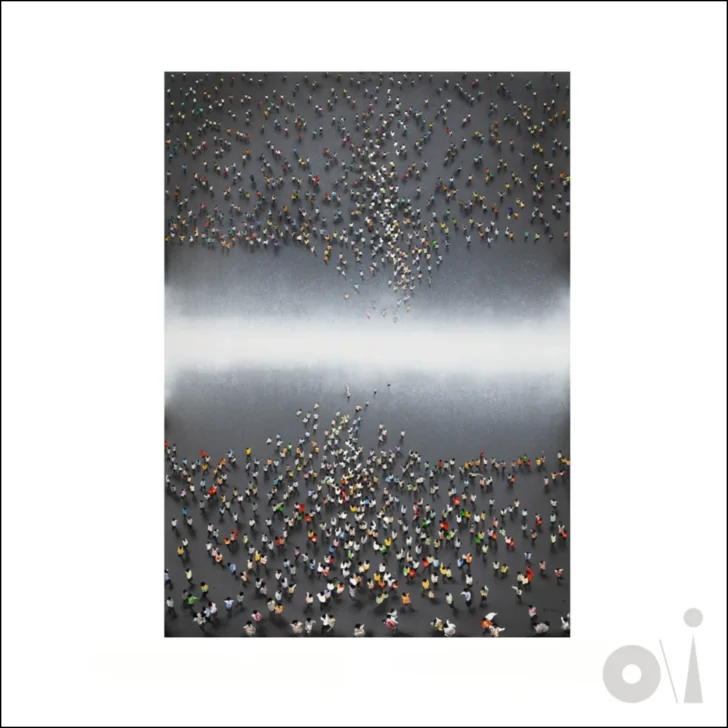
Art
Juan Genovés was a Spanish painter and graphic artist who was born in 1930 and died in 2020. He is regarded as the most important figure in modern Spanish painting.
The selected work is entitled Bloques (2011). It depicts one of Genovés's typical motifs: a background on which many small dots are grouped together; on closer inspection, one can make out human figures viewed from above. In the centre of the picture is a white area which can be interpreted as a zone of light. The figures are moving towards this zone.
Genovés came from a family with close ties to the labour movement and experienced the violence of the Spanish Civil War as a child. Later, he came into conflict with the Franco dictatorship, which further influenced his art. His themes were fear, persecution and oppression.
As with Won't Stand Down, it was difficult for Gabriel and the team to find a suitable image. It was intended to express political movement, but not to represent any specific cause. In Bloques, however, Gabriel sees a very fitting depiction of the separation of people and the attempt at reunification.
Further selected works by Genovés can be viewed on his Website.
More about the o\i artworks and the artists behind them in our separate article.
Dark-Side Mix – 26th October 2026
Words and Music by Peter Gabriel
Produced by Peter Gabriel
Mixed by Mike Elizondo
Mix Assistant: Alex Wilders
Engineering by Richard Chappell, Faye Dolle, Katie May
Assistant engineering by Charles Hughes, Xav Sinden, Maisy Preece
Additional engineering by Erica Block, Alex Wilders, Abe Rounds at Phantom Studios, Andriu Yanovski at Match Point Studio, Richard Mitchell at SABC, Dom Shaw
Pre-production engineering by Richard Chappell
Brass Arrangement by Peter Gabriel
Choir MD /Arranger: Diniloxolo Ndlakuse
Mastered by Matt Colton at Metropolis Studios
Recorded at Real World Studios, Bath and The Beehive, London, Match Point Studio, New Orleans, LA, Phantom Studios, Gallatin, TN, SABC South Africa
Drums: Abe Rounds
Rhythm Programming: Mike Elizondo, Peter Gabriel
Percussion: Peter Gabriel, Abe Rounds
Bass: Tony Levin, Mike Elizondo
Synth Bass: Mike Elizondo, Peter Gabriel
Synths: Peter Gabriel, Don E, Mike Elizondo
Electric Guitar: Leo Nocentelli, David Rhodes, Katie May
Synths: Peter Gabriel, Don E, Mike Elizondo
Trumpet, Trombone: Josh Shpak
Saxophone: Evan Smith
Choir: Soweto Gospel Choir
Synth Brass, Vocals: Peter Gabriel
Length 5:38
Gabriel says the track is a bit different from the rest of the album. It does have a message, but that message needs to be presented in a way that makes you want to dance. And he reckons that, for him at least, it gets him moving too.
He also says there are influences from funk and soul in it. But you could also suggest there are hints of reggae.
Music
This time there's no introduction, unlike almost all the other tracks on the album. It kicks off straight away with the first "Who are we talking to?", and we're right in the thick of it. In the midst of a multi-layered rhythmic tapestry that sways along gently, clatters with drums and hums with a steady bassline.
For the verse, the song shifts to a different underlying harmony. The rhythmic tapestry remains, but it's layered more sparingly and sounds more sombre, in keeping with the lyrics. When the line "No one is worthless" is inserted, the character shifts slightly once more. A descending guitar figure in the background briefly introduces a melancholic air, but disappears again with the next verse.
The return to the opening chord progression for the chorus then lifts the whole piece once more. It continues in a confident and serene manner. A second verse section unfolds, but the encouraging "Everyone" remains central; its repetitions build up into a relaxed closing section, which then fades out.
'Who Are We Talking to?' isn't lavishly instrumented; in fact, it's almost sparse. Much of the focus is on the groove, whilst other elements are interspersed rather casually: guitar, organ, backing vocals. In the closing section, there's even a shrill saxophone solo which, whilst noticeable, isn't particularly emphasised.
All the elements are, so to speak, dabbed in and primarily serve to underpin the rhythmic texture. At least in this mix, the track has a rather electronic feel to it. It will be interesting to see whether this is a distinctive feature of Elizondo's version, or whether it will also be the case in the Bright-Side Mix.
Personnel
There are a few notable aspects to the list of contributors this time round.
The most striking thing, surely, is that this Dark-Side Mix was produced not by Tchad Blake, as is usually the case, but by Mike Elizondo. Apparently, Blake was unavailable at the time, and Elizondo had already worked on several other o\i tracks, not least co-producing A Hard Lesson. For Gabriel, choosing him was a natural choice.
Elizondo also recorded a bass track. In the introductory video, Gabriel emphasises that he did so with the utmost respect for Tony Levin, but wanted to contribute something that now sounds "fatter and emptier" at the end. Nevertheless, both can be heard on the track.
Gabriel then mentions that, alongside Rhodes, Leo Nocentelli also plays guitar. The man, best known for his work in the funk band The Meters (see Plus of US), had already featured on Digging In The Dirt and Steam back in the day. Here, after all these years, he makes another contribution that is understated but effective.
The Gospel Soweto Choir also makes another appearance, albeit a rather restrained one (at any rate, they're significantly less prominent than they were on the radio jingles).
And finally, there are three musicians to be heard who have already featured on the album (and, in some cases, beyond): firstly, Don E, who contributes some synth parts once again; then Josh Shpak, whose trumpet and trombone, however, remain unobtrusive apart from the choral brass parts; whilst Evan Smith contributes a saxophone solo in the closing section.
Bright-Side Mix – 9th November 2026
–
Author: Thomas Schrage
Links
Introductory video for Who Are We Talking To?:
Song-background info on petergabriel.com
Website of Juan Genovés.
All programmes from Radio Everyone on Mixcloud
The main jingle of Radio Everyone on Soundcloud
Join the discussion about the song here in the forum.