

- Article
- Read in 5 minutes
Song 12: Yes, It Will Go (24th November 2026)
Three days before the release of the full album, Yes, It Will Go – the penultimate track from o\i – is being released
overview of the o\i article series
Three days before the release of the full album, Gabriel has released the penultimate track in advance. Unlike three years ago, however, not both versions are being released at the same time – only the Bright-Side Mix is.
Gabriel says that Yes, It Will Go is the most recent of all the o\i songs to be written – and that it holds great personal significance for him. He doesn't elaborate on exactly what he means by this, but judging by the lyrics, one can infer that it has something to do with family, friends, wife, children, parents.
In any case, it is a song about impermanence. And that everything is in a state of constant change – both our personal circumstances and life itself. Gabriel says, "everything is also being accelerated with AI – along with the changes from climate change. There are all sorts of fundamental transitions that are happening so fast to us. (…) The negative is that you're having to learn to let go of a lot – to handle loss. At the same time as this loss I think there is hope that grows from that act of letting go, that acceptance that things are always going to be changing." Because loss also creates space for something new. "Maybe, 'the same as it ever was' has flipped around to become 'changing, as I ever was'."
Lyrics
It sounds like speaking to a sick or elderly person – or at any rate, someone who is doomed to die. Very gentle and reassuring. – And now here's the trick: you can also read the text as a song for a child. A lullaby, perhaps.
It says that everything will be all right. That there are people who care about. That life goes on, just as day follows night. And later on, that perhaps not everything has turned out as it should have, but that you can still remember the beautiful things.
The chorus says that everything will fade in time, and everything that seems permanent will go. – This can be interpreted in many ways: that pain will go, that a life will go…
In the climactic middle section, the focus is on what the waves wash up on the shore: one shouldn't let it go, but fight for more of it. Yet: don't shut out doubt. Love goes where it will. The flow should not be stopped.
The track concludes with the eponymous line: "Everything's going to fade in time. Yes, it will go."

Art
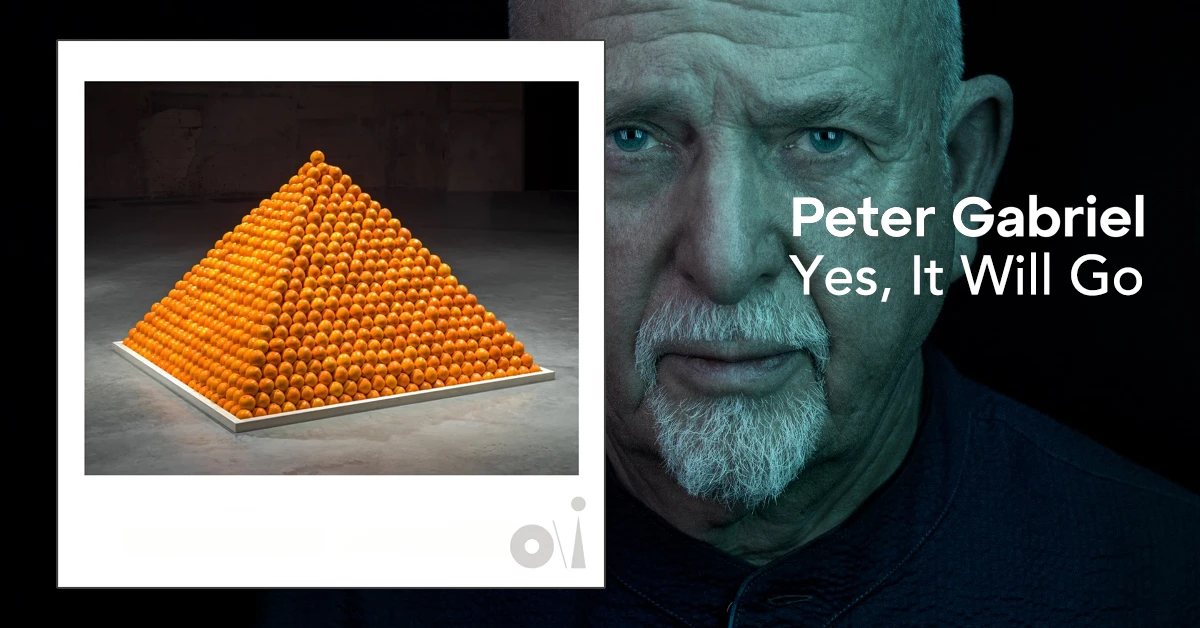
The selected work is by Roelof Louw and is entitled Soul City (Pyramid of Oranges) (1967). It is also his best-known piece and has been recreated on numerous occasions. Depending on the arrangement, between 5,000 and 8,000 oranges are stacked into a pyramid, which visitors are encouraged to take and eat – thereby altering and even destroying the artwork.
Roelof Louw was born in South Africa in 1936 and died in 2017. He moved to London in 1961, working there as well as in New York and Cape Town. He always regarded his works as sculptures, even though his practice was actually aimed at forging a new understanding and a new definition of 'sculpture'. What he created was characterised by minimalist structure, conceptual rigour and the essential involvement of the audience.
He doesn't have his own website, but you can get an idea of his work here, for example.
Gabriel used AI to search for a piece of art to go with Yes, It Will Go. When Soul City by Louw was suggested, he was instantly taken with it. After all, a pyramid is actually meant to last for ages – but this one will rotten away in some weeks. He thinks that's very fitting for a song about impermanence.
More about the o\i artworks and the artists behind them in our separate article.
Bright-Side Mix – 24. November 2026
Words and Music by Peter Gabriel
Produced by Peter Gabriel
Bright-Side Mixed by Mark 'Spike' Stent
Mastered by Matt Colton at Metropolis Studios
Brass and String arrangement by Peter Gabriel
Engineering by Faye Dolle, Katie May, Dom Shaw
Assistant engineering by Charles Hughes, Xav Sinden, Maisy Preece
Additional engineering by Erica Block, Alex Wilder, Abe Rounds at Phantom Studios, Tim Bruzon
Recorded at Real World Studios, Bath and The Beehive, London, Phantom Studios, Gallatin, TN
Drums: Manu Katché
Percussion: Abe Rounds
Bass: Tony Levin
Electric Guitar: David Rhodes
Trombone, Flugel, Euphonium: Josh Shpak
Backing Vocals: Melanie Gabriel, Faye Dolle
Piano, Synths, Synth Strings, Vocals: Peter Gabriel
Length 5:05
[Radio Edit 4:34 – 33-second interlude cut – rain sequences each 2 seconds longer]
It is perhaps the most emotional track on the album – although, in its overall tone, it remains rather restrained and composed. Yet it conveys its universal truth in a way that is both mercilessly bitter and compassionate at the very same moment.
Music
An unusual opening: a light drizzle – perhaps on a windowsill. The piano accompaniment kicks in alongside the first sung line. Chord progressions that sound as though they're being played on an ancient, out-of-tune piano. The scenes from the introductory video reveal that this is exactly the case. The intention here was to make it sound imperfect.
By the second verse, gentle, warm bass notes are added. Then come subtle synthesiser lines. Everything sounds soft here in the Bright-Side Mix. Even the restrained drums during the first chorus.
The arrangement remains simple – yet during the second verse, a trumpet cautiously joins in with a sustained note. It only really comes into its own during the second chorus, though it never takes centre stage.
This changes during the instrumental interlude, which features not only a trumpet but also a small brass section. However, it sounds as though it were being played at a first rehearsal. Gabriel says it brought a smile to his face when he heard just how miserable it was. Here, too, the imperfection is intentional.
The subsequent bridge soars to greater heights, changes the underlying harmony and introduces a dense accompaniment. Gabriel calls it the emotional core of the song. The next verse contrasts completely with this and takes you right back to the beginning – just tinkling piano and bass – before the full band arrangement, including the trumpet, gradually returns.
The track ends with a final piano chord and then fades away once more, accompanied by a light rain. It remains true to its character, which still somehow brings to mind a lullaby.
Personnel
Josh Shpak can be heard once again on the trumpet (and a few other wind instruments). It would certainly be interesting to find out why Gabriel chose him rather than Fresu. Earlier this year, he mentioned that he finds it easier to communicate with musicians he has known for some time (those he has been on tour with, for example). Perhaps that is one reason. Or perhaps it was simply a matter of scheduling, of course.
Otherwise, in his introductory video, Gabriel singles out Tony Levin for special praise; Levin is indeed very much to the fore and brings a wonderful warmth to the track. Gabriel says that Levin always knows exactly when to play which notes – and when silence is best.
Gabriel also mentions his daughter Melanie again, who provides backing vocals. Her contribution isn't actually particularly substantial (though it is effective). The fact that he highlights her in this way could perhaps be taken as a hint that the whole song is, in a way, a family affair.
Dark-Side Mix
–
Author: Thomas Schrage
Links
introductory video for Yes, It Will Go:
Song-background info on petergabriel.com
A website with art by Roelof Louw.
Join the discussion about the song here in the forum.